Installing a heat pump in 2026 typically costs £7,000–£15,000 after the £7,500 BUS grant, but failing to meet building regulations can add £2,000–£5,000 in remedial work.
If you are thinking about replacing your gas boiler with a heat pump in 2026, the headline numbers look attractive. The Boiler Upgrade Scheme (BUS) now offers a flat £7,500 grant, bringing the typical installed price of an air-source heat pump down to £7,000–£12,000 for a three-bed semi-detached home (Energy Saving Trust, 2026).
But there is a catch. The 2026 building regulations set strict conditions on heat pump installations, and if your property or the installation does not meet them, you could face thousands of pounds in unexpected remedial work. The direct answer is this: you must have a minimum EPC rating of D, use an MCS-certified installer, and install a heat pump with a Seasonal Coefficient of Performance (SCOP) of at least 3.0 for air-source models, or you risk invalidating your grant and needing costly fixes.
The 2026 building regulations require a specific minimum energy performance before installation
Before you can install a heat pump under permitted development rights or claim the BUS grant, your home must meet a minimum energy performance standard. The property must have an Energy Performance Certificate (EPC) rating of D or better, or equivalent fabric efficiency verified by a retrofit assessment (GOV.UK Building Regulations 2026, Part L1B, Volume 1: Dwellings).
This means your loft insulation must be at least 270mm thick, and cavity walls must be filled where structurally feasible. If your home does not meet this standard, you will need to carry out insulation upgrades before the heat pump can be installed. These upgrades typically cost £1,500–£4,000 for a three-bed semi, depending on the extent of work needed (Energy Saving Trust, 2026).
The Department for Energy Security and Net Zero (DESNZ) “Heat Pump Ready” programme guidance confirms that the installer must complete a retrofit assessment to verify your home’s fabric efficiency before proceeding with the installation.
Permitted development rights for heat pumps changed in 2026, here are the new limits
In 2026, the rules for permitted development rights for heat pumps became stricter. You can install a heat pump without full planning permission only if you meet these conditions:
- The outdoor unit must be at least 1 metre from the property boundary.
- For air-source heat pumps, the unit must be no closer than 1 metre to a neighbour’s window or door.
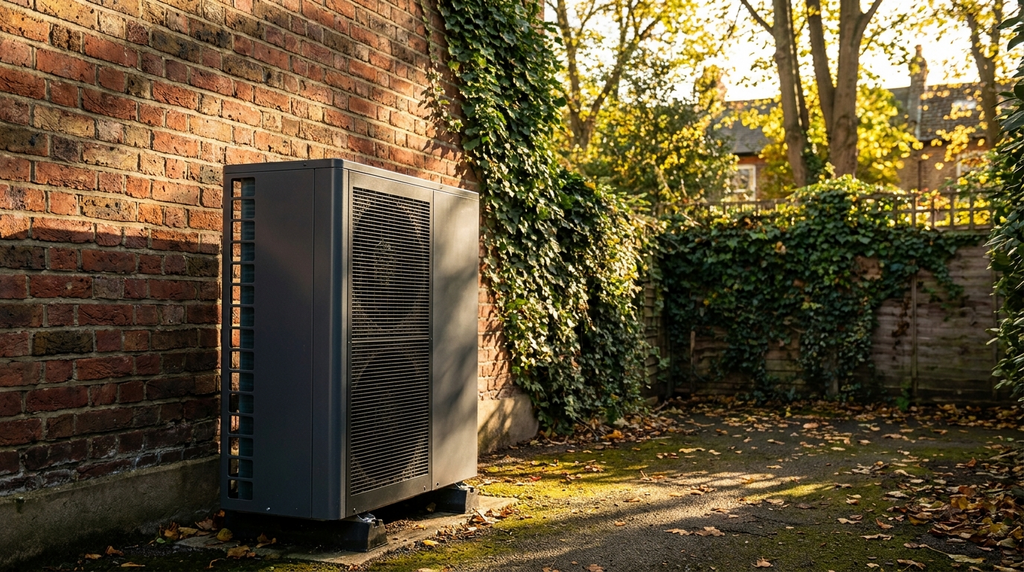
- The unit’s noise level must not exceed 42 dB(A) at the nearest neighbouring habitable room window, measured at 1 metre from the unit.
- The heat pump must be installed by an MCS-certified installer to qualify for permitted development; otherwise, full planning permission is required.
These limits are set out in the 2026 update to the “Permitted development rights for domestic microgeneration” guidance (GOV.UK, 2026) and the MCS 020 standard (MCS, 2026). If your installation does not meet these noise or distance limits, you will need to apply for full planning permission, which can add weeks to the timeline and cost several hundred pounds in application fees.
The Part L building regulations set a minimum efficiency standard for the heat pump itself
The heat pump you install must meet a minimum efficiency standard under Part L of the Building Regulations. For air-source heat pumps, the Seasonal Coefficient of Performance (SCOP) must be at least 3.0. For ground-source models, the minimum is 3.5. The SCOP is measured in line with the European standard EN 14825 and reflects the average efficiency over a full heating season (Building Regulations Approved Document L, 2026 edition).
The system must also include a weather compensation control, which automatically adjusts the heat pump’s output based on the outdoor temperature. This prevents the system from running at full power unnecessarily and improves efficiency. Finally, the installer must complete a commissioning report using the MCS Heat Pump Design and Installation Checklist (MIS 3005) (MCS MIS 3005, 2026).
The Heat Pump Association (HPA) technical standards confirm that these requirements apply to all new heat pump installations covered by building regulations.
Quick numbers, key costs, savings, and regulation thresholds for a typical 3-bed semi
| Metric | Air-source heat pump (ASHP) | Ground-source heat pump (GSHP) | Gas boiler (comparison) |
|---|---|---|---|
| Installed cost (after BUS grant) | £7,000–£12,000 | £14,000–£24,000 | £2,500–£4,500 |
| Annual running cost (2026, Ofgem price cap) | £850–£1,100 | £700–£950 | £1,200–£1,500 |
| SCOP minimum (Part L 2026) | 3.0 | 3.5 | n/a |
| Noise limit at neighbour (permitted development) | 42 dB(A) | n/a | n/a |
| EPC rating required (before installation) | D or better | D or better | n/a |
Source: EST “Heat Pump Cost and Savings 2026″ report (Energy Saving Trust, 2026), Ofgem “Price Cap January 2026” figures (Ofgem, 2026), and MCS register data (MCS, 2026).
What the building regulations actually require for the heat pump’s electrical and plumbing connections
The electrical and plumbing connections for your heat pump must meet specific standards under the 2026 building regulations. The heat pump must be connected to a dedicated electrical circuit, typically rated at 16–32 amps, with a Type B or Type C miniature circuit breaker. This requirement comes from BS 7671, the 18th Edition Wiring Regulations (IET Wiring Regulations BS 7671, 2026 amendment).
The system must also include a buffer tank or low-loss header if the heat pump’s minimum flow rate exceeds the heating circuit’s demand. This prevents short cycling, where the heat pump turns on and off too frequently, which reduces efficiency and lifespan. All pipework must be insulated to a minimum of 19mm closed-cell foam (Class O) for outdoor sections and 13mm for indoor runs, meeting Part L’s heat-loss limits (Building Regulations Approved Document L, 2026).
The Heat Pump Association “Heat Pump Installation Guide” (2026 edition) provides the detailed technical specifications for these connections.
To comply with building regulations in 2026, you must use an MCS-certified installer, no exceptions
There is no legal way around this requirement. Only MCS-certified installers can self-certify the installation as compliant with building regulations. If you use an installer who is not MCS-certified, you must apply for a building notice from your local authority, which adds cost and delays (GOV.UK, 2026).
The installer must hold a current MCS certificate for the specific heat pump type, air-source or ground-source, and must be registered with TrustMark for consumer protection (TrustMark, 2026). They must also provide a full design and commissioning report, including a heat loss calculation using the MCS Heat Loss Calculation Tool and a system schematic (MCS, 2026).
If you skip this step, you risk invalidating your BUS grant and may be required to pay for remedial work to bring the installation up to standard.
The payback period for a heat pump under 2026 regulations depends on your current heating system and insulation level
The payback period for a heat pump varies significantly depending on your current heating system and your home’s insulation. If you are replacing an older gas boiler that is G-rated (about 60% efficient) in a well-insulated home with an EPC rating of C, the payback period is typically 8–12 years after the BUS grant. This calculation is based on current gas and electricity prices under the Ofgem price cap (Energy Saving Trust, 2026).
However, if you are replacing a modern A-rated gas boiler (90% efficient) in a poorly insulated home with an EPC rating of E, the payback period can stretch to 15–20 years, even with the £7,500 BUS grant. This is because the heat pump will need to work harder to heat the property, reducing its efficiency advantage.
The payback calculation must also include the cost of any required insulation upgrades. For a three-bed semi, these typically add £1,500–£4,000 to the upfront cost (DESNZ BUS Grant Scheme Rules, 2026). If your home already has good insulation and an EPC rating of C or better, the payback is much shorter.
Compare heat pump running costs vs gas boiler 2026
Frequently Asked Questions
You need an EPC rating of D or better. Ofgem confirms this is required for the Boiler Upgrade Scheme grant and permitted development rights.
No, if you meet building regulations including EPC D and MCS certification. GOV.UK states heat pumps are permitted development under these conditions.
Air-source heat pumps must have a Seasonal Coefficient of Performance (SCOP) of at least 3.0. The Energy Saving Trust specifies this for compliance.
Remedial work typically costs £2,000–£5,000. MCS data shows this covers insulation upgrades or system reconfiguration to meet regulations.
No, you must use an MCS-certified installer. GOV.UK Building Regulations require this to ensure compliance and grant eligibility.