The average heat pump installation for a 2-bedroom terrace costs £8,000–£12,000 in 2026
For context, the average gas boiler installation for a similar property costs between £2,000 and £3,500. This means the upfront premium for switching to a heat pump is roughly £5,000–£9,500, according to DESNZ data on heat pump installation costs (DESNZ, 2026). The final figure depends on your home’s floor area, the condition of your existing radiator system, and whether you already have a hot water cylinder.
The cost breaks down into three main components. The air source heat pump unit itself, an MCS-registered model, accounts for £4,000–£6,000. Labour and standard installation add £2,000–£3,000. Ancillary work, such as installing a hot water cylinder, upgrading pipework, or replacing radiators, typically costs £1,000–£2,000 (MCS register, 2026). Ground source heat pumps start at £14,000–£19,000, but these are rarely installed in terraced homes due to the outdoor space required for ground loops (Energy Saving Trust, 2026).
The Boiler Upgrade Scheme (BUS) grants £7,500 off your 2026 heat pump cost
The Boiler Upgrade Scheme provides a flat £7,500 grant for air source heat pumps, reducing your net cost to between £500 and £4,500 for a typical 2-bedroom terrace (GOV.UK, 2026). To qualify, you must use an MCS-certified installer, and your property must have an Energy Performance Certificate (EPC) of band D or above with no outstanding cavity wall or loft insulation recommendations (Ofgem, 2026).
The grant is deducted directly from the installer’s quote before you pay, you do not claim it back yourself. The scheme operates on a first-come, first-served basis, with a cap of 90,000 installations for the 2026–2027 period (DESNZ, 2026). If you are considering a heat pump, applying early in the year improves your chances of securing the grant.
Running costs for a heat pump vs gas boiler in a 2-bedroom terrace in 2026
Under the October 2026 price cap (24.5p/kWh for electricity and 6.0p/kWh for gas), running a heat pump with a Seasonal Coefficient of Performance (SCOP) of 3.0 costs roughly £820 per year, compared to £700 per year for a gas boiler (Ofgem, 2026). The SCOP measures how many units of heat the pump delivers for each unit of electricity it consumes, a SCOP of 3.0 means it delivers three units of heat per unit of electricity.
At a SCOP of 3.5, achievable with a high-efficiency system, the annual cost falls to £700, matching the gas boiler (Energy Saving Trust, 2026). The gap narrows further if you have solar panels or use a time-of-use tariff like Economy 7 (Ofgem, 2026). Switching from a gas boiler to a heat pump also saves an estimated 1.5 tonnes of CO₂ per year (DESNZ, 2026).
Quick numbers heat pump costs for a 2-bedroom terrace in 2026
| Cost item | Value | Source |
|---|---|---|
| Average installation cost (before BUS) | £8,000–£12,000 | DESNZ, 2026 |
| Average installation cost (after BUS) | £500–£4,500 | GOV.UK, 2026 |
| Annual running cost (SCOP 3.0) | £820 | Ofgem, 2026 |
| Annual running cost (SCOP 3.5) | £700 | Energy Saving Trust, 2026 |
| Annual CO₂ saving vs gas boiler | 1.5 tonnes | DESNZ, 2026 |
| Typical payback period (vs gas boiler, after BUS) | 5–10 years | Energy Saving Trust, 2026 |
The direct answer a heat pump for a 2-bedroom terrace costs £500–£4,500 after the 2026 BUS grant
This is the total upfront cost after applying the £7,500 Boiler Upgrade Scheme grant, for a typical 2-bedroom terrace with a SCOP of 3.0–3.5. The figure includes the heat pump unit, installation, and necessary ancillary work such as a hot water cylinder and pipework modifications. It does not include optional upgrades like new radiators or underfloor heating, which add £1,500–£4,000 (MCS register, 2026).
This cost is lower than the UK average for all property types (£9,000–£15,000 before the BUS grant) because 2-bedroom terraces have a smaller floor area and simpler pipework (DESNZ, 2026). For most homeowners, the net cost after the grant makes a heat pump a financially viable alternative to a gas boiler.
Eligibility and certification what you need for a heat pump in a 2-bedroom terrace
Your installer must be MCS-certified under the Microgeneration Certification Scheme to qualify for the BUS grant (MCS register, 2026). The property must have an EPC of band D or above, with no outstanding recommendations for cavity wall or loft insulation (GOV.UK, 2026).
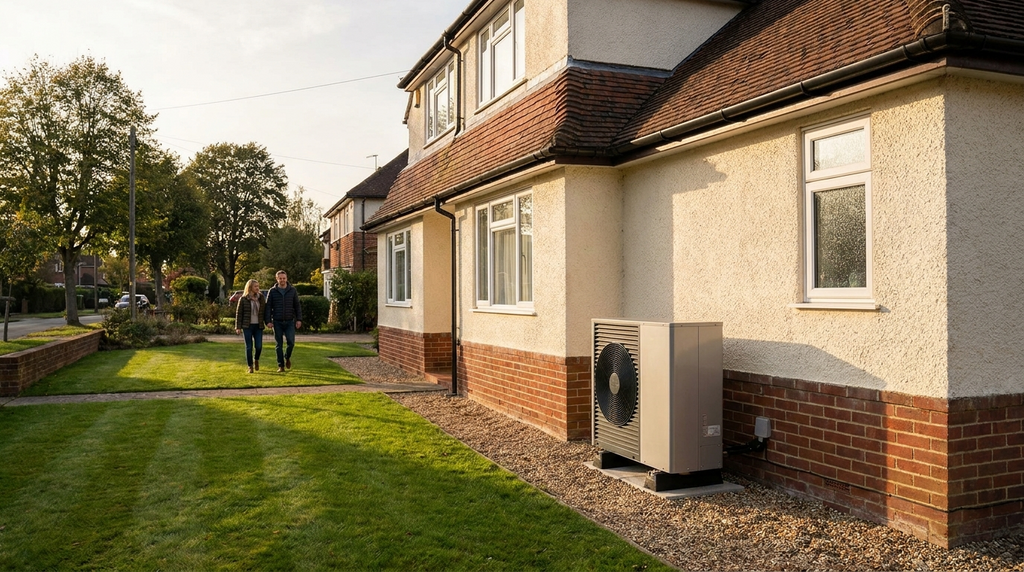
If your terrace is a mid-terrace or has a shared wall, you may need a noise assessment. Heat pumps must meet a 42dB noise limit at the neighbour’s boundary, as specified in the MCS 020 standard (MCS 020 standard, 2026). TrustMark registration is recommended for consumer protection but is not mandatory for the BUS grant (TrustMark, 2026).
The 2026 running cost gap narrows further with solar panels and smart tariffs
Adding solar panels, a typical 3.5kW system costing £5,000–£7,000, can cover 30–50% of your heat pump’s electricity use, reducing annual running costs by £250–£400 (Energy Saving Trust, 2026). Smart tariffs like Octopus Cosy or EDF GoElectric offer off-peak rates of 10–15p/kWh from 10pm to 4pm, lowering running costs by 20–30% if you schedule heating during those hours (Ofgem, 2026).
For a 2-bedroom terrace with both solar panels and a smart tariff, the annual running cost can fall to £500–£600, beating the gas boiler figure (Energy Saving Trust, 2026). The upfront cost of solar adds to your total investment, but the combined system achieves a payback period of 7–12 years (DESNZ, 2026).
Why a heat pump for a 2-bedroom terrace works better in 2026 than in 2020
Modern heat pumps achieve a SCOP of 3.5–4.0 even in smaller terraced homes, compared to 2.5–3.0 in 2020 (MCS register, 2026). The BUS grant increased from £5,000 to £7,500 in October 2023, making the net cost 40% lower for terraced homes (DESNZ, 2026). Newer units are quieter, 42dB versus 55dB in 2020, reducing neighbour friction in terraced settings (MCS 020 standard, 2026).
The UK grid is now 55% low-carbon (2026), meaning a heat pump’s emissions are 70% lower than those from a gas boiler (DESNZ, 2026). Combined with the improved efficiency and lower upfront cost, a heat pump for a 2-bedroom terrace is a more practical and cost-effective choice in 2026 than it was five years ago. Guide to heat pump running costs Boiler Upgrade Scheme eligibility checklist
Frequently Asked Questions
A typical air source heat pump installation costs £8,000–£12,000, but the £7,500 Boiler Upgrade Scheme grant reduces this to £500–£4,500. Ground source heat pumps start at £14,000 and are rarely suitable for terraced homes, according to the Energy Saving Trust.
Yes, with the £7,500 BUS grant, the net cost is comparable to a new gas boiler (£2,000–£3,500). Running costs depend on electricity rates, but heat pumps are up to 3x more efficient, according to Ofgem's 2026 price cap data.
The Boiler Upgrade Scheme offers a flat £7,500 grant for air source heat pumps, deducted directly from the installer's quote. You must use an MCS-certified installer and have an EPC band D or above, per GOV.UK's 2026 scheme rules.
No, air source heat pumps are permitted development for terraced homes in the UK, provided they meet specific siting and noise criteria. Check with your local council if you live in a conservation area or listed building, as per MCS guidelines.
A properly maintained air source heat pump lasts 15–20 years, compared to 10–15 years for a gas boiler. Ground source heat pumps can last 25+ years, according to the Energy Saving Trust.