Measuring a window correctly prevents costly ordering mistakes and installation delays
Ordering a replacement window is not a forgiving task. A measurement error of just a few millimetres can mean a new window that does not fit, leading to return fees, extended project times, and wasted materials. The Centre for Sustainable Energy notes that incorrectly measured windows are one of the most common causes of wasted material and extended project timelines in home renovations (Centre for Sustainable Energy, 2026).
Measure width at top, middle, and bottom inside the frame, using the smallest figure. Repeat for height at left, centre, and right. Measure depth from front to back of the frame. Always measure from inside the existing frame, not the glass or brickwork.
- Take three measurements per window: width, height, and depth.
- Measure inside the existing frame, not the glass or brickwork.
- Record width at top, middle, and bottom; use the smallest figure.
- Record height at left, centre, and right; use the smallest figure.
- Check depth to ensure the window fits the reveal without protruding.
- Measuring a window correctly prevents costly ordering mistakes and installation delays
- The three measurements every homeowner must take for a replacement window
- Quick numbers typical window sizes and what they mean for your order
- How to measure for a bay window width, angles, and the critical centre-point rule
- The direct answer the correct way to measure a window in the UK in 2026
- Eligibility and certification how to verify your window installer is MCS or FENSA registered
- What the Energy Saving Trust says about window measurements and energy savings
- Common measurement units and how to convert for UK window suppliers
The direct answer is this: take three measurements, width, height, and depth, for every window, and always measure from the inside of the existing frame, not the glass or the outer brickwork. This method matches the industry standard for replacement windows used by FENSA-registered installers across the UK.
The three measurements every homeowner must take for a replacement window
Every replacement window order requires three distinct measurements: width, height, and depth. Each must be taken at multiple points to account for any irregularity in the existing frame.
Width. Measure the inside of the frame at the top, middle, and bottom. Record the smallest of the three figures. Frames are rarely perfectly square, and using the smallest width ensures the new window will fit without forcing.
Height. Measure the inside of the frame at the left, centre, and right. Again, use the smallest measurement. For vertical sliding sash windows, measure the full height of the frame opening, not the visible glass area.
Depth. Measure from the front of the inside frame to the back of the inside frame. This determines if the new window will fit the existing reveal, the recess into which the window sits. A window that is too deep for the reveal will protrude beyond the intended plane. These procedures are outlined in FENSA technical guidance on replacement window measurement (FENSA, 2026).
Quick numbers typical window sizes and what they mean for your order
| Window type | Typical width (mm) | Typical height (mm) | Common glazing thickness (mm) |
|---|---|---|---|
| Standard casement | 600–1200 | 900–1500 | 24–28 |
| Tilt-and-turn | 800–1400 | 1000–1800 | 28–32 |
| Fixed pane | 500–2000 | 500–2000 | 24–28 |
| Sash (vertical slider) | 600–1200 | 1200–1800 | 24–28 |
These dimensions are typical for UK homes built after 1970, based on data from the Glass and Glazing Federation (GGF, 2026). Older properties, particularly those built before 1919, often require bespoke sizes. If your measurements fall outside these ranges, expect a longer lead time and higher unit cost.
How to measure for a bay window width, angles, and the critical centre-point rule
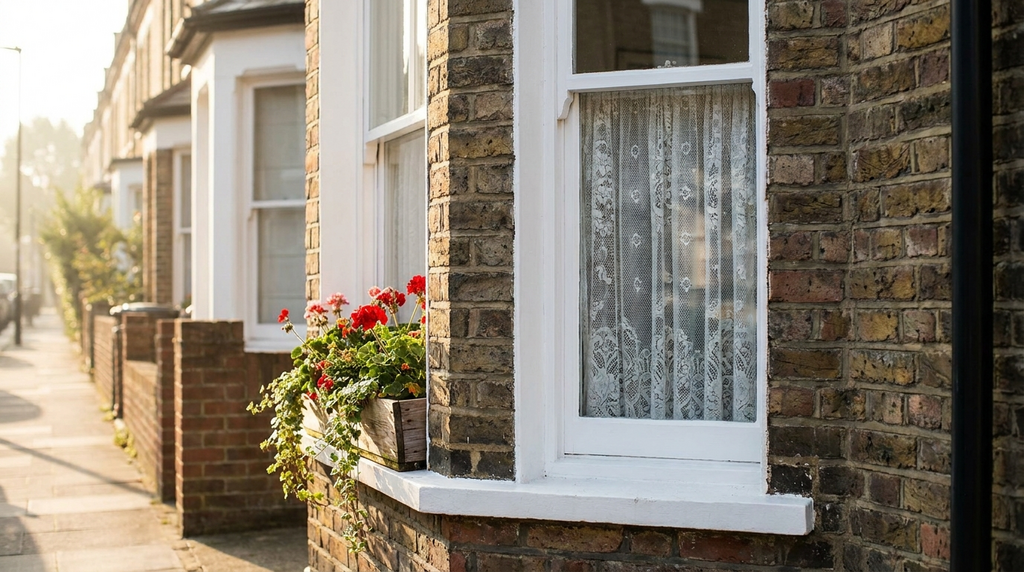
Bay windows require a different approach because they consist of multiple angled faces. Measure each individual face as a separate unit, following the same three-measurement rule for width, height, and depth on each face.
The critical centre-point rule applies to bay windows specifically. Measure the width of each bay face at the centre of the window opening, not at the front or back edge. This accounts for any taper in the bay, where the opening is wider at the front than at the back, or vice versa. For angled bays, measure the angle between each face using a protractor or angle finder, and record the angle in degrees for the manufacturer. The British Fenestration Rating Council provides guidance on this procedure (BFRC, 2026).
The direct answer the correct way to measure a window in the UK in 2026
The correct method is to measure the width and height of the existing frame opening, the reveal, at three points each, record the smallest measurement for width and height, and then measure the depth of the frame from front to back. Always measure in millimetres to the nearest millimetre; never round up or down. Do not include the outer brickwork, sill, or any external trim in your measurements, as these are not part of the frame opening. This method is confirmed by FENSA technical guidance and the Glass and Glazing Federation “How to Measure” fact sheet (FENSA, 2026).
Eligibility and certification how to verify your window installer is MCS or FENSA registered
For new windows installed under a building regulations compliance scheme, the installer must be registered with FENSA (Fenestration Self-Assessment Scheme) or a similar competent person scheme. This registration allows the installer to self-certify that the work complies with Building Regulations Part L, covering thermal performance and air leakage.
The Great British Insulation Scheme closed on 31 March 2026. It funded insulation measures only and never covered windows or glazing. Check an installer’s registration on the FENSA website or the MCS register before ordering. Unregistered installers cannot self-certify compliance, which may cause issues when selling the property. The GOV.UK page “Competent person schemes: windows, doors and glazing” lists all approved schemes (GOV.UK, 2026). How to check if your window installer is FENSA registered
What the Energy Saving Trust says about window measurements and energy savings
The Energy Saving Trust states that incorrectly measured windows can reduce thermal performance by up to 15% due to gaps or compression of seals (Energy Saving Trust, 2026). This means a window that would otherwise achieve a U-value of 1.2 W/m²K might perform closer to 1.4 W/m²K, a meaningful drop in efficiency.
A properly fitted double-glazed window with a U-value of 1.2 W/m²K or lower can save a typical semi-detached home approximately £110–£135 per year on heating bills, based on 2026 energy prices from Ofgem’s price cap (Ofgem, 2026). The payback period for correctly measured and installed A-rated windows is typically 15–20 years, depending on the number of windows and the property type. How to calculate window U-values and compare energy ratings
Common measurement units and how to convert for UK window suppliers
All UK window suppliers require measurements in millimetres (mm). Never use inches or centimetres. To convert centimetres to millimetres, multiply by 10 (e.g., 85 cm = 850 mm). To convert inches to millimetres, multiply by 25.4 (e.g., 33 inches = 838 mm). The British Standards Institution provides guidance on measurement units in construction, confirming millimetres as the standard (BSI, 2026). If you are working from an older set of plans or a tape measure marked in inches, convert every figure before placing your order. A single decimal error in conversion can render a window unusable.
Frequently Asked Questions
Measure width at three points (top, middle, bottom) and height at three points (left, centre, right), always inside the existing frame. Use the smallest measurement for each. FENSA technical guidance recommends this method for accurate replacement orders.
Always measure from the inside of the existing frame, not the glass or outer brickwork. This matches the industry standard used by FENSA-registered installers across the UK.
Standard UK window sizes vary, but common widths range from 600mm to 1200mm and heights from 900mm to 1500mm. Always measure your specific opening rather than relying on standard sizes, as frames can be irregular.
For curtains, measure the width of the window frame plus any desired overlap (typically 15-20cm each side) and the length from the curtain pole to the floor or sill. This differs from replacement window measurements, which require precise internal frame dimensions.
Yes, you can measure a window yourself using a tape measure and following FENSA guidance. However, for complex or non-standard openings, a professional survey is recommended to avoid costly errors.