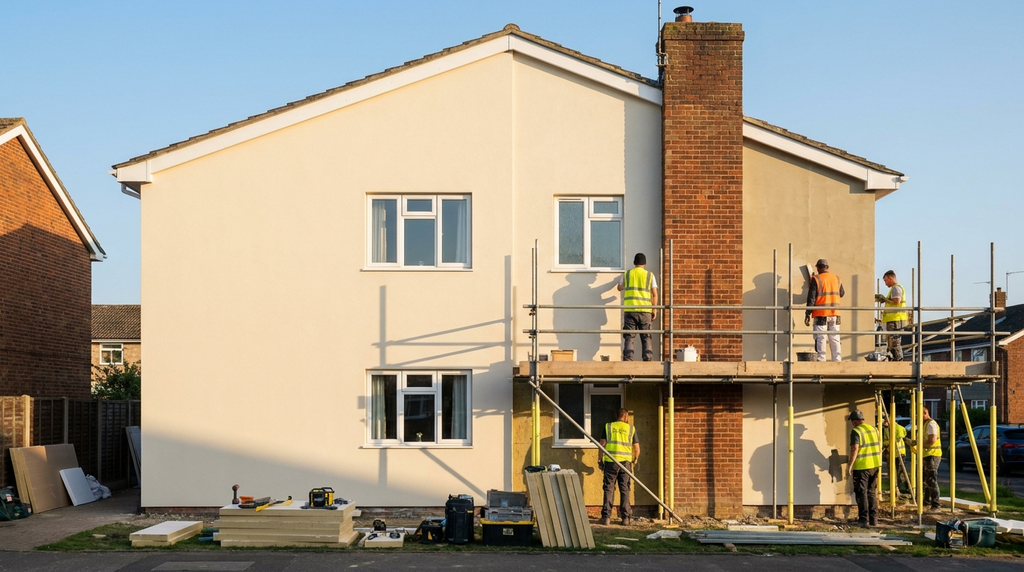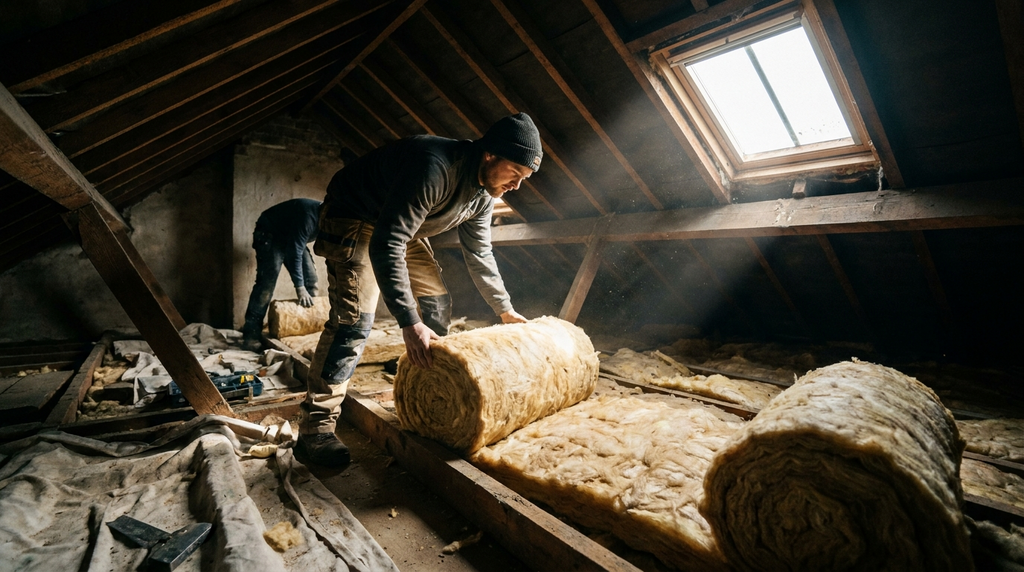
Spray foam removal is the first step, top-up insulation is the second
Spray foam removal leaves your loft or wall cavity empty, with no thermal layer remaining. Insulation removal alone does not restore a home’s thermal performance. Top-up insulation must be installed to meet current Building Regulations (Energy Saving Trust, 2026).
Insulation top-up after spray foam removal costs £300-£800 for a standard loft. You must install new insulation to meet a U-value of 0.16 W/m²K. The Great British Insulation Scheme closed on 31 March 2026. It funded insulation measures only and never covered windows or glazing.
- Top-up insulation must achieve a U-value of 0.16 W/m²K for lofts.
- Mineral wool, cellulose, and PIR board are the three main options.
- The Great British Insulation Scheme closed on 31 March 2026. It funded insulation measures only and never covered windows or glazing.
- ECO4 covers households on Universal Credit or under £31,000 income.
- Owner-occupiers and private tenants with permission are eligible.
- Spray foam removal is the first step, top-up insulation is the second
- Who qualifies for UK insulation top-up grants after spray foam removal
- Quick numbers, typical costs, grants, and savings for top-up insulation
- The direct answer, who qualifies for spray foam removal insulation top-up
- How to verify an installer for spray foam removal and top-up insulation
- What to do if you do not qualify for a grant, self-funded top-up options
After removal, you must decide which insulation material and thickness to install to achieve the target U-value of 0.16 W/m²K for loft insulation, as set out in Approved Document L 2021 (GOV.UK, 2026). A U-value measures how quickly heat passes through a material, lower numbers mean better insulation.
Three common top-up insulation types are mineral wool, cellulose, and PIR board. Each has different costs, installation methods, and thickness requirements. Your choice will depend on your budget, the space available, and whether you qualify for a grant.
Who qualifies for UK insulation top-up grants after spray foam removal
The Great British Insulation Scheme closed on 31 March 2026. It funded insulation measures only and never covered windows or glazing. Eligibility depends on the property’s current insulation level and the household’s income or benefits status (Ofgem, 2026).
The Great British Insulation Scheme closed on 31 March 2026. It funded insulation measures only and never covered windows or glazing. Spray foam removal leaves the cavity empty, which typically meets this condition. For ECO4, households on means-tested benefits such as Universal Credit or Pension Credit, or with a low income under £31,000 per year, qualify. Non-benefit households may still qualify under the flexible eligibility route via their local authority (GOV.UK, 2026).
Owner-occupiers and private tenants with landlord permission are eligible. Social housing tenants may qualify under separate schemes. You do not need to have removed the spray foam yourself, the grant covers the cost of installing new insulation after removal.
Quick numbers, typical costs, grants, and savings for top-up insulation
| Insulation type | Typical cost per m² | Maximum GBIS grant per m² | Annual saving on heating bill per m² | Minimum thickness for 0.16 U-value |
|---|---|---|---|---|
| Loft insulation (mineral wool) | £10–£15 | £12 | £2.50 | 270 mm |
| Loft insulation (cellulose) | £15–£25 | £15 | £3.00 | 250 mm |
| Wall cavity insulation (PIR board) | £25–£40 | £20 | £4.00 | 100 mm |
| Wall cavity insulation (mineral wool) | £15–£25 | £15 | £3.50 | 120 mm |
Costs and savings are based on 2026 data from the Energy Saving Trust and Ofgem (Energy Saving Trust, 2026; Ofgem, 2026). Actual figures vary with your property size, fuel type, and energy tariff.
Who qualifies for spray foam removal insulation top-up
Homeowners who have already removed spray foam insulation from their loft or walls can apply for top-up grants if their property’s insulation level is below 50 mm for lofts or if the cavity is empty for walls. Eligibility is not automatic after removal. The household must meet either the benefits-based criteria under ECO4 or the property-based criteria under GBIS for the top-up material (GOV.UK, 2026).
For GBIS, the installer must confirm the existing insulation thickness is below 50 mm. For ECO4, the local authority must confirm the household’s income status. The top-up grant covers the full cost of installation up to a cap for eligible households. Non-eligible households can still claim a reduced grant or pay privately (Ofgem, 2026).
If you are unsure about your eligibility, contact your local authority or an approved installer. guide to GBIS eligibility criteria
How to verify an installer for spray foam removal and top-up insulation
The installer must hold MCS certification for the insulation type, such as mineral wool, cellulose, or PIR, to ensure compliance with the Microgeneration Certification Scheme standards (MCS, 2026). For spray foam removal, the installer should be registered with the Spray Foam Removal Association (SFRA) or hold a relevant hazardous materials removal certification.
The top-up insulation installer must be registered with TrustMark for consumer protection (TrustMark, 2026). If the work involves gas appliances, the installer must also be registered with Gas Safe Register (Gas Safe Register, 2026).
Homeowners should check the MCS Installer Directory at mcsinstallerdirectory.com and the TrustMark database at trustmark.org.uk for certified installers. Always ask for proof of certification before agreeing to any work.
What to do if you do not qualify for a grant, self-funded top-up options
Homeowners who do not meet the benefits or property criteria can still pay for top-up insulation privately. Typical costs range from £10–£25 per m² for mineral wool, £15–£30 per m² for cellulose, and £20–£40 per m² for PIR board (Energy Saving Trust, 2026).
The payback period for self-funded top-up insulation is typically 3 to 7 years, depending on the insulation type and current energy prices (Energy Saving Trust, 2026). Self-funded homeowners can claim VAT relief under the Reduced Rate 5% scheme for energy-saving materials (GOV.UK, 2026).
The installer must still hold MCS and TrustMark certification to ensure the work meets Building Regulations and warranty requirements. how to claim VAT relief on insulation
Frequently Asked Questions
Yes, you must install top-up insulation after removal. Spray foam removal leaves the cavity empty, so new insulation is required to meet Building Regulations target U-value of 0.16 W/m²K, as set by GOV.UK.
Three common types are mineral wool, cellulose, and PIR board. Each has different costs and thickness needs. The Energy Saving Trust recommends mineral wool for lofts due to its low cost and ease of installation.
You must have no existing insulation or insulation below 50 mm, and meet income or benefits criteria set by Ofgem.
Typical costs range from £300 to £800 for a standard loft, depending on material and thickness. The Great British Insulation Scheme closed on 31 March 2026. It funded insulation measures only and never covered windows or glazing.
Households on means-tested benefits like Universal Credit or Pension Credit, or with an income under £31,000 per year, qualify for ECO4. Non-benefit households may qualify via local authority flexible eligibility, per GOV.UK.
Approved Document L 2021 requires a target U-value of 0.16 W/m²K for loft insulation. This is the standard set by GOV.UK to ensure adequate thermal performance.