The most transformative detail in a room is often the one you step on first
It’s the dim, quiet hour just before dawn. You’re carrying a warm mug of tea, still in your slippers, and you pause at the front door to let the cat in. Your foot lands on something that feels… right. Not the scratchy, tired coir mat you bought in a hurry three years ago, but something with weight, with texture, with a colour that echoes the mossy brickwork of your 1930s suntrap bay. That moment, when an everyday object becomes a small, daily pleasure, is what a thoughtful doormat can do for your entrance.
This piece is about turning that overlooked threshold into a considered part of your home. This covers why texture matters more than you think, how scale can transform a narrow hallway, and why the right colour will make your front door feel like it belongs to a house that’s loved. Plus, eight ways to use a doormat to soften a tall sash window, because the entrance isn’t just the door.
Why the threshold deserves more than a rubber grid
The entrance sets the tone for the entire home. A tired, stained doormat signals neglect, like a handshake that’s half-hearted. A thoughtful one, by contrast, suggests care. It’s the first thing you and your visitors touch, the first sensory impression of your space. And it’s one of the cheapest, easiest changes you can make.
You don’t need to re-tile the porch or replace the front door. A good doormat costs around £30 to £120, depending on size and material. That’s less than a takeaway for two, and it pays back every time you come home. It makes coming home feel intentional, not accidental. And if you’re planning to sell, a curated entrance is the kind of detail estate agents call “kerb appeal” without being able to explain why.
Let texture do the talking
Flat coir is fine for scraping mud off wellies. But it’s not fine for making an entrance feel like a room. Move beyond the standard coconut mat and consider woven sisal, which has a subtle, almost linen-like grain. Or looped wool, which catches the light differently depending on the time of day, soft in the morning, warmer in the afternoon. Ribbed rubber, too, has its place: it feels deliberate, industrial, and pairs beautifully with a polished concrete doorstep.
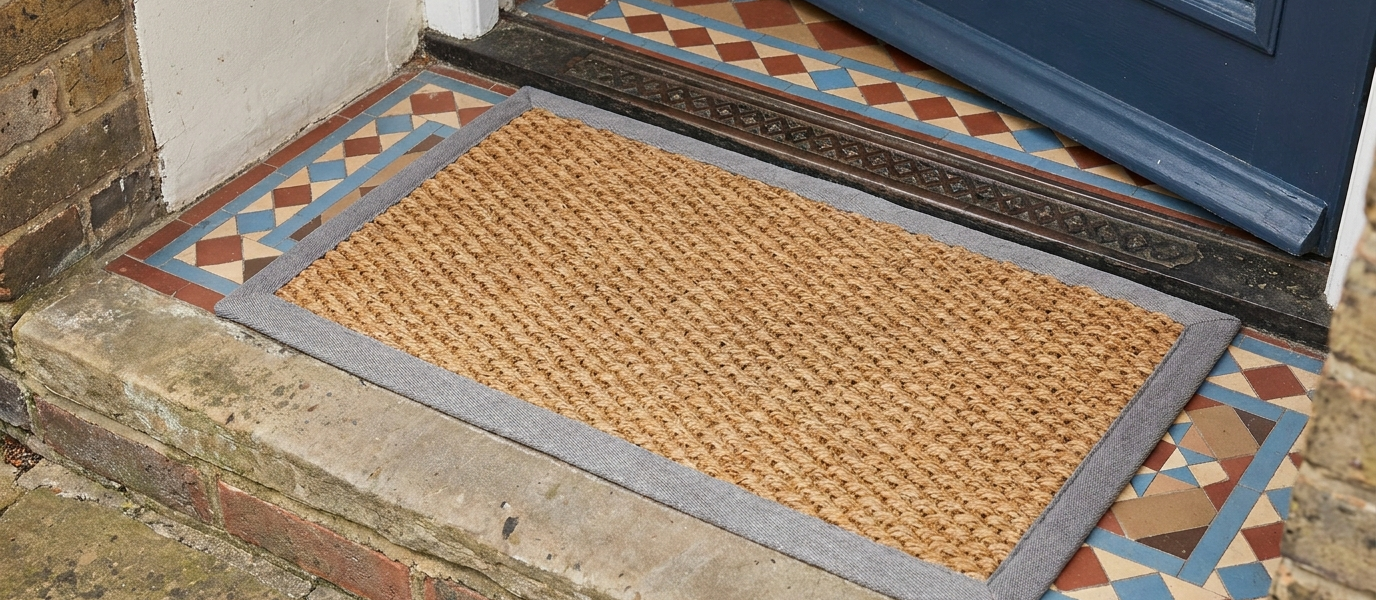
Texture isn’t just visual. It’s tactile. A mat with visible weave feels warmer and more deliberate underfoot. It says someone thought about this. Pair the texture with the material of your doorstep, rough coir on smooth tile, soft wool on rough stone, for a layered, curated look that feels like it grew there.
Scale up for presence
The most common mistake is buying a doormat that’s too small. A 40cm x 60cm mat looks like a postage stamp under a standard door. It shrinks the entrance rather than anchoring it. Aim for a mat that extends at least the width of the doorframe, ideally 60cm x 90cm or larger. That extra size creates a landing zone, a moment of arrival, not just a place to wipe your feet.
An oversized mat also gives you room to pause. You can put down a shopping bag, kick off shoes, and feel like you’ve actually entered the house before you’ve crossed the threshold. It’s a small psychological shift, but a real one. For a Victorian sash door with a deep step, consider a runner-style mat that runs the full length of the step, around 120cm long. That’s presence.
Pick a colour that softens with the seasons
Black shows every speck of dust. White shows every splash of mud. Avoid both. Instead, choose a hue that echoes the exterior palette of your home. Terracotta for brick, slate for grey stone, sage for painted wood. These colours don’t just hide wear, they age gracefully, especially when the mat uses natural dyes or unbleached fibres. A deep indigo mat will patina over time, getting softer and more interesting, rather than looking faded and tired.
Warm ochre, moss green, or a muted rust are all excellent choices. They work with the seasons: green feels fresh in spring, warm in autumn. And they hide the inevitable marks that come with daily life. For a cohesive look, consider the colour of your front door’s hardware, more on that in a moment.
Eight ways to soften a tall sash window with a doormat
If your entrance has a tall sash window, those elegant, vertical panes that are so common in Victorian and Edwardian homes, a doormat can actually help balance the proportions. Here’s how:
- Place a narrow runner mat parallel to the window to echo its verticality. A 50cm x 150cm runner creates a visual line that mirrors the window’s height.
- Use a patterned mat to break up the window’s long lines. A geometric repeat or a subtle stripe interrupts the verticality and adds rhythm.
- Layer a small round mat under a low console or plant stand near the window. The circle softens the hard right angles of the sash.
- Choose a mat with a subtle geometric repeat that mirrors window panes. A diamond or square pattern echoes the glass divisions.
- Keep the mat low-profile, no more than 1cm thick, so it doesn’t compete with the window’s height visually.
- Match the mat’s colour to the window frame for a smooth, architectural look. If the frame is painted in Farrow & Ball Drop Cloth, find a mat in a similar warm off-white.
- Use a coir mat with a natural edge to soften the window’s sharp, painted lines. The raw fibre adds organic texture.
- Position the mat slightly off-centre to create asymmetry against the window’s perfect symmetry. It’s a designer trick that makes the room feel lived-in.
Why pattern works best when it’s unexpected
A plain mat is safe. A patterned mat is a conversation starter. Geometric or abstract patterns, tiles, stripes, organic shapes, add personality without shouting. They hide wear and dirt better than a solid colour, too, because the eye reads the pattern before the dirt. That means your mat looks good for longer.
The trick is to choose a pattern that feels unexpected but not chaotic. A mat with a subtle Moroccan tile repeat, for example, adds a playful surprise for visitors while still feeling sophisticated. Or try a mat with a single, bold stripe across the width, it draws the eye horizontally, which can make a narrow entrance feel wider.
Layer two mats for depth and function
One mat does one job. Two mats do two. Start with a sturdy outdoor mat, coir or rubber, placed just outside the door for scraping mud and grit. Then, just inside, place a softer indoor mat, wool, cotton, or a flatweave, for comfort and style. The two-mat approach creates a visual transition from outside to inside, like a welcome rug for the doorstep.
Choose contrasting textures: rough below, smooth above. And consider contrasting colours, too: a deep charcoal outdoor mat with a warm ochre indoor mat creates a pleasing tension. The layered look also gives you flexibility, you can swap the indoor mat seasonally without changing the outdoor one.
Let the doormat echo the front door’s hardware
This is the kind of detail that makes an entrance look curated rather than accidental. If your front door has brass handles, opt for a mat with warm metallic fibres or a brass-toned border. For black or iron hardware, choose a mat with deep charcoal or iron-grey tones. Even a subtle hint, a woven stripe in the same metal finish, pulls the whole entrance together.
It’s a small thing, but it’s the kind of small thing that visitors notice without being able to name. They’ll just feel that the entrance is cohesive, that it belongs. And that feeling is worth the price of a good mat. front door colour ideas
A doormat isn’t a utility. It’s a threshold ritual, a first impression that can make a tired entrance feel considered, even curated. And it starts with the step you take every day.