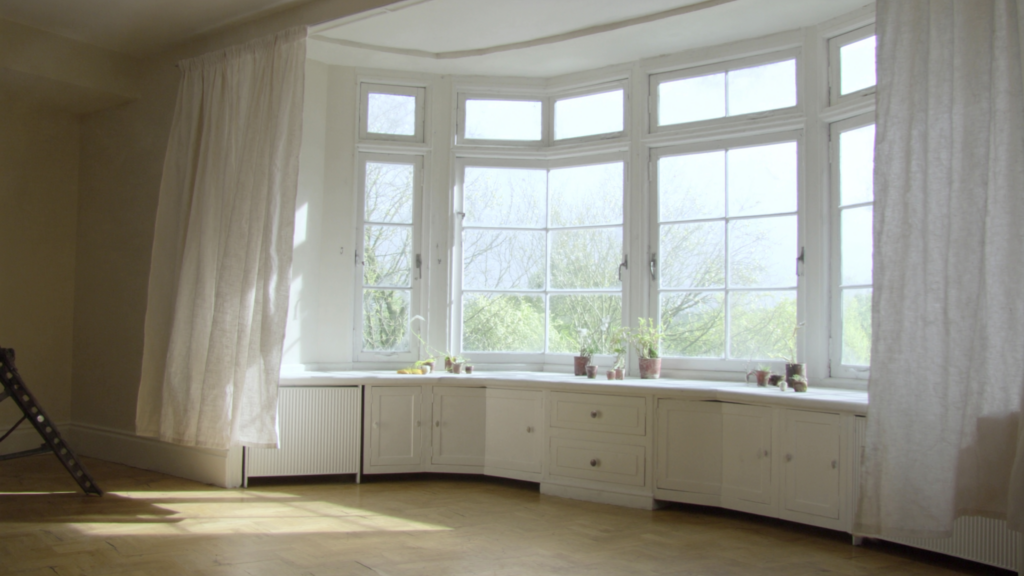
The room that never knows what time it is
There is a particular cruelty to the 6am bedtime. Your brain has already surrendered to the idea of sleep, but your body, still thrumming with the residue of the night shift, feels the morning light pressing against your eyelids like a persistent, unwelcome visitor. That pale gold stripe that finds its way past the curtain, the way the room turns from deep navy to a reluctant grey, the slow, inexorable brightening that tells your circadian rhythm: it is day, and you are lying to yourself.
For the shift worker, the bedroom must perform a daily deception. It must lie convincingly about the hour, every single time you close the door. And here’s the uncomfortable truth most people discover too late: a room that can’t fake night will slowly hollow out your sleep, your mood, your recovery. That is a cost no single blackout curtain can fix on its own.
Why the window is the real problem, not the curtain
Most shift workers reach for fabric first. A thick blackout curtain, they think, and the problem is solved. But the gap between curtain and frame, that thin sliver of space where the track meets the wall, leaks light like a sieve. Even the most expensive thermal drape can’t seal a window that lets daylight pour in through the sides, the top, the bottom. The curtain is not the problem. The window is.
The glazing itself matters more than most people realise. Double or triple glazing with a low-E coating doesn’t just insulate heat, it can be specified with a tint or reflective layer that cuts daylight before it reaches the room at all. There is a meaningful difference between “room darkening” glass, which softens the light but still lets it through, and “total blackout” glass, which is engineered to block virtually all visible light. For a 2pm bedtime, when the sun is high and the room faces south, that difference is the line between a fitful three hours and a genuine restorative sleep.
If you’re replacing windows anyway, this is the moment to specify glazing that works for your schedule, not just the estate agent’s energy rating.
Eight ways to soften a tall sash window
A Victorian sash window is beautiful. It is also, for the shift worker, a light-leaking nightmare. The tall proportions mean more glass surface, more gaps, more angles for daylight to find a way in. But you don’t have to board it up. Here are eight ways to tame it, from the simple to the serious:
- A secondary glazing panel with a magnetic seal that snaps shut like a vault. It’s invisible from the street, but it creates an airtight pocket that blocks light and sound.
- A roman blind cut wide enough to overlap the frame by three inches on each side. Most blinds are cut to fit the recess. That’s the mistake. Go wider, and you kill the side leaks.
- A curtain track that curves around the corners of the reveal, creating a light-lock pocket. The curtain wraps around the edge of the window, not just across it.
- A pelmet box that bridges the gap between curtain and ceiling, killing the top stripe of light that most people ignore until they can’t sleep.
- A blackout roller blind mounted outside the recess, not inside it. Inside the recess leaves a gap on every side. Outside, the blind covers the entire frame.
- A layer of heavy velvet over a cotton blackout liner. The velvet adds weight and density, which blocks both light and noise. Texture becomes soundproofing.
- A tension rod fitted with a blackout film that clings to the glass itself. It’s not permanent, but for a rented room or a quick fix, it works better than you’d expect.
- A custom-made shutter with no light slots. Solid panels that tilt but seal tight when closed. No gaps. No compromise.
Each of these options buys you a little more darkness. Stack two or three together, and you’ve built a room that genuinely doesn’t know it’s daytime.
The colour that softens with the seasons
Paint choice is not just aesthetic. It affects how much ambient light the room reflects back at you. A bright white wall will bounce even the faintest sliver of daylight around the room, amplifying it. For the shift worker, that amplification is enemy number one.
A deep, matte finish in a muted earthy tone, think Farrow & Ball’s Railings (a warm, soft charcoal), Little Greene’s Mushroom, or a muted aubergine like Paint & Paper Library’s Slate III, absorbs stray light rather than bouncing it. The room feels visually quieter. Even when a thin line of daylight sneaks past the blind, the brain registers less stimulation. The colour itself becomes a second line of defence, softening the edges of the room and telling your nervous system that it is, in fact, late evening, not early afternoon.
Matte finish is important here. A sheen reflects light. A flat, chalky finish swallows it. Paint the ceiling in the same deep tone as the walls, and the room becomes a cocoon, no bright stripe where wall meets ceiling, no visual interruption. It’s counterintuitive for a small room, but for a shift worker’s bedroom, dark walls are not oppressive. They are liberating.
Texture as the second line of defence
The bedroom light shift worker relies on more than darkness. They need a sense of enclosure, of being wrapped. Light control is the first battle, but texture is the second, and it’s the one that often gets overlooked.
Layered textures work on two levels. First, they absorb sound: a linen headboard, a chunky knit throw, a wool rug all dampen the ambient noise of a daytime world, the postman, the neighbour’s lawnmower, the delivery van. Second, they soften the visual edges of the room. A room full of hard surfaces, bare walls, wooden floor, metal bedframe, feels bright and alert. A room layered with soft textures feels hushed and still, like a library at dusk.
For the deepest sleep, consider a ceiling-mounted canopy or a four-poster frame with heavy drapes. It creates a “room within a room”, a dark, quiet pocket inside the larger space. The drapes don’t need to be blackout fabric themselves; they just need to be dense enough to cut the ambient light and create that sense of enclosure. It’s an old trick, used in grand houses for centuries, and it works precisely because it mimics the primal safety of a den.
The window that thinks for itself
There is a point at which manual effort becomes an obstacle. If you’re rotating shifts, the daily ritual of wrestling with curtains and blinds, when you’re already exhausted, already running on fumes, is friction you don’t need. This is where smart glazing earns its place.
Electrochromic glass tints on demand. A flick of a switch, a voice command, or a scheduled timer, and the window turns from clear to opaque. For shift workers who rotate, a system that remembers “today I sleep 9am to 5pm” and adjusts the light block automatically removes the cognitive load of remembering to close the blinds before you collapse into bed. Motorised blackout blinds that sync with a sleep schedule app do the same thing: they close when your alarm says “sleep time” and open when your alarm says “wake time”, even if that wake time is 9pm on a Tuesday.
The real value here is not the gadgetry. It’s the removal of friction. The room works so you don’t have to. When you’re already fighting your own biology to sleep at the wrong hour, the last thing you need is a physical fight with a curtain track. A window that thinks for itself is not a luxury. It is a tool for survival.