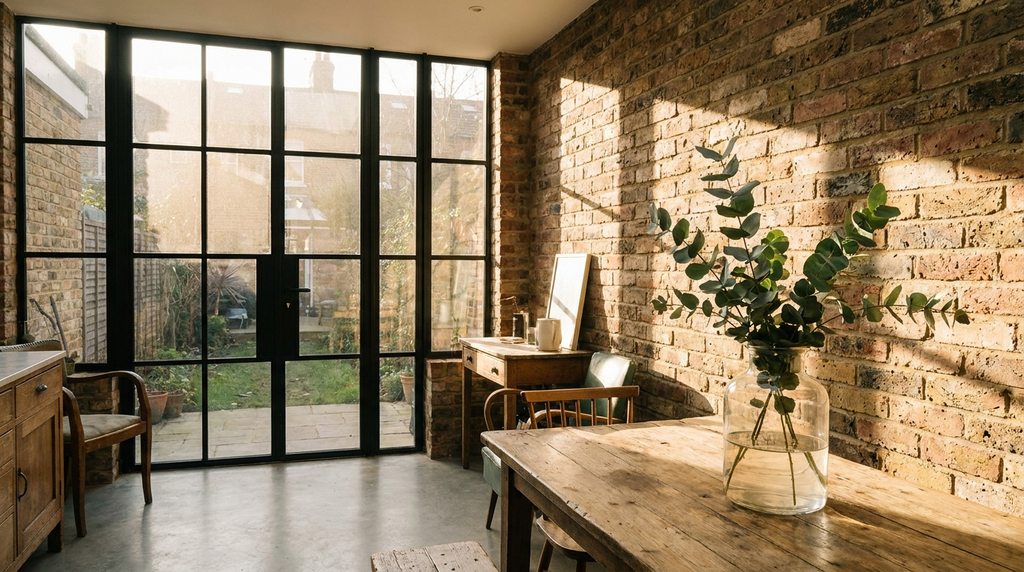
Why your workstation deserves a window, not a wall
There is a particular kind of quiet that settles over a room when your screen faces a blank wall. Your shoulders creep upward. Your eyes narrow. The afternoon stretches out like a grey corridor. Now imagine the opposite: you glance up from your keyboard and there is the garden, the street, the sky. A branch moving. A cloud shifting. A cat on the fence, pretending not to see the pigeons. That small, unconscious pause, the moment your gaze rests on something beyond the screen, is not a distraction. It is a reset.
Window placement changes your posture, your mood, and your ability to focus without you ever consciously noticing. A window behind you creates a silhouette problem, not a light problem. Your monitor becomes a dark mirror, and your own reflection stares back at you like an uninvited guest. But a window at a deliberate angle to your screen, say, 90 degrees to the side, gives you the best of both worlds: natural light that washes across the room without landing on the glass, and a view that sits just off your peripheral vision, waiting for the moment you need it.
The golden rule of screen glare, and when to break it
The received wisdom is simple: never put your screen directly in front of a window. The backlight fights the daylight, your pupils contract, and within an hour you are rubbing your temples. But the rule has a quiet exception. Tall sash windows, those elegant Victorian and Georgian verticals that run from sill nearly to ceiling, can be tamed with a sideways desk arrangement. Place the monitor at a 45-degree angle to the glass, and the light skims past rather than striking the screen head-on.
North-facing windows are the real gift here. The light is soft, diffuse, and remarkably consistent throughout the day. No harsh morning glare, no afternoon blaze. A desk positioned to catch that northern light, with the window at your left or right shoulder, gives you a workspace that barely changes from breakfast to dusk. South-facing rooms, by contrast, demand more management: blinds, angles, and a willingness to shift your chair by a few inches as the sun arcs overhead.
Let your view do the heavy lifting
Not all views are created equal. A window that frames a blank brick wall or a neighbour’s fence offers little more than a reminder that you are indoors. But a window that catches a layered scene, a foreground of potted herbs, a midground of treetops, a sliver of sky, works like a gentle tonic for tired eyes. The eye muscles relax when they have something to follow, something to track from near to far. It is the same principle as the 20-20-20 rule (look at something twenty feet away for twenty seconds every twenty minutes), except the view does the remembering for you.
The small upgrade that makes this work is a low sill. Not a deep ledge cluttered with plant pots and photo frames, but a clear, shallow landing strip for your gaze. A place your eyes can rest between tasks. If your window has a deep internal sill, consider a slim floating shelf at the same height, just enough room for a single trailing plant or a small ceramic dish. The point is not decoration. It is permission to look away.
Eight ways to soften a tall sash window without losing light
Tall sash windows are beautiful, but they are also uncompromising. They flood a room with light and they do not apologise for it. If you need to work at a screen, you need to manage that light without destroying the window’s character. Here are eight approaches that keep the glass clear and the glare in check:
- Sheer linen roman blinds, They filter without blocking, and they fold into neat horizontal pleats that echo the window’s vertical lines.
- A slim floating shelf at sill height, For a single trailing plant that breaks up the glass without obscuring it. A pathos or a string of pearls works beautifully.
- Adjustable wooden venetian blinds, Tilted upward, they bounce light onto the ceiling, filling the room with a soft, reflected glow.
- A freestanding screen or room divider, Placed at an angle between the window and the desk, it diffuses direct sun without touching the window frame.
- Matte window film, Applied to the lower third of the glass, it gives privacy without sacrificing daylight. The upper two-thirds remain clear.
- A deep-set window reveal painted in a warm off-white, Something like Farrow & Ball Slipper Satin or Little Greene French Grey. The reduced contrast between glass and wall softens the whole room.
- A single oversized pendant lamp centred over the desk, On overcast days, it balances the window light and prevents the room from feeling flat.
- A low-backed armchair or reading nook tucked into the bay, This keeps the window-facing desk zone clear while giving you a second spot for phone calls or afternoon daydreams.
Why texture matters more than colour when your window is behind you
Here is the counterintuitive bit. When the window sits at your back, the room’s tactile surfaces become your visual anchor. Your eyes cannot rest on the view, it is behind you, so they search for something else to hold onto. That something is texture. A ribbed glass-fronted cabinet. A fluted wooden desk edge. A chunky wool rug underfoot. These surfaces catch the light in tiny, uneven ways, giving your gaze something to settle on without demanding attention.
A matte desk surface is essential here. Glossy finishes catch the window light and throw it back at you, creating a second glare source. A soft, nubby chair upholstery, linen, wool bouclé, or a textured cotton, prevents the space from feeling cold or clinical. And the windowsill itself: if you can, finish it in honed stone or lime-washed timber. These materials absorb light rather than bouncing it, and they feel quiet under your hand when you reach out to open the sash.
Pick a colour that softens with the seasons
The best home office colours are the ones that change with the light. A sage green like Farrow & Ball French Gray deepens in winter, when the sun sits low and thin. A warm putty like Little Greene Rolling Fog glows in summer, catching the high golden light and holding it. The trick is to choose a colour that works with your window’s orientation, not against it.
South-facing rooms can take cooler tones, a pale grey-blue, a dusty lavender, because the light is warm enough to balance them. North-facing rooms need warmth: a soft ochre, a clay pink, a milky beige. The payoff is a room that feels connected to the outdoors without competing with the view. Your eye moves from the wall to the window and back again, and neither one shouts louder than the other.
Why this matters, the one human gain
When your screen faces the window, you stop fighting the light and start working with the day’s rhythm. The morning sun on your left shoulder. The soft grey of an overcast afternoon. The dim, quiet hour just before dusk when the room seems to hold its breath. You notice these things because they are there, at the edge of your vision, waiting for you to look up.
The result is less eye strain, fewer headaches, and a desk you actually want to sit at. Not because it is ergonomically perfect, but because it feels human. A window is not a design feature. It shows the world is still turning outside your screen. And that, it turns out, is the one thing a home office really needs.