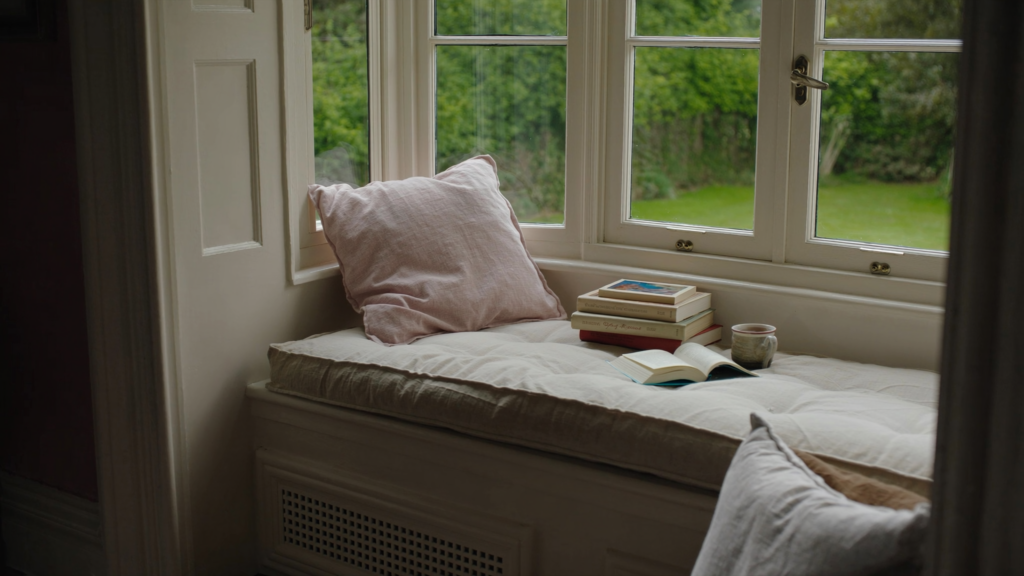
The light that lands on a page
It happens in the late morning, just before eleven. The sun clears the roofline opposite and pours through the bay window of your Victorian terrace, falling across the worn armchair you dragged in from the spare room. It picks out the grain of the wooden armrest, warms the paper in your hands, and for twenty minutes you don’t turn a page because the light itself is the story. That corner, the one you used to walk past with a stack of laundry, has become the room you actually want to sit in.
A reading nook by a window doesn’t need a designer or a budget. It needs a window that knows how to behave, a chair that doesn’t demand attention, and the quiet realisation that the best spots in your house are already there, waiting for you to stop and sit down.
Let your front door do the heavy lifting
Walk through your house slowly, the way you would if you were seeing it for the first time. Notice where the light behaves differently, a landing at the top of the stairs where the afternoon sun pools on the floorboards, a stair turn where a sash window catches the last of the evening, a hallway dead end where the front door’s sidelights cast a surprising triangle of morning brightness into a narrow space. Tuck a small chair and a floor lamp into that hallway corner and you’ve made a reading nook without touching a wall.
A nook doesn’t need a big window, just the right one. A 1930s front door with a fanlight above can throw a stripe of light across a hall table that’s perfect for a cup of tea and a slim volume of poetry. A landing window at head height, the kind you’d normally pass without stopping, becomes a perch if you add a low stool and a cushion. The front door itself, with its glazed panels, does the heavy lifting: it brings light into a space that was never designed for sitting, and suddenly you want to stay.
Pick a colour that softens with the seasons
The window frames the view, but the wall colour around it sets the mood for reading. Deep greens and ochres absorb glare on a bright day, making the page easier on the eye; pale pinks and greys reflect what little light there is, keeping a north-facing nook from feeling like a cave. A south-facing reading nook by a window can handle cooler, quieter shades, a soft Farrow & Ball Borrowed Light or a pale Little Greene French Grey, because the sun will warm them anyway. A north-facing one needs warmth: think a deep Setting Plaster pink or a warm Edward Bulmer Ochre that glows even on a grey January afternoon.
The paint colour changes hour by hour, and that’s the point. What looks rich and enveloping at noon becomes almost translucent at dusk, and the window becomes a clock you don’t have to wind. The wall around it isn’t decoration, it’s the frame that makes the light inside the frame sing.
Why texture matters more than colour
A reading nook by a window is a tactile place. The wool of a throw, the linen of a cushion, the rough bark of a houseplant’s pot, these are the things your hand reaches for when you’re not turning a page. Texture absorbs sound, too, which matters in period homes with tall sash windows that let in both light and street noise. A velvet cushion on a hard window seat turns a cold sill into a place you can sit for an hour. A sheepskin thrown over the arm of a chair catches the light differently every time you look up.
In a room with high ceilings and bare floorboards, texture softens the transition from bright glass to dark room. A single chunky-knit throw or a linen curtain that falls to the floor rather than stopping at the sill can make a hard window seat feel like a room within a room. You don’t need to reupholster the whole house, just one corner, one window, one chair.
Eight ways to soften a tall sash window
A tall sash window is a beautiful thing, but it can feel imposing when you’re trying to curl up beside it. The trick is to soften it without hiding it. Here are eight small gestures that turn a tall window into a reading nook’s best friend:
- A Roman blind at the top third, not covering the whole window, just the upper section, so you control the light without blocking the view.
- A shelf of trailing plants, set just below the midpoint of the window, so ivy or pothos softens the hard lines of the frame.
- A low stool that doubles as a side table, tuck it under the sill for your tea, pull it out when you need a footrest.
- A floor lamp aimed at the ceiling, bounces light off the plaster rather than into your eyes, perfect for evening reading.
- A cushion that matches the sill depth, custom-cut foam wrapped in linen, so the window seat feels intentional, not improvised.
- A small rug under the chair, anchors the nook and absorbs echo from the bare floor.
- Curtains that puddle on the floor, just a few inches of extra fabric at the bottom adds softness and a sense of enclosure.
- A mirror on the opposite wall, reflects the window’s light deeper into the room, making the nook feel twice as bright.
The cumulative effect is a reading nook by a window that feels built, not bought. Each decision is small, but together they make the corner feel like it always belonged there.
The window that makes the nook possible
None of this works if the window itself fights you. Slim frames let in more light, that’s the physics of it, but the feeling is that the room breathes easier. Tilt-and-turn options allow you to open the window for ventilation without a draft hitting the back of your neck, which matters when you’re sitting still for an hour. Acoustic glass keeps the street noise down to a murmur, so the sound of traffic becomes a background hum rather than a distraction.
This isn’t a technical deep-dive. It’s a recognition that the window’s character shapes the nook’s character. A wide, low casement in a cottage calls for a deep sill and a pile of cushions. A tall sash in a Georgian townhouse wants a straight-backed chair and a reading lamp that reaches the page. Choose your window for how it feels to sit beside, not just how it looks from the street. The nook will follow.