The first thing you notice is the light
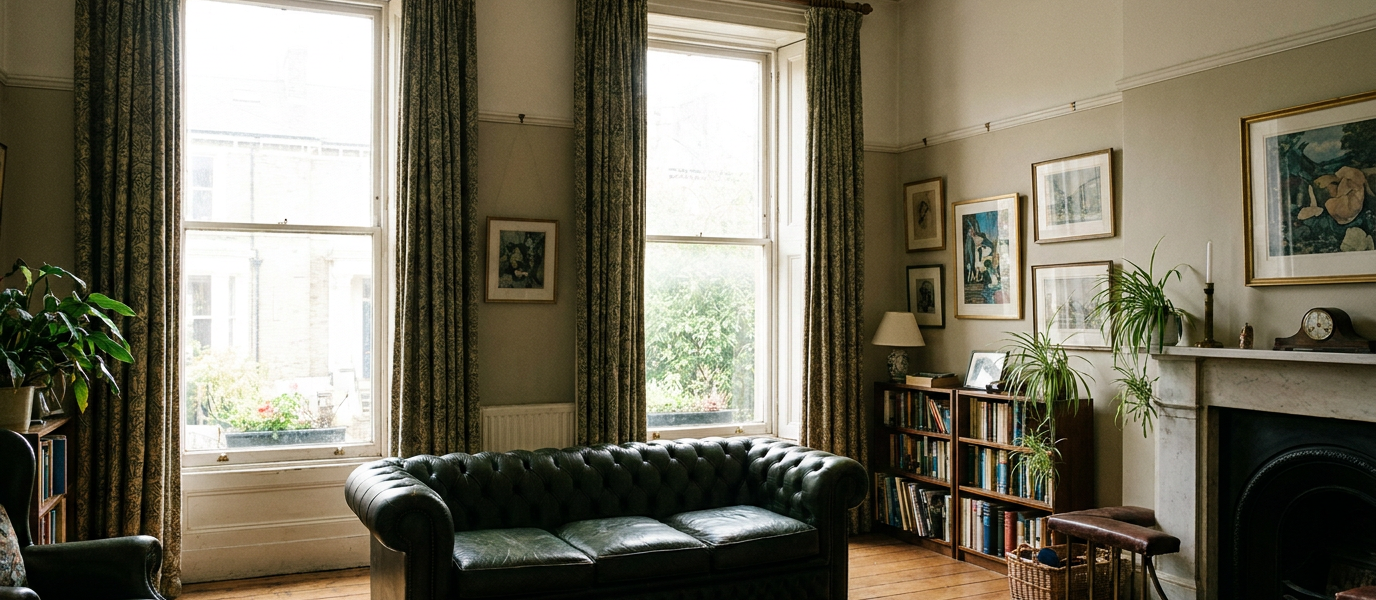
Walk into any room with a tall Victorian sash window and something peculiar happens to your sense of time. It’s not the view that catches you first, though that will claim your attention soon enough, but the quality of the light itself. It arrives differently here, softer at the edges, pooling on bare floorboards in long pale rectangles that shift through the day. In the dim, quiet hour just before dusk, those rectangles warm to amber, catching dust motes in slow suspension. The room breathes with the weather. A bright March morning feels almost Mediterranean; a November afternoon turns the space into a watercolour study in grey and silver.
These windows change how you live in a room. They demand you arrange furniture differently, chairs pulled closer to the glass, sofas set perpendicular to the bay, nothing that blocks the vertical fall of light. You find yourself sitting nearer the window than you might in a modern home, drawn into conversation with the outside. A tall sash doesn’t just frame the garden or the street; it pulls the landscape into the room, making the boundary between inside and out feel porous. After a few weeks, you stop thinking of windows as holes in a wall. They become the room’s main character, the quiet presence around which everything else arranges itself.
Let the proportions do the work
There is an innate elegance to the vertical sash that no modern window quite replicates. The height draws the eye upward, making ceilings feel loftier, spaces more generous. A room with a tall Victorian sash feels taller than it measures, because the window teaches your eye to read verticality as the primary axis. This is architecture doing its job without shouting about it.
The temptation, when faced with such a strong feature, is to compete with it. Resist. A tall window asks for restraint, a single vase of bare branches on a low console, a bench set beneath the sill, nothing that fights the vertical line. Victorian window styling, at its best, is a philosophy of subtraction. You don’t add drama; you uncover the drama already there. Think of it as editing rather than decorating. A room with a sash this generous doesn’t need a feature wall. It already has one, and it’s made of glass and sky.
The art of dressing a tall sash
The question of curtains versus blinds is, for a tall sash, less a matter of fashion and more one of proportion. Floor-to-ceiling linen drapes in a natural oatmeal or stone work beautifully because they echo the window’s verticality without competing with it. Let them pool slightly on the floor, an inch or two of fabric resting on the boards softens the geometry without hiding the window’s bones. The effect is generous, lived-in, quietly luxurious.
If you prefer a cleaner line, a Roman blind in a natural texture, rough linen, slubby cotton, even a matte wool, sits neatly within the recess without interrupting the frame. The key is keeping the hardware simple: a brass or unlacquered metal rail, nothing ornate. You want the window itself to remain the focal point, not the dressing. For more ideas on how to approach this, our guide on door colour ideas explores similar principles of restraint and material honesty that apply just as well to window treatments.
Why texture matters more than colour
With so much glass, the walls and floor become the backdrop, but that doesn’t mean they disappear. This is where texture earns its keep. Limewash on the walls catches the light differently from flat emulsion, holding a subtle variation that shifts with the day. Rough linen upholstery, worn oak floorboards, matte clay pots on the sill, these materials have a tactility that colour alone can’t provide. They give the room depth without competing with the window.
Colour, in a room with a tall sash, can afford to be quiet. Warm whites like Farrow & Ball’s Drop Cloth or a soft Setting Plaster pink work because they let the window bring its own shifting palette of sky and season. A muted green, think of the lichen on an old stone wall, can anchor a room without shouting. The window does the work of providing drama; the walls just need to hold the space. A room with a tall sash doesn’t need a feature wall. It already has one, and it changes every hour.
Eight ways to soften a tall sash window
Sometimes the window needs a little help feeling like part of the room rather than a magnificent stranger. Here are eight ways to draw it into the life of the space:
- 1. Hang a single pendant light low in the centre of the window bay. It anchors the vertical space and creates a second focal point at eye level.
- 2. Place a low stool or window seat beneath the sill. A place to sit, to read, to watch the rain, the window becomes a destination, not just a view.
- 3. Stack a few books or a sculptural object on the sill itself. Keep it minimal; one or two items, nothing that clutters the line.
- 4. Use a sheer inner layer behind heavier curtains. Voile or muslin softens the light during the day while maintaining privacy.
- 5. Paint the window frame in a slightly darker tone than the wall. A deep charcoal or slate against a pale wall gives the frame definition without heaviness.
- 6. Add a trailing plant on a bracket beside the sash. A cascade of ivy or a philodendron softens the architecture with living green.
- 7. Let the floorboards run uninterrupted toward the window. No rugs that stop short; the eye should flow freely to the glass.
- 8. Keep the view clean. No clutter on the sill, no fussy ornaments. The window doesn’t need accessories.
The quiet discipline of maintenance
A tall sash window rewards attention. There is a quiet satisfaction in the smooth glide of the cord, the seal against draughts, the paint that doesn’t peel at the edges. These windows ask for care, regular checks on the weights, the occasional re-glazing, a fresh coat of paint every few years. But that care becomes a ritual, a way of inhabiting the room with intention.
Living with a Victorian sash means accepting that it will demand something of you. Unlike a modern double-glazed unit that you can ignore for decades, a sash window insists on relationship. You learn to notice when the cord begins to fray, when the frame needs a little wax, when the draught excluder has slipped. That attention isn’t a burden; it’s part of how you come to know the room. The window teaches you to slow down, to look properly, to care for the things that matter. For more on maintaining the character of period features, our piece on door colour ideas covers similar ground in caring for original woodwork.
What the window gives back
On a grey afternoon, rain streaming down the glass, the room quiet and warm, you understand what a tall sash window really gives you. It’s not just light, though that is generous enough. It’s a daily reminder of scale, of the generosity of Victorian architecture, of the craftsmanship that made these frames by hand. It holds the outside world at a gentle distance, letting you watch the weather without being in it, keeping the seasons close but not too close.
You don’t style a Victorian sash window. You learn to live alongside it. You arrange your life around its rhythm, its light, its quiet demands. And in return, it gives you a room that feels alive, not decorated, but inhabited. That is the real gift of these windows: they make a house feel like a home, not because of what you add, but because of what you leave in place.