Power flushing a UK boiler costs roughly £450–£600, which is about half the price of a replacement boiler installation
If your radiators have cold patches at the bottom or your boiler is cycling on and off more than usual, the problem may be internal sludge. Power flushing is the process of cleaning that sludge out of your central heating system. For 2026, the national average cost of power flushing a boiler in a standard three-bedroom home is £500 to £550, according to Checkatrade’s national averages (Checkatrade, 2026). That is roughly half the typical cost of a new boiler installation, which runs between £1,000 and £2,500.
Costs vary by property size and the number of radiators. A typical three-bedroom house has 6 to 10 radiators, and each additional radiator adds roughly £30 to £50 to the total. Smaller homes with four or fewer radiators may cost as little as £350, while larger properties with more than 12 radiators can reach £800 or more. The Energy Saving Trust notes that sludge buildup is common in systems over five years old, making power flushing a cost-effective alternative to full replacement (Energy Saving Trust, 2026).
Power flushing is the only way to clear internal sludge that standard bleeding or inhibitor cannot fix
Sludge is a mixture of magnetite (iron oxide) and other debris that builds up inside radiators and pipework over 5 to 10 years. This sludge restricts water flow, causing cold spots on radiators and forcing the boiler to cycle on and off more frequently. Standard bleeding or adding inhibitor chemicals cannot remove existing sludge; they only prevent new buildup. Power flushing is the only method that physically dislodges and removes the sludge.
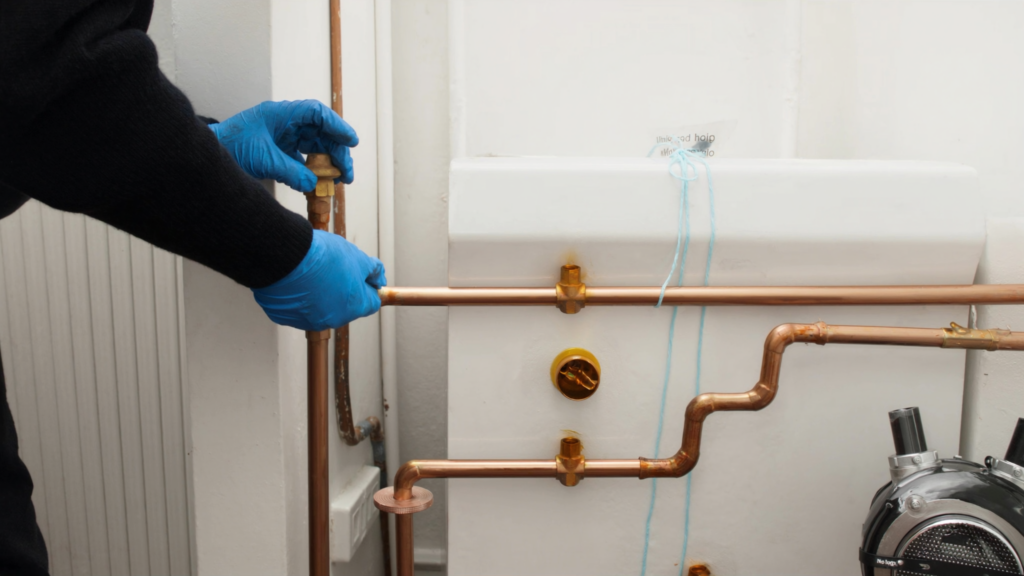
A power flush uses a high-flow pump connected to the heating system. The pump circulates cleaning chemicals and water at high velocity through the radiators and pipework, breaking up and flushing out the sludge. The process typically takes 4 to 8 hours for a standard home, depending on the number of radiators and the level of contamination. The Heating & Hotwater Industry Council (HHIC) technical notes confirm that power flushing is the recommended method for restoring system efficiency when sludge is present (HHIC technical notes, 2026). Ofgem’s boiler-efficiency guidance also states that clearing sludge can improve heat output and reduce energy consumption by 5 to 10% (Ofgem, 2026).
Power flushing eligibility for a UK Government grant is limited to homes receiving specific benefits
Power flushing is not funded as a standalone measure under the Boiler Upgrade Scheme (BUS) or the Energy Company Obligation (ECO4). However, it can be included as part of a full boiler replacement or heat-pump installation under ECO4, provided the household meets the eligibility criteria. To qualify, the household must be receiving one of the following benefits: Pension Credit, Child Tax Credit, Income Support, or Universal Credit with an income below £31,000. The GOV.UK page for ECO4, updated January 2026, states that power flushing is eligible only when it is necessary for the proper operation of the new heating system (GOV.UK, 2026).
If you are not receiving these benefits, you will need to pay for the power flush privately. The BUS, which provides grants for heat pumps, does not cover power flushing as a separate item. Ofgem’s ECO4 guidance confirms that installers must document the need for a power flush as part of the overall installation to claim the cost (Ofgem ECO4 guidance, 2026).
Quick numbers, power flushing cost, time, and performance data
| Item | Value | Source |
|---|---|---|
| Average cost (3-bed home) | £500–£550 | Checkatrade 2026 |
| Typical time | 4–8 hours | HHIC guidance |
| Radiators in a typical home | 6–10 | EST housing survey data |
| Flow improvement (typical) | 20–30% | MCS technical note 2026 |
| Warranty requirement | Flush required for new boiler warranty | MCS 025 standard |
It is a high-pressure cleaning process that restores boiler efficiency and is often required to keep a new boiler warranty valid
Power flushing is a high-pressure cleaning process that removes internal sludge from your central heating system, restoring boiler efficiency and improving heat output. For most boiler manufacturers, a power flush is a non-negotiable prerequisite for keeping the warranty valid when replacing a system with known sludge. The MCS 025 standard states that a power flush must be performed before installing a new boiler in a system with visible sludge, otherwise the manufacturer can void the warranty if sludge later damages the new boiler (MCS 025 standard, 2026).
Power flushing is not a repair for a broken boiler. It is a preventive maintenance step that improves heat output and can reduce energy bills by 5 to 10%, according to Energy Saving Trust data (Energy Saving Trust, 2026). If your radiators have cold spots, your boiler cycles frequently, or you are planning a boiler replacement, a power flush is the recommended first step. How to tell if your boiler needs a power flush
How to verify an installer for power flushing, MCS certification and Gas Safe registration are the minimum requirements
For power flushing alone, the installer must be Gas Safe registered if they work on gas boilers. Gas Safe registration is a legal requirement for anyone working on gas appliances in the UK. You can check an installer’s Gas Safe number on the Gas Safe Register website (Gas Safe Register, 2026). For the power flush itself, the installer should also hold MCS certification for the flushing equipment, specifically MCS 025, which covers the cleaning and commissioning of heating systems (MCS 025, 2026).
If the power flush is performed as part of a boiler replacement that qualifies for an ECO4 grant, the installer must be MCS certified and TrustMark registered. TrustMark is the government-endorsed quality scheme for tradespeople. You can verify an installer’s TrustMark registration on the TrustMark website (TrustMark, 2026). Always ask for proof of certification before agreeing to any work. How to choose a certified heating installer
Frequently Asked Questions
The average cost is £500-£550 for a standard three-bedroom home in 2026, according to Checkatrade. Smaller homes with fewer radiators may cost as little as £350, while larger properties can reach £800 or more.
Yes, at £450-£600 it is roughly half the cost of a new boiler installation (£1,000-£2,500). The Energy Saving Trust notes it is a cost-effective alternative for systems over five years old with sludge buildup.
For a standard three-bedroom home, the process typically takes 4 to 8 hours. This depends on the number of radiators and the severity of sludge buildup.
It is not recommended. Power flushing requires specialist equipment and chemicals to avoid damaging the system. A professional heating engineer should carry it out to ensure safety and effectiveness.
Every 5 to 10 years is typical, or when sludge buildup is identified. The Energy Saving Trust recommends it for systems over five years old to maintain efficiency and prevent boiler cycling.