If you are a UK homeowner, the boards fixed to the edges of your roof are your first line of defence against rain, wind, and pests. A failing roofline can cause damp walls and rotten rafters, leading to repairs that cost thousands of pounds. This glossary explains the four main components, bargeboard, fascia, soffit, and verge, so you can identify what needs attention on your property.
The roofline is the collective term for the boards fixed along the edges of a roof where the tiles meet the walls or gable ends. Its primary job is to seal the gap between the roof covering and the wall, preventing rain, wind, and pests from entering the roof space. A failed roofline can lead to damp walls, rotten rafters, and costly structural repairs, making early identification of problems essential. This glossary explains the four main components, bargeboard, fascia, soffit, and verge, so you can identify what needs attention on your property.
What is a fascia board?
A fascia board is the vertical board that runs along the lower edge of the roof where tiles meet the gutter. The fascia is fixed directly to the ends of the roof rafters, forming a straight horizontal line along the eaves. Its main functions are to support the bottom row of roof tiles and to carry the guttering system.
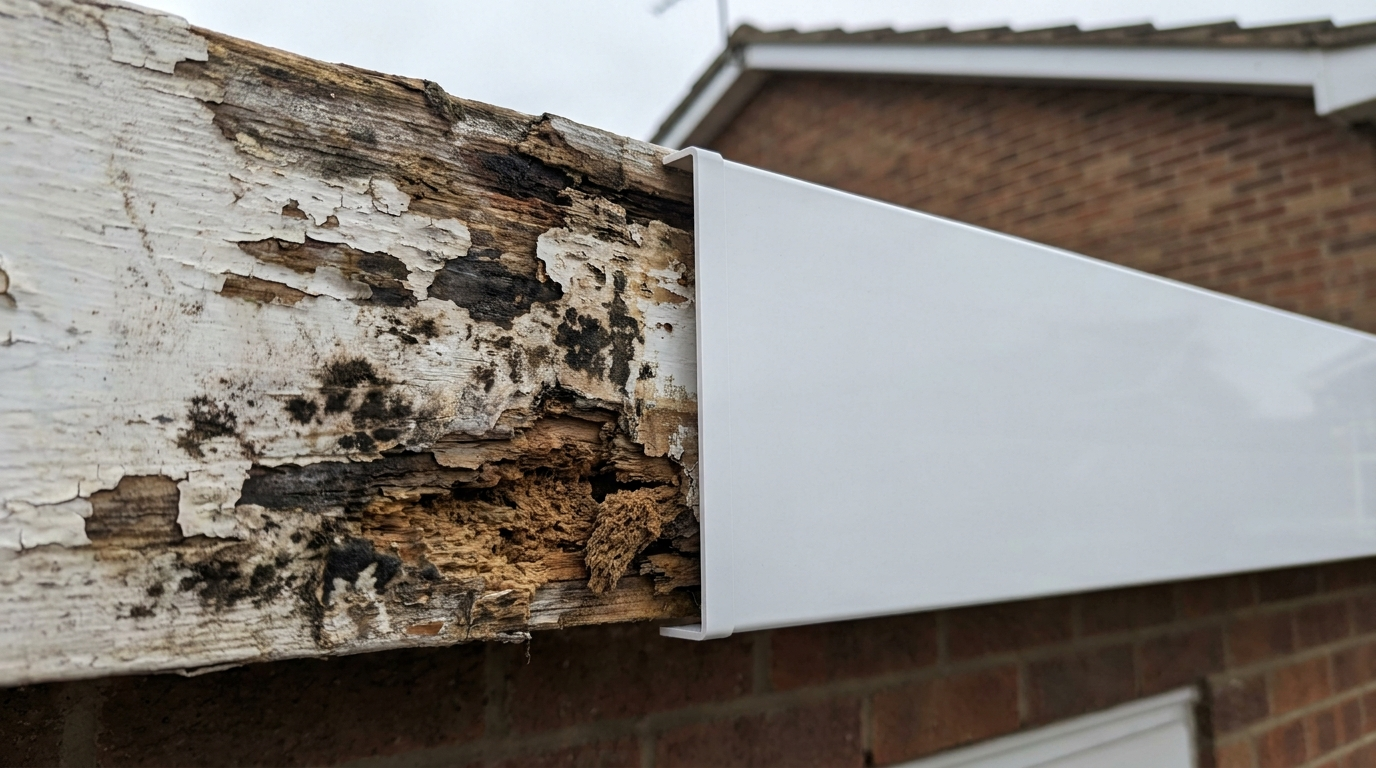
Common materials are uPVC (most common in new installations since the 1990s), timber (traditional, requires painting every 3–5 years), and aluminium (durable but more expensive). Rot or sagging in a timber fascia often appears as peeling paint, soft spots, or moss growth directly under the gutter line. The Energy Saving Trust notes that timber fascias typically need repainting every three to five years to prevent decay (Energy Saving Trust, 2026).
What is a bargeboard?
A bargeboard is the angled board that follows the slope of the gable end, covering the edge of the roof where it projects over the wall. Unlike a fascia, which is horizontal, a bargeboard runs diagonally along the gable, protecting the exposed ends of roof battens and tiles. Its purpose is to prevent wind-driven rain from penetrating the roof edge at the gable end.
Bargeboards are often more ornate on older properties, with decorative cut ends, and are a common cause of hidden rot because they are less visible from ground level. When replacing, you must match the board to the existing roof pitch angle, a mismatch will leave a visible gap or cause water ingress. The NHBC Standards Chapter 7.1 specifies that bargeboards must be fixed to the gable wall with adequate weatherproofing to prevent water penetration (NHBC, 2026).
What is a soffit?
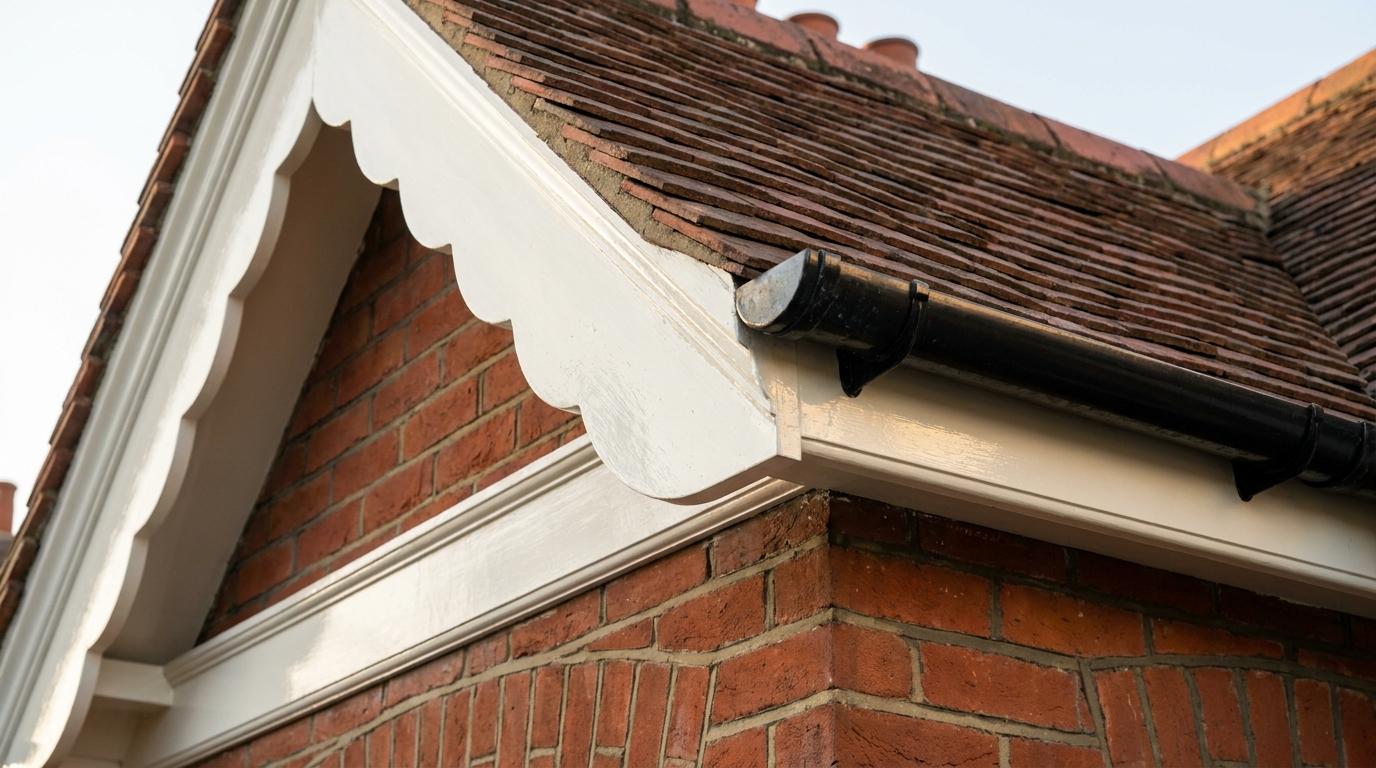
A soffit is the horizontal board that runs underneath the fascia, bridging the gap between the wall and the roof edge. The soffit closes off the underside of the eaves, creating a finished look and providing ventilation to the roof space. Two main types exist: solid soffits (no vents, used when the roof has other ventilation) and perforated soffits (with small holes to allow airflow, used to prevent condensation in the loft).
uPVC soffits are now the standard replacement for timber, as they do not rot and require no painting. A blocked or missing soffit vent can lead to condensation in the loft, which in turn rots the rafters and insulation from the inside. Building Regulations Approved Document F requires that roof spaces be adequately ventilated to prevent moisture buildup, with soffit vents being the most common method (GOV.UK, 2026). how to improve loft ventilation
Quick numbers, typical lifespan, cost, and material comparison
| Component | Material | Typical lifespan (years) | Average replacement cost per linear metre (2026, installed) | Key maintenance |
|---|---|---|---|---|
| Fascia board | uPVC | 30–40 | £25–£45 | Clean gutters annually |
| Fascia board | Timber | 15–25 | £30–£50 | Paint every 3–5 years |
| Bargeboard | uPVC | 30–40 | £35–£55 | Check at gable end |
| Bargeboard | Timber | 15–25 | £40–£60 | Inspect for rot yearly |
| Soffit | uPVC | 30–40 | £20–£35 | Clear vents of debris |
| Soffit | Timber | 15–20 | £25–£40 | Paint and check vents |
Lifespan data is based on NHBC Standards and Energy Saving Trust maintenance guides (NHBC, 2026). Cost figures are from industry pricing data for roofline work in 2026, with regional variations expected (Checkatrade, 2026).
The difference between a bargeboard and a fascia
This is the most common confusion among UK homeowners. The simple rule: if it runs horizontally along the bottom edge of the roof, it is a fascia; if it runs diagonally up the side of the gable, it is a bargeboard. A fascia always sits above the gutter; a bargeboard sits above the wall at the gable end and does not normally carry a gutter.
On a standard semi-detached house, the front and back have fascias, while the two side walls (if they are gable ends) have bargeboards. If you are replacing only one, a mismatch in material or profile between bargeboard and fascia will be very noticeable from the street. how to match roofline materials
How to verify a roofline installer
For uPVC roofline work, the key certification is TrustMark, a government-endorsed quality scheme that covers all home improvement trades (GOV.UK, 2026). If the roofline replacement involves any electrical work (e.g., adding soffit lights), the installer must be registered with NICEIC or NAPIT. While MCS is primarily for renewable energy systems, some roofers offering integrated solar roofline products will require MCS certification (MCS, 2026).
Always ask for proof of public liability insurance (minimum £2 million cover) and a written guarantee of at least 10 years for uPVC installations. Trading Standards guidance recommends this minimum cover to protect against damage during work (GOV.UK, 2026).
How to spot roofline rot early
The simplest way to spot roofline rot before it reaches the rafters is to check the underside of the bargeboard and the ends of the fascia from inside the loft. Go into the loft on a dry day and look at the ends of the rafters where they meet the fascia, any dark staining, damp timber, or white fungal growth indicates water ingress.
Outside, check the gable end bargeboard where it meets the wall, soft or crumbling timber at this joint is a sign of rot that has already reached the rafter ends. On uPVC rooflines, look for sagging or gaps between the boards, the fixings may have corroded. This allows water to run behind the plastic. If you can push a screwdriver more than 5mm into the timber, the rot has progressed and the rafter end likely needs replacement, not just the board. RICS guidance on timber decay in roofs advises that any rot penetrating beyond the surface of the board requires professional assessment (RICS, 2026).
Frequently Asked Questions
A fascia runs horizontally along the eaves to support the gutter. A bargeboard runs diagonally along the gable end to cover the roof edge. Both protect against weather, but the fascia carries the gutter while the bargeboard seals the gable. The Energy Saving Trust advises checking both annually for rot or damage.
Replacing fascia and soffits on a typical 3-bed semi costs £1,000–£2,500 for uPVC. Timber replacement is cheaper upfront but requires painting every 3–5 years. Costs vary by house size and scaffolding access, so get at least three quotes. Ofgem does not cover roofline work under ECO4 grants.
No, replacing bargeboards like-for-like is permitted development in most UK homes. If you change material or profile significantly, check with your local council. Listed buildings and conservation areas require consent. GOV.UK confirms minor repairs do not need planning permission.
Blocked soffit vents are usually caused by bird nests, cobwebs, or debris from roof gutters. Lack of airflow can lead to condensation and mould in the loft. Clean vents annually and install mesh guards to prevent pest entry. The Energy Saving Trust recommends checking loft ventilation during any roof work.
uPVC fascias and soffits typically last 20–30 years with minimal maintenance. They do not rot like timber but can become brittle or discoloured over time. Aluminium lasts longer but costs more. Replace if you see cracking, sagging, or water ingress behind the boards.