Let your bin store earn its place in the garden
The waste area is usually an afterthought, shoved behind a wonky fence panel or left to fester beside the bins like a guilty secret. You know the scene: a tangle of green and black plastic, a stray lid rolling across the drive, the faint whiff of something that was forgotten last collection day. It’s the one corner of the house you hope nobody notices. But here’s the thing: that neglected patch is a missed opportunity for curb appeal. A well-designed bin store doesn’t just hide the unsightly, it anchors a side return, softens a boundary, and quietly tells the street that this house is cared for, not cluttered. When the bin store looks intentional, the whole frontage reads as deliberate, not apologetic.
Think of it less as a necessary evil and more as a piece of garden architecture. A bin store that earns its place does what good design always does: it solves a problem without shouting about it.
Treat it like a garden room, not a shed
Most bin stores are thrown together from flimsy timber or galvanised steel, functional, yes, but about as charming as a filing cabinet. Instead, treat the structure like a small outbuilding. Use materials that echo the house: brick pillars that match the main wall, timber cladding that picks up the fence stain, or a rendered finish that ties into an extension. The shift in mindset is subtle but powerful, a bin store that looks like a garden room rather than a box adds character and a whisper of perceived value.
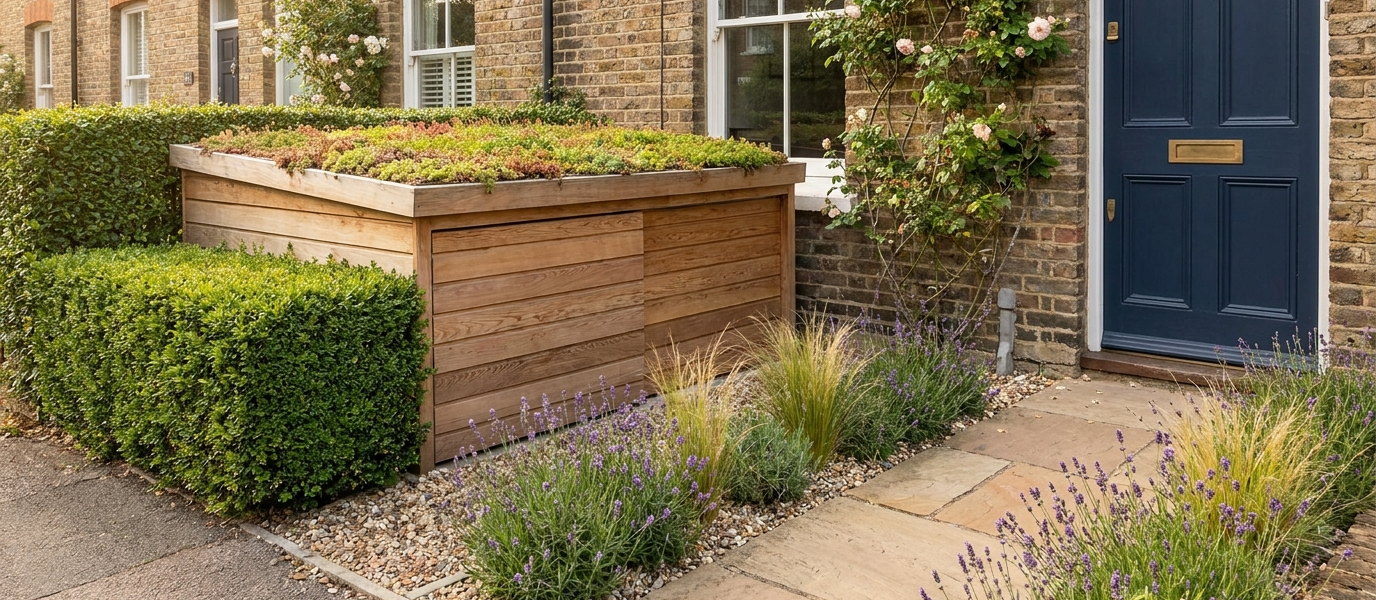
Roof options matter more than you’d think. A sedum roof turns the store into a soft green lid that blends with the planting, while slatted timber allows ventilation and a sliver of light. For something airy, a clear corrugated panel lets the sky in and keeps the space from feeling like a dark, musty cupboard. The detail that sells it: a shallow overhang that casts a shadow line and stops the store from looking like a blunt cube dropped on the lawn.
The louvred screen trick for airflow and privacy
Solid doors trap smells and heat, turning your bin store into a miniature greenhouse of regret on a warm July afternoon. The fix is elegant and simple: louvred or slatted timber. Vertical battens on a hinge create a clean, modern facade that works with both contemporary extensions and Victorian terraces. The gaps let air circulate, so the bins dry out and the odours drift away rather than stewing inside.
The bonus is almost accidental: a louvred front doubles as a trellis. Train a climbing jasmine or a slow-growing ivy up the slats, and within a season the store becomes a living screen, softening the lines and adding a layer of scent. It’s the kind of detail that makes visitors pause and say, “Oh, that’s clever,” without realising they’re admiring a bin store.
One door or two, what your layout needs
The door decision is less about aesthetics and more about how you move through the space. A single wide door works for a straight run of bins, wheel them in side by side, close the door, done. Double doors suit a deeper store where you need to access the back bin without playing a game of plastic-tetris. For everyday use, a drop-down front panel is a quiet revelation: you can slide a bin out without opening the whole facade, keeping the front clean and the neighbours none the wiser.
The detail that makes the difference is the hardware. A recessed handle or a magnetic catch keeps the front flush and uncluttered, so the store reads as furniture rather than a utility cupboard. Spend the extra ten pounds on a decent latch, it’s the difference between a bin store that opens smoothly and one that sticks, rattles, and eventually gets wedged shut with a brick.
Colour that blends or pops, pick your strategy
Colour is where the bin store goes from functional to intentional. You have two clear strategies, and neither is wrong. The first is to blend: match the store to your window frames or front door for a cohesive streetscape. A soft sage green, a slate grey, or a warm black (think Farrow & Ball’s Railings or Little Greene’s Slaked Lime) makes the store disappear into the architecture. It’s the quiet approach, and it works beautifully on terraced houses where the frontage is tight.
The second strategy is to pop. A deep ochre, a navy blue, or a terracotta turns the bin store into a deliberate accent piece, a punctuation mark at the end of the side passage. Why it works: a painted bin store reads as garden furniture, not a utility box. It’s the same trick that makes a front door in Chartwell Green or a shed in Duck Egg Blue feel charming rather than accidental.
Five ways to soften a tall bin store
A vertical bin store can feel imposing, especially in a narrow side return. Here are five ways to break its height and make it sit more gently in the garden:
- Climb it. A trellis panel on one side with a climbing rose or clematis softens the silhouette and draws the eye upward through leaves, not timber.
- Paint a horizontal band. A painted strip at roughly one-third height, in a contrasting or complementary colour, visually shortens the store and adds a decorative detail.
- Add a roof overhang. A shallow projection casts a shadow line and reduces the visual weight of the top edge, making the store feel grounded.
- Top it with a planter. A small shelf or a shallow box on the roof for trailing ivy or succulents turns the top into a feature rather than a blank lid.
- Use a lighter colour at the top. Painting the upper half in a paler shade, a soft cream or a pale grey, makes the store feel taller but lighter, like a piece of joinery rather than a bunker.
The hidden detail that makes daily use effortless
A bin store that looks good but is awkward to use will quickly become a dumping ground. The secret is in the small conveniences that make daily life frictionless. A pull-out step or a low lip at the base stops bins from tipping when you drag them out, a tiny detail that saves a morning’s worth of swearing. A hook inside for the recycling bag, a shelf for the compost caddy, a loop for the wheelie bin handle, these are the things that stop the store from filling with odd bits of garden twine and forgotten plant pots.
The real gain is psychological: a bin store that works smoothly gets used properly, so it stays tidy. You don’t have to wrestle with the door or dig through clutter to find the right bin. It becomes a quiet, reliable part of the weekly rhythm, not a chore you put off until the night before collection.
When the bin store becomes a boundary feature
The most satisfying bin stores do more than hide the bins, they earn their place as a boundary feature. Position it at the end of a side passage or against a fence line, then extend the roofline to create a covered walkway or a log store. Use the same brick or timber as the house wall, and suddenly it doesn’t look like an addition, it looks like it was always there, an original part of the property that the architect had the good sense to include.
The payoff is considerable: a bin store that doubles as a screen for the neighbour’s view or a windbreak for the patio. It’s the kind of dual-purpose design that makes you wonder why you ever settled for a row of bins against the fence. When the store becomes a piece of the garden’s architecture, the bins stop being an eyesore and start being a footnote, and that’s the point at which the kerb wins back its charm.