How Soundproof Insulation Differs From Thermal Insulation
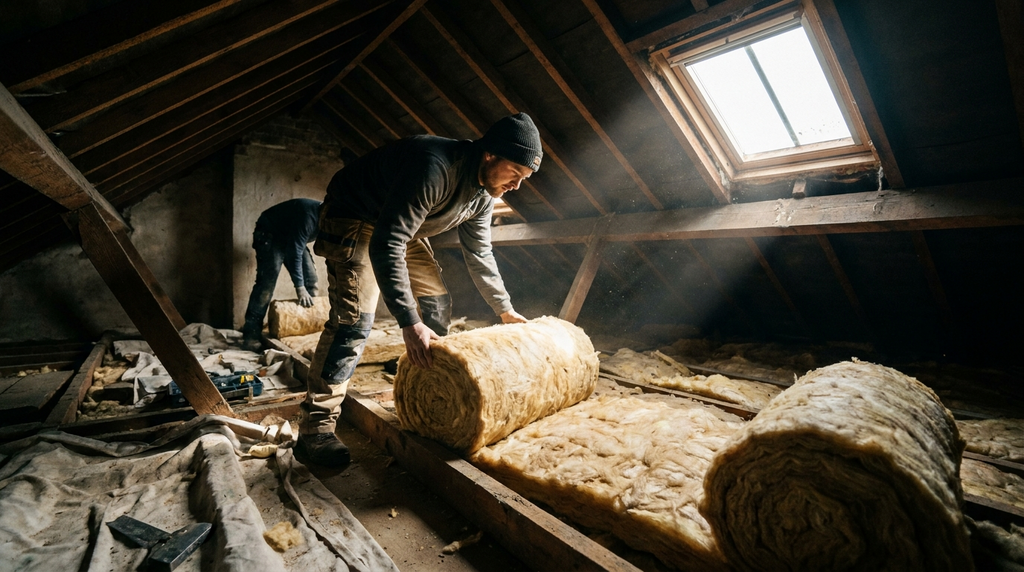
Soundproof insulation is measured by the sound reduction index, usually given as Rw or DnT,w, not by thermal conductivity or U-value. Mass and density are the main factors for blocking airborne sound. Acoustic mineral wool for soundproofing typically has a density of 45–100 kg/m³ (BRE Sound Insulation Guide, 2026). Standard loft roll insulation is often 10–20 kg/m³ and is designed for heat loss, not sound.
Acoustic insulation also targets flanking transmission through frames and gaps. This requires airtight installation that thermal insulation alone does not guarantee. The UK Building Regulations Approved Document E sets minimum standards for sound insulation in new-build and converted dwellings (GOV.UK Approved Document E, 2026 edition). Retrofit upgrades are voluntary but common for noise reduction.
British Standard BS EN ISO 717-1 defines how sound reduction is measured. Using thermal insulation for soundproofing will typically give a reduction of 30–35 dB, whereas a dedicated acoustic product in the same wall can achieve 45–55 dB.
The Three Most Effective Materials for UK Homeowners in 2026
Acoustic mineral wool slabs such as Rockwool RW3 or Isover Acoustic Partition offer the best balance of cost and performance for internal walls. Typical Rw values are 45–55 dB when installed correctly. These slabs are available at most builders’ merchants and cost £15–£30 per square metre for material only (Energy Saving Trust, 2026).
Mass-loaded vinyl (MLV) is a dense, flexible membrane that adds mass without significant thickness. It is suitable for floors and ceilings where space is limited. MLV costs £25–£50 per square metre and can improve sound reduction by 25–30 dB when added to an existing structure (MCS installer guidance, 2026).
Resilient channel systems combined with acoustic plasterboard such as SoundBloc or Fermacell create a decoupled structure that reduces both impact and airborne sound. A full system can achieve Rw 60+ dB. The cost for materials is £40–£80 per square metre (GOV.UK Approved Document E, 2026).
Quick Numbers
| Material Type | Typical Density (kg/m³) | Sound Reduction (Rw, dB) | Cost per m² (material only) | Best Use Case |
|---|---|---|---|---|
| Standard mineral wool (loft roll) | 10–20 | 30–35 | £5–£10 | Thermal only, not for sound |
| Acoustic mineral wool slab | 45–100 | 45–55 | £15–£30 | Internal walls, party walls |
| Mass-loaded vinyl (MLV) | 5–10 kg/m² (surface density) | 25–30 (as add-on) | £25–£50 | Floors, ceilings, thin applications |
| Acoustic plasterboard + resilient channel | 12–15 kg/m² (board) | 55–65 | £40–£80 | High-performance rooms, home cinemas |
Source: Manufacturer datasheets (Rockwool, Isover, British Gypsum, Acoustiblok UK), EST product database (2026).
Best Soundproof Insulation for Internal Walls
For timber stud walls, acoustic mineral wool slabs with a density of 45–60 kg/m³ are the standard choice. They are installed between studs with no compression. Typical cost is £250–£400 for a 4m x 2.5m wall, including materials only (BRE Sound Insulation Guide, 2026).
For masonry walls, adding a 50mm acoustic mineral wool slab behind a secondary layer of acoustic plasterboard on resilient bars can improve Rw by 10–15 dB. The most cost-effective upgrade for existing cavity walls is to fill them with blown mineral wool or cellulose fibre, but this is only viable for cavity walls over 50mm wide.
For party walls in semi-detached or terraced homes, Approved Document E requires a minimum DnT,w + Ctr of 43 dB (GOV.UK Approved Document E, 2026). Retrofit solutions must be built to avoid flanking paths, such as gaps around pipes and electrical sockets. soundproofing party walls guide
Best Soundproof Insulation for Floors and Ceilings
For impact noise, such as footsteps and furniture movement, a resilient layer is required. Acoustic mineral wool underlay of 10–20mm or a floating floor system can reduce impact sound by 15–20 dB (BRE Impact Sound Guide, 2026).
For airborne noise, such as voices and TV, adding acoustic mineral wool between joists plus a layer of mass-loaded vinyl and acoustic plasterboard on resilient channels is the most effective combination. The cost for a complete floor-ceiling soundproofing retrofit for a 12m² room ranges from £800 to £1,500 for materials, plus labour.
Approved Document E requires a minimum weighted standardized impact sound pressure level (L’nT,w) of 62 dB for new-build floors (GOV.UK Approved Document E, 2026). Retrofit targets are not mandatory but aim for 55–60 dB.
How to Verify an Installer for Soundproof Insulation
Soundproof insulation installation is not a controlled trade like gas or electrical work. However, MCS certification is required if the work is part of a wider energy-efficiency retrofit under ECO4 or the Great British Insulation Scheme (MCS website, 2026).
For party wall soundproofing, installers should hold TrustMark accreditation and follow Solid Details Ltd or BRE design standards (TrustMark scheme rules, 2026). For floor and ceiling work, check the installer is registered with a competent person scheme such as NICEIC or NAPIT if electrical work is involved.
Always request a sound test certificate from an accredited UKAS laboratory after installation to verify the achieved sound reduction (GOV.UK Approved Document E, 2026). This is the only reliable way to confirm performance.
The Direct Answer to “Best Soundproof Insulation UK”
For most UK homeowners, the best all-round soundproof insulation is a 100mm acoustic mineral wool slab, such as Rockwool RW3 or Isover Acoustic Partition, installed in a stud wall or between floor joists. This must be combined with a decoupling system like resilient channels and acoustic plasterboard (Energy Saving Trust, 2026).
This combination achieves a sound reduction of 50–60 dB for airborne noise and typically costs £30–£60 per square metre for materials. It is the most cost-effective high-performance solution for internal walls, party walls, and floors. For impact noise in floors, add a 10mm acoustic mineral wool underlay and a floating floor layer, which can reduce impact sound by 15–20 dB (BRE Sound Insulation Guide, 2026).
For thinner applications where space is limited, mass-loaded vinyl at £25–£50 per square metre is a practical alternative. For highest performance in home cinemas or music rooms, a full resilient channel system with acoustic plasterboard at £40–£80 per square metre is recommended. cost of soundproofing a room UK
Frequently Asked Questions
Acoustic mineral wool slabs like Rockwool RW3 or Isover Acoustic Partition are best, achieving Rw values of 45–55 dB. Energy Saving Trust rates them as the top choice for UK homes in 2026.
Acoustic mineral wool costs £15–£30 per m², mass-loaded vinyl £25–£50 per m², and resilient channel systems £20–£40 per m². Figures are from Energy Saving Trust and MCS installer guidance (2026).
No, thermal loft roll (10–20 kg/m³) only reduces sound by 30–35 dB. Dedicated acoustic products are needed to meet UK Building Regulations Approved Document E standards.
Acoustic mineral wool typically achieves Rw 45–55 dB when installed correctly. This is measured per BS EN ISO 717-1 and confirmed by BRE Sound Insulation Guide (2026).
Install acoustic mineral wool slabs tightly between studs, seal all gaps with acoustic sealant, and add resilient channels with acoustic plasterboard. Approved Document E requires airtight installation for compliance.