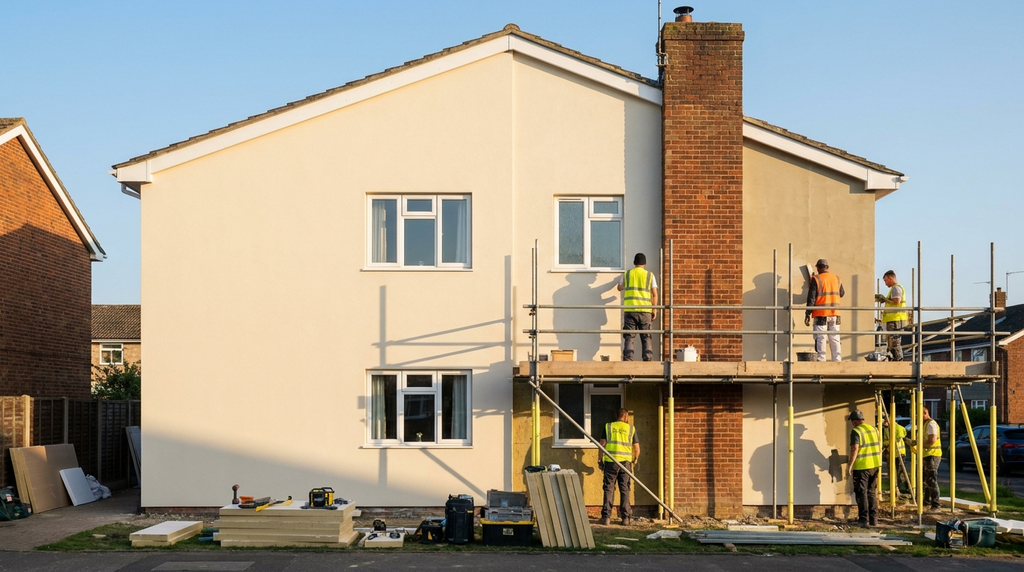
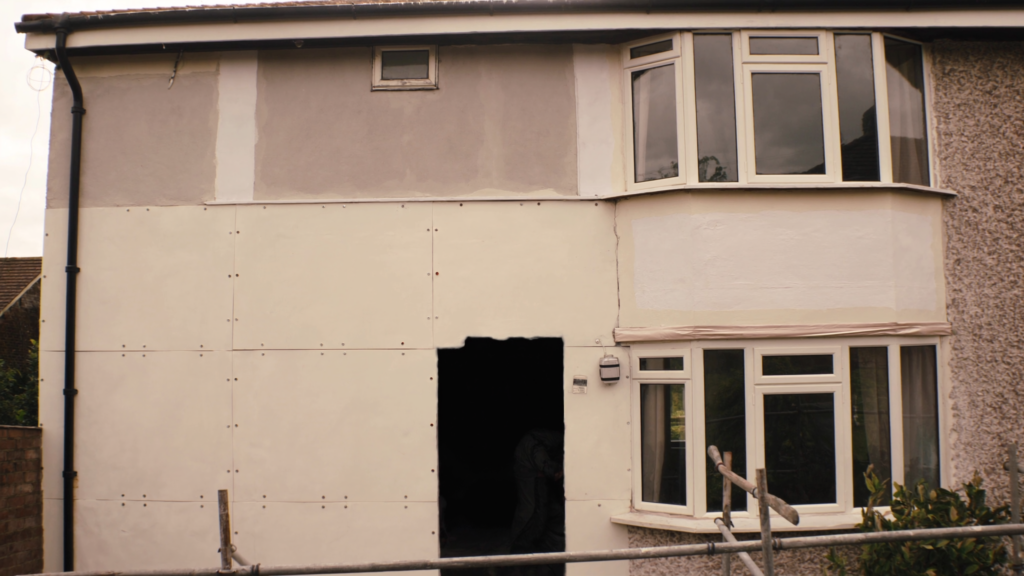
A 0.30 W/m²K wall and a 0.16 W/m²K roof can save you around £250–£350 a year in heating costs compared to an uninsulated home.
If you are researching home insulation, you will see the term “U-value” everywhere. It is the single most important number for understanding how much heat your walls, roof, and floors are losing.
A lower U-value means slower heat loss. A 0.30 W/m²K wall loses roughly half the heat of a 0.60 W/m²K wall. For a typical semi-detached home, upgrading from a 0.60 wall to a 0.30 wall and a 0.16 roof can save between £250 and £350 per year on heating bills (Energy Saving Trust, 2026). This article explains how these numbers work, what the legal requirements are, and how to check your installer’s calculations.
The legal minimum U-values for new homes and extensions in 2026
Building Regulations Part L sets maximum U-values for all new homes and extensions in England. The 2026 edition of Approved Document L requires the following maximum U-values for new dwellings:
- Walls: 0.18 W/m²K
- Roofs: 0.11 W/m²K
- Floors: 0.13 W/m²K
These limits are set out in Table 4.2 of the Approved Document (GOV.UK, 2026). Any extension or loft conversion must meet the same standards unless there is a material change of use (such as converting a garage into a habitable room). The Great British Insulation Scheme closed on 31 March 2026. It funded insulation measures only and never covered windows or glazing.
How to read a U-value certificate from an insulation product
Every insulation product sold in the UK comes with a certificate showing its “declared” or “design” U-value. This number is given in watts per square metre per degree Kelvin (W/m²K). The certificate also lists the insulation layer thickness and the material’s thermal conductivity, called the lambda value (λ).
Lambda is the key to comparing materials. A lower lambda means better performance per millimetre of thickness. For example, PIR foam has a lambda of around 0.022 W/mK, while mineral wool is around 0.044 W/mK. That means you need roughly twice the thickness of mineral wool to achieve the same U-value as PIR. The certificate should be issued by the British Board of Agrément (BBA) or a European Technical Assessment (ETA) (BBA, 2026).
Quick numbers – U-values for common insulation materials and thicknesses
The table below shows typical lambda values and the thicknesses needed to meet the 2026 Building Regulations targets. Costs are approximate and vary by supplier and region.
| Material type | Typical lambda (W/mK) | Thickness for 0.18 wall (mm) | Thickness for 0.11 roof (mm) | Approximate cost per m² |
|---|---|---|---|---|
| Mineral wool | 0.044 | 150 | 250 | £15–£25 |
| PIR board | 0.022 | 80 | 130 | £30–£45 |
| EPS | 0.038 | 130 | 210 | £20–£35 |
| Wood fibre | 0.040 | 140 | 230 | £25–£40 |
| Spray foam | 0.028 | 100 | 160 | £40–£60 |
These figures are based on manufacturers’ datasheets (e.g., Kingspan, Celotex, Knauf, Rockwool) and MCS installation standards (MCS, 2026). Your installer must use the exact lambda for the product they install, not a generic average.
You need a U-value of 0.18 W/m²K for a wall to meet current Building Regulations
For new homes and extensions, the maximum U-value for external walls is 0.18 W/m²K under Part L 2026 (GOV.UK, 2026). What thickness does that mean in practice?
- Cavity wall: Typically requires 100–150 mm of cavity insulation or 90–120 mm of external wall insulation (EWI).
- Solid wall: Needs 80–100 mm of internal insulation (PIR) or 100–140 mm of external insulation.
The exact thickness depends on the material’s lambda value and the existing wall construction. A solid brick wall without insulation has a U-value of around 2.0 W/m²K. Adding 80 mm of PIR board brings that down to about 0.18 W/m²K. The installer must calculate this using the BRE U-value calculator or SAP 10.2 software (BRE, 2026).
How to verify your installer’s U-value calculations and certification
Before work starts, your installer should provide a U-value calculation for every element they plan to insulate. This calculation must match the product certificate and the installed thickness. You have the right to request this in writing.
For cavity wall insulation, check for a CIGA (Cavity Insulation Guarantee Agency) or BBA certificate. The Great British Insulation Scheme closed on 31 March 2026. It funded insulation measures only and never covered windows or glazing.
If the installer cannot produce a U-value calculation, do not proceed. The Energy Performance of Buildings Regulations require that any insulation work must be backed by a calculation showing it meets the required standard (GOV.UK, 2026).
What a single U-value number means for your heating bill
A U-value tells you how many watts of heat escape through one square metre of a building element for every degree of temperature difference between inside and outside. A 0.30 W/m²K wall loses 30 watts per square metre per degree of difference.
Take a typical semi-detached house with 100 m² of external wall area. On a winter day with an average 10°C temperature difference (20°C inside, 10°C outside), a 0.30 wall loses 3,000 watts per hour. Reducing the U-value to 0.18 cuts that loss to 1,800 watts per hour.
Over a 150-day heating season, that difference saves roughly 4,320 kWh. At the 2026 average electricity price of 27p per kWh (Ofgem typical domestic consumption values), the saving is around £300 (Ofgem, 2026). For a roof, the savings are similar because roof areas are generally smaller but the temperature difference is larger in winter.
The actual saving depends on your home’s size, heating system efficiency, and local climate. But the principle is straightforward: every 0.1 W/m²K reduction in your U-values cuts your heating bill by roughly 10–15% (BRE Domestic Energy Model, 2026).
How to compare insulation quotes and avoid common mistakes
Frequently Asked Questions
A U-value measures heat loss through a building element in watts per square metre per degree Kelvin (W/m²K). Lower numbers mean better insulation. The Energy Saving Trust states a 0.30 W/m²K wall loses half the heat of a 0.60 wall.
For new homes and extensions in England, 2026 Building Regulations Part L require walls to have a maximum U-value of 0.18 W/m²K (GOV.UK, 2026). Retrofits have no legal target but grants may set minimums.
A U-value certificate shows the declared U-value in W/m²K, insulation thickness, and the material's lambda value (thermal conductivity). A lower lambda means better performance per millimetre. Check the MCS or BBA certification for accuracy.
A good roof U-value for new builds is 0.11 W/m²K or lower (2026 Regs). For retrofits, aiming for 0.16 W/m²K can save around £250-£350 a year compared to an uninsulated home, per the Energy Saving Trust.
Yes, loft insulation products have a declared U-value. Building Regulations require new lofts to meet 0.16 W/m²K. For retrofits, 270mm of mineral wool typically achieves around 0.16 W/m²K, meeting Great British Insulation Scheme standards.