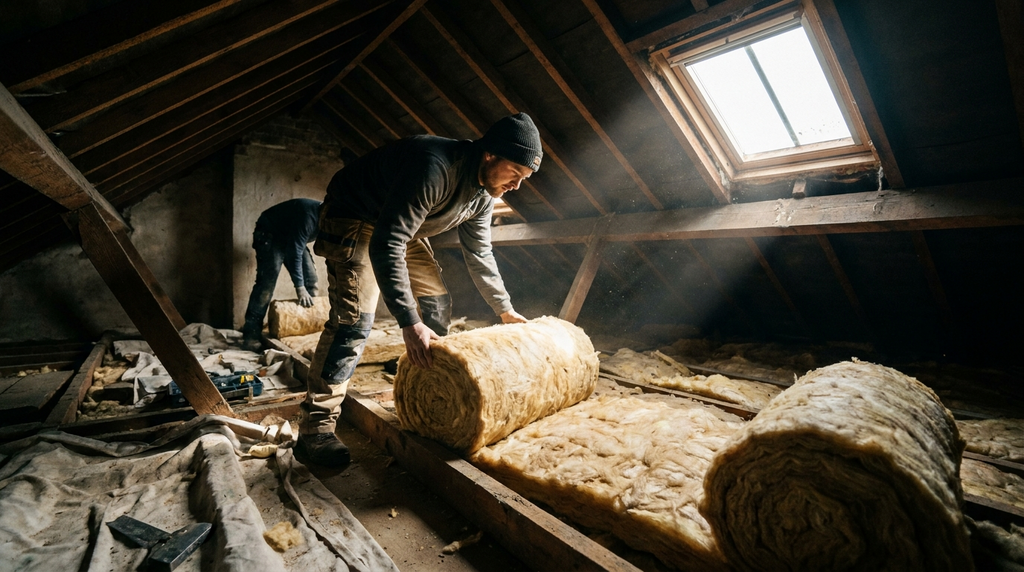
PIR boards and mineral wool insulate differently because they solve different problems
Polyisocyanurate (PIR) boards are rigid foam panels that resist heat flow using closed cells filled with a low-conductivity gas. Mineral wool, made from rock or glass fibre, traps air within a fibrous matrix and also provides acoustic damping and fire resistance. These two materials have fundamentally different thermal conductivities, which dictates where each is best applied.
PIR boards outperform mineral wool in thermal efficiency (0.022 vs 0.032–0.044 W/mK), needing less thickness for the same U‑value. However, mineral wool wins on fire resistance, sound damping, and cost. Choose based on your priority: space or safety.
- PIR lambda value is 0.022 W/mK vs mineral wool 0.032–0.044 W/mK (BBA certificates).
- PIR needs 140–150 mm for 0.18 U-value; mineral wool needs 200–250 mm (DESNZ 2026).
- Mineral wool provides superior fire resistance and acoustic damping.
- PIR boards suit thin-build retrofits where depth is limited.
- Mineral wool compresses under boarding; PIR can be walked on when covered.
- PIR boards and mineral wool insulate differently because they solve different problems
- PIR boards deliver higher thermal performance per millimetre than mineral wool
- Mineral wool provides superior fire resistance and acoustic performance
- Quick numbers key performance and cost differences for a typical 100 mm thickness
- PIR vs mineral wool which one is right for your home’s specific building element?
- PIR is the direct answer to “which insulation gives the highest R‑value per inch?” – but only if you don’t need fire or sound protection
- Eligibility for government grants depends on the property’s energy performance, not the insulation material
- You must verify the installer holds MCS certification and TrustMark registration before any grant-funded work begins
PIR typically achieves a lambda value around 0.022 W/mK, whereas mineral wool ranges from 0.032 to 0.044 W/mK, according to British Board of Agrément (BBA) certificates and the Standard Assessment Procedure (SAP 10.2) data tables from the Department for Energy Security and Net Zero (DESNZ, 2026). This means a thinner layer of PIR can meet the same U-value target as a thicker layer of mineral wool. The choice between them depends on the specific building element (roof, wall, floor), the available depth for insulation, and whether sound or fire performance is a priority.
PIR boards deliver higher thermal performance per millimetre than mineral wool
To achieve a typical building‑regulation U‑value of 0.18 W/m²K for a pitched roof, PIR boards require roughly 140–150 mm of insulation, whereas mineral wool needs 200–250 mm. This is based on U‑value calculation examples in DESNZ’s Building Regulations Approved Document L (2021 edition, updated 2026) (DESNZ, 2026).
The higher thermal efficiency of PIR means less build‑up depth, which can be critical in retrofit projects where room height or internal floor levels cannot be changed. Manufacturer technical datasheets for PIR (e.g., Kingspan Kooltherm, Celotex) and mineral wool (e.g., Rockwool, Knauf Earthwool) consistently show this thickness advantage. For homeowners insulating a loft that also needs storage space, PIR boards can be walked on when covered with boarding, whereas mineral wool would compress and lose performance.
Mineral wool provides superior fire resistance and acoustic performance
Mineral wool is non‑combustible, achieving Euroclass A1 or A2‑s1,d0 under BS EN 13501‑1, and acts as a fire barrier within building cavities. PIR boards are combustible (Euroclass E or F unless faced with a special fire‑retardant layer) and require fire‑resistant coverings in certain applications, such as cavity walls or roofs above habitable rooms, as specified in Approved Document B (DESNZ, 2026).
Mineral wool’s fibrous structure absorbs sound significantly better than rigid foam. For party walls and floors in dwellings, Approved Document E requires minimum acoustic performance levels that mineral wool meets readily, while PIR alone does not (DESNZ, 2026). Typical manufacturer test data shows mineral wool achieving a weighted sound reduction index (Rw) of around 40 dB, compared with roughly 25 dB for PIR of the same thickness.
Quick numbers key performance and cost differences for a typical 100 mm thickness
| Property | PIR board (100 mm) | Mineral wool (100 mm) | Source |
|---|---|---|---|
| Thermal conductivity (lambda) | 0.022 W/mK | 0.035 W/mK | BBA certificates; SAP 10.2 |
| U‑value achieved (typical, no other layers) | ~0.22 W/m²K | ~0.35 W/m²K | Calculated from lambda and thickness |
| Material cost per m² (2026 retail) | £25–£35 | £10–£18 | National Insulation Association price tracker; builders’ merchant list prices |
| Fire classification (Euroclass) | E (unless faced) | A1 | BS EN 13501-1 |
| Acoustic performance (Rw) | ~25 dB | ~40 dB | Manufacturer test data (e.g., Rockwool Sound Insulation Guide) |
PIR vs mineral wool which one is right for your home’s specific building element?
For a warm roof (insulation between rafters or above the roof deck), PIR is the industry standard due to its high thermal efficiency in limited depth; mineral wool is rarely used here because of the depth penalty. For a cold roof (insulation at ceiling level), mineral wool is common and cost‑effective, but PIR can be used if loft space is needed for storage, as PIR boards can be walked on when covered with boarding.
For internal wall insulation, PIR is preferred where room space is tight; mineral wool is used when soundproofing between rooms is also needed. For solid floors, PIR is typical below a screed; mineral wool is rarely used in floors because of compression and moisture sensitivity. The Domestic Building Services Compliance Guide (2026 edition) and NHBC Standards 2026 Chapter 8.1 provide detailed insulation thickness tables for each element (NHBC, 2026). How to choose insulation for each room in your home
PIR is the direct answer to “which insulation gives the highest R‑value per inch?” – but only if you don’t need fire or sound protection
If the primary goal is to achieve the best possible thermal performance in the thinnest possible layer, PIR boards are the market leader among common insulation materials. However, this advantage comes with trade‑offs: PIR is combustible, has poor acoustic performance, and costs significantly more per square metre than mineral wool. The “best” choice is therefore not PIR or mineral wool in isolation – it is the material that matches the building element’s performance requirements (thermal, fire, acoustic) and the available depth. DESNZ SAP 10.2 thermal conductivity tables and manufacturer fire‑safety technical bulletins confirm these characteristics (DESNZ, 2026).
Eligibility for government grants depends on the property’s energy performance, not the insulation material
The Great British Insulation Scheme closed on 31 March 2026. It funded insulation measures only and never covered windows or glazing. Neither scheme specifies that a particular material (PIR or mineral wool) must be used; the installer must meet the required U‑value and comply with Building Regulations. To check eligibility, homeowners must have an EPC (or a Green Deal Advice Report) and confirm their benefit status; the installer arranges the grant funding. The Great British Insulation Scheme closed on 31 March 2026. It funded insulation measures only and never covered windows or glazing. How to check if you qualify for free insulation grants
You must verify the installer holds MCS certification and TrustMark registration before any grant-funded work begins
The Great British Insulation Scheme closed on 31 March 2026. It funded insulation measures only and never covered windows or glazing. Without MCS certification, the grant cannot be claimed by the installer, and the homeowner risks being liable for the full cost. Homeowners should check the MCS Installer Database (MCS, 2026) and TrustMark website (TrustMark, 2026) to confirm the installer’s current status before signing any contract. OFGEM’s ECO4 Guidance: Delivery (version 4.0, 2026) confirms these requirements.
Frequently Asked Questions
PIR typically has a lambda value of 0.022 W/mK, while mineral wool ranges from 0.032 to 0.044 W/mK, according to British Board of Agrément certificates and DESNZ's Standard Assessment Procedure data (2026).
Mineral wool is better for soundproofing because its fibrous structure absorbs airborne noise and reduces flanking transmission, whereas PIR boards offer minimal acoustic damping.
To achieve a Uu2011value of 0.18 W/m²K, PIR boards need roughly 140–150 mm of insulation, based on DESNZ's Building Regulations Approved Document L (2021 edition, updated 2026).
Yes, mineral wool is nonu2011combustible and can withstand temperatures above 1000°C. That makes it ideal for fireu2011sensitive applications such as party walls and timber frames.
Yes, PIR boards can support foot traffic when covered with loft boarding, whereas mineral wool would compress and lose its thermal performance under weight.
Mineral wool is generally cheaper per square metre than PIR, but PIR's higher thermal efficiency may reduce overall material and labour costs by requiring a thinner layer.