A Heat Pump Can Replace Most Boilers, But the Economics Depend on Your Home’s Heat Loss and Existing System
If you are considering switching from a gas or oil boiler to a heat pump, the first question is whether the technology can physically work in your home. The core requirement under the MCS 020 standard is that your home’s total heat loss at -3°C must be lower than the heat pump’s maximum output at that same outdoor temperature (MCS, 2026). In plain terms, the heat pump must be capable of keeping the house warm on the coldest day of the year.
Heat pumps are most cost-effective in homes with a heat loss below 8–10 kW. Larger losses, say 15–20 kW, are still possible but require a bigger, more expensive unit and almost certainly need radiator upgrades. The key efficiency metric is the Seasonal Coefficient of Performance (SCOP). A modern heat pump in a well-insulated home achieves a SCOP of 3.0–4.0, meaning for every 1 kWh of electricity you buy, you get 3–4 kWh of heat into your home (Energy Saving Trust, 2026). The upfront cost is the main barrier: a typical air-source heat pump installation in the UK costs £7,000–£13,000 after the Boiler Upgrade Scheme grant, compared with £1,500–£3,500 for a new gas boiler (Energy Saving Trust, 2026; MCS installer survey data).
Quick Numbers Cost, Running Cost, and Grant Comparison for a Heat Pump vs. Gas Boiler
The table below compares a typical air-source heat pump installation with a like-for-like gas boiler replacement for a three-bedroom semi-detached home. All figures are for 2026.
| Item | Heat Pump | Gas Boiler | Difference |
|---|---|---|---|
| Upfront cost (after BUS grant) | £7,000–£13,000 | £1,500–£3,500 | £5,500–£9,500 more for heat pump |
| Annual running cost (3-bed semi) | £900–£1,200 | £600–£800 | £200–£400 more per year for heat pump |
| Annual CO₂ savings | 1,500–2,000 kg | Baseline | ~70% reduction |
| Payback period (with BUS grant) | 5–10 years | N/A | Heat pump recovers cost in 5–10 years |
Running costs are based on the April 2026 Ofgem price cap, which sets electricity at 24.5p/kWh and gas at 6.0p/kWh (Ofgem, 2026). CO₂ savings use DESNZ emissions factors for grid electricity and natural gas (DESNZ, 2026). The payback period assumes a SCOP of 3.0 and current energy prices; without the grant, payback is typically 8–15 years.
The Boiler Upgrade Scheme Grant Is the Single Biggest Financial Lever for a Heat Pump Switch
The Boiler Upgrade Scheme (BUS) offers a flat-rate grant of £7,500 for an air-source heat pump installation in England and Wales. The grant is applied directly by your installer, so you do not handle the paperwork yourself (GOV.UK, 2026). Eligibility requires that you own the property, have a valid Energy Performance Certificate (EPC) with no outstanding recommendations for loft or cavity wall insulation, and use an MCS-certified installer.
The grant reduces the typical payback period from 10–15 years to 5–8 years, assuming a SCOP of 3.0 and current energy prices (DESNZ impact assessment, 2025). Scotland has a separate grant through Home Energy Scotland that can be combined with the BUS for up to £10,000 (Home Energy Scotland, 2026). guide to the Boiler Upgrade Scheme eligibility and application process
Your Existing Radiators Will Likely Need Upsizing for a Heat Pump to Work Efficiently
Heat pumps deliver lower flow temperatures (35–50°C) than gas boilers (60–80°C). To emit the same amount of heat into a room, radiators must be larger. A 40°C flow temperature requires radiators roughly 2–3 times larger in heat output than those designed for a 70°C flow (Energy Saving Trust, 2026; MCS 020).
A heat loss survey, which MCS-certified installers must carry out, determines whether your existing radiators are adequate. If they are not, you may need to replace some or all of them with larger models or install underfloor heating. Underfloor heating is ideal for heat pumps because it operates at 30–35°C, but retrofitting it is disruptive and costly, typically £3,000–£6,000 for a ground floor (NICEIC, 2026; Energy Saving Trust).
Hot Water Capacity Is a Real Concern – Expect a Smaller Hot Water Cylinder or a Longer Reheat Time
Heat pumps heat a hot water cylinder to 50–55°C, not the 60–65°C of a gas boiler. This means you get less usable hot water per litre (because you mix with more cold water) and reheat times are longer, typically 1–2 hours versus 20–30 minutes for a gas boiler (Energy Saving Trust, 2026; MCS 020).
A typical 200-litre cylinder is usually sufficient for a three-bedroom home, but if you have a large family or high hot water demand, you may need a 250–300 litre cylinder (MCS installer guidance, 2026). If your home currently has a combi boiler (no cylinder), you will need to install a new hot water cylinder and possibly a new airing cupboard, adding £1,000–£2,000 to the installation cost (Energy Saving Trust, 2026; MCS).
Space Requirements You Need a Suitable Outdoor Location and Indoor Space for a Cylinder
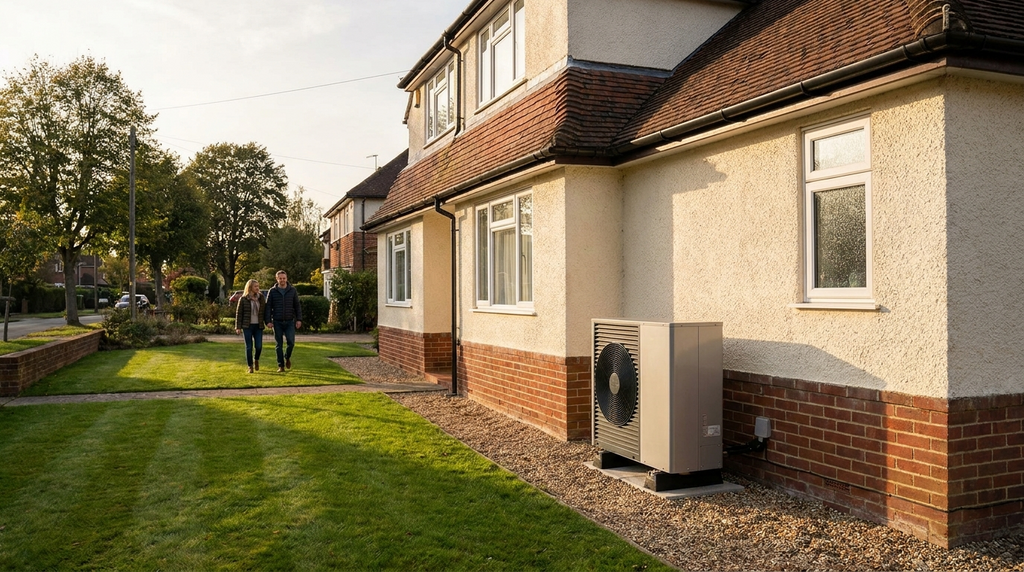
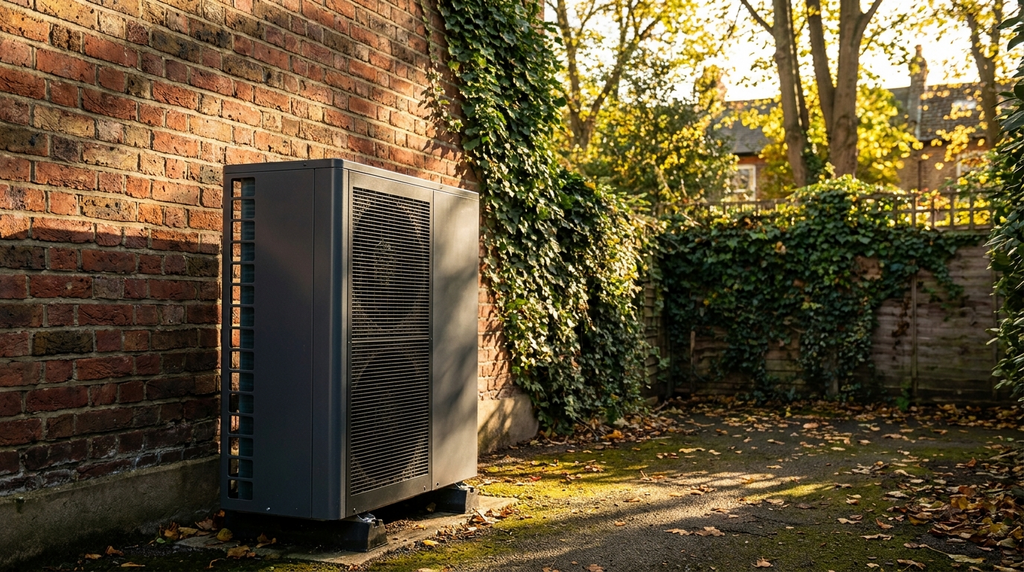
An air-source heat pump outdoor unit requires a flat, level, well-ventilated space, typically 1m x 1m, within 10–15 metres of the indoor unit. It must be at least 1 metre from windows and property boundaries (MCS 020, 2026; Building Regulations Part F). Indoors, you need a location for the indoor unit (approximately 60cm x 60cm x 30cm) and, if you do not already have one, a hot water cylinder (typically 55–65cm diameter, 150–180cm tall) (MCS installer guidance, 2026).
The outdoor unit produces noise, typically 60–65 dB at 1 metre. Building regulations limit noise to 42 dB at the nearest neighbour’s window (Building Regulations Part E; MCS 020). If your property has a narrow side passage or a shared garden, this can be a constraint.
How to Verify an Installer MCS Certification and TrustMark Are Non-Negotiable for the Grant
To claim the BUS grant, your installer must be MCS-certified (Microgeneration Certification Scheme). This is a legal requirement (GOV.UK, 2026). MCS certification ensures the installer follows MCS 020 standards for heat loss calculation, system sizing, and commissioning. You can check the MCS installer database at mcs-certified.com.
TrustMark registration is also required for BUS eligibility. TrustMark is a government-endorsed quality mark for tradespeople (TrustMark, 2026; GOV.UK). For gas boiler removal, you need a Gas Safe registered engineer (Gas Safe Register, 2026). For electrical work, an NICEIC or NAPIT registered electrician should sign off the new heat pump circuit (NICEIC, 2026; NAPIT, 2026). how to find and vet an MCS-certified heat pump installer
The Direct Answer Yes, a Heat Pump Can Replace Your Boiler, But Only If Your Home Has Low Heat Loss and You Can Afford the Upfront Cost
Yes, a heat pump can replace a gas or oil boiler in most UK homes, but it requires a lower heat loss (typically under 10 kW), larger radiators or underfloor heating, a hot water cylinder, and an outdoor unit. The average cost after the £7,500 BUS grant is £7,000–£13,000, with annual savings of £100–£300 on running costs if electricity prices fall, but payback takes 5–10 years (Energy Saving Trust, 2026; MCS 020, 2026; GOV.UK, 2026; Ofgem, 2026).
Frequently Asked Questions
Yes, a heat pump can replace a gas boiler in most UK homes. The MCS 020 standard requires your home's heat loss at -3°C to be lower than the heat pump's maximum output, according to MCS guidelines.
Replacing a boiler with an air-source heat pump costs £7,000-£13,000 after the Boiler Upgrade Scheme grant, compared to £1,500-£3,500 for a new gas boiler, based on Energy Saving Trust data.
Heat pumps work best with larger radiators or underfloor heating because they operate at lower flow temperatures. You may need to upgrade radiators, especially in homes with heat loss over 8-10 kW, as advised by MCS installers.
A typical heat pump installation takes 3-5 days, including indoor unit setup, outdoor unit placement, and pipework connections. This is longer than a gas boiler swap, which often takes 1-2 days, according to MCS installer surveys.
No, a heat pump is typically £200-£400 more per year to run than a gas boiler for a 3-bed semi, based on Energy Saving Trust data. However, it reduces CO₂ emissions by about 70%.