What the permitted development noise limit means for your property
Permitted development rights allow you to install an air source heat pump without a full planning application, provided you meet specific conditions. The key noise condition in England is that the heat pump must not exceed a rating of 42 dB LAeq at the nearest neighbouring habitable window, such as a bedroom, living room, or kitchen window (GOV.UK, 2026).
This limit applies only if the heat pump is installed within one metre of your property boundary. If the unit is further than one metre from the boundary, the 42 dB limit is measured at the boundary itself, not at the neighbour’s window. The noise level must be calculated using the MCS 020 standard, which takes into account background noise and the heat pump’s specific sound power level (MCS, 2026).
If your installer cannot demonstrate compliance with this limit, you lose your permitted development rights and must apply for full planning permission. This is a common source of neighbour disputes and enforcement action.
Typical heat pump noise levels at 1, 5, and 10 metres
Modern air source heat pumps in the 8–12 kW range typically produce between 40 and 60 decibels when measured at one metre distance. This is comparable to a quiet refrigerator or a running dishwasher. Because sound follows the inverse-square law, it drops significantly as you move away. At five metres, the level falls to roughly 30–45 dB, and at ten metres it is around 25–35 dB (Energy Saving Trust, 2026).
Ground source heat pumps are quieter still, typically operating at 30–40 dB at one metre. They rarely trigger noise complaints or require planning permission for noise reasons. The difference is because ground source units have their compressor and fan components buried or housed in a less intrusive casing.
Manufacturer data varies. For example, a Mitsubishi Ecodan unit may show a sound power level of 58 dB, while a Vaillant aroTHERM may be around 55 dB. Your installer should provide the specific sound power level for the model they propose to install.
Quick numbers, noise, cost, and planning thresholds
| Item | Value | Source |
|---|---|---|
| Typical heat pump noise at 1 m (modern unit) | 40–60 dB | Energy Saving Trust, 2026 |
| Permitted development noise limit (at neighbour’s window) | 42 dB LAeq | GOV.UK, 2026 |
| Cost of a standard 8–12 kW air source heat pump (installed) | £7,000–£13,000 | Energy Saving Trust, 2026 |
| Cost of a noise-reducing enclosure or acoustic screen | £300–£1,500 | Industry supplier data |
| Typical planning application fee (if required) | £462 (England) | GOV.UK planning fees, 2026 |
When a heat pump installation requires full planning permission
Full planning permission is needed if your property is a listed building, located in a conservation area, or within a World Heritage Site. Exceptions apply for flats and commercial properties, but for most homeowners in these areas, a full application is mandatory (GOV.UK, 2026).
Permission is also required if the heat pump unit exceeds 0.6 metres in height above ground level, or if the total installed microgeneration capacity exceeds 45 kW thermal. Most domestic installations are well under this capacity, so the height limit is the more common trigger.
If you live in a conservation area, your local authority may also impose additional conditions on siting, colour, and screening. Check with your council before ordering equipment.
How to verify your installer meets the noise compliance rules
Your installer must be MCS-certified to claim the Boiler Upgrade Scheme (BUS) grant and to certify that the installation meets permitted development noise limits. The MCS certificate includes a noise assessment report under the MCS 020 standard, which proves compliance with the 42 dB limit (MCS, 2026).
Keep this certificate for any future neighbour dispute. If your installer cannot provide an MCS 020 noise assessment, they are not complying with permitted development requirements. TrustMark registration is also required for BUS grant eligibility, but noise compliance is specifically an MCS responsibility (GOV.UK, 2026).
Ask your installer for the sound power level of the proposed unit and the calculated noise level at the neighbour’s nearest window before work begins. How to choose an MCS-certified heat pump installer
What the 42 dB limit means in practice (plain-English answer)
A heat pump running at 42 dB is about as loud as a quiet conversation or a running refrigerator from one metre away. It is noticeable but not disruptive if positioned away from bedrooms. The limit is measured at the nearest neighbour’s window that is most likely to be open, such as a living room or bedroom window. If your heat pump is on the opposite side of your house, it may not affect them at all (GOV.UK, 2026).
If you cannot meet the 42 dB limit, you must apply for full planning permission. This process may involve a noise impact assessment and possible conditions, such as acoustic screening, time-of-day restrictions, or relocation of the unit. The planning fee in England is £462 as of 2026 (GOV.UK planning fees, 2026).
The 42 dB limit is not a maximum sound level. It is an average over a period, so short-term peaks above 42 dB are allowed as long as the average stays below the limit.
Costs of noise mitigation if your heat pump is too loud
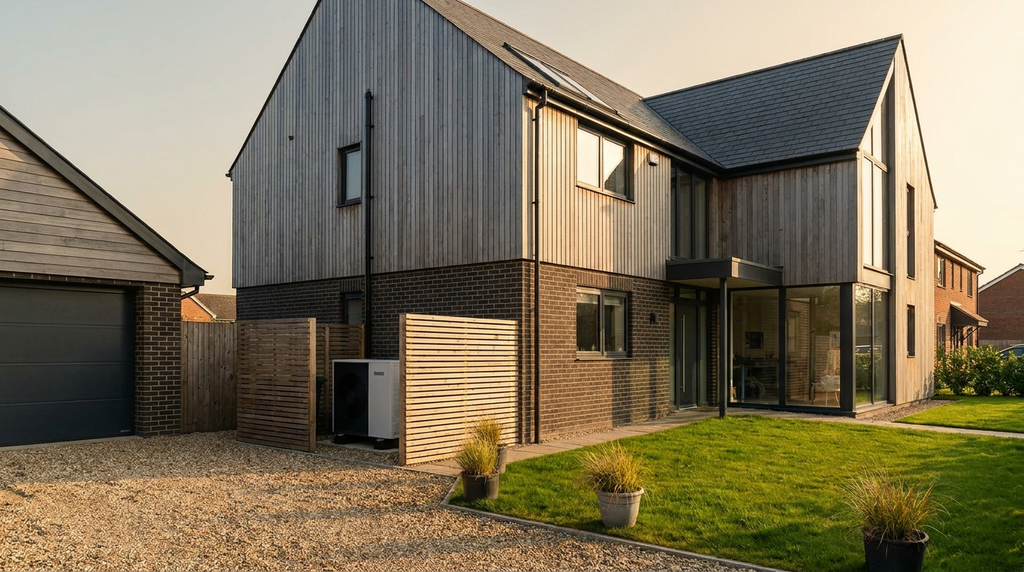
Acoustic enclosures, such as a full box or half-height screen, cost between £300 and £1,500. They can reduce noise by 5–10 dB, but must not block airflow or cause overheating. Any enclosure must be built to allow adequate ventilation for the heat pump to operate efficiently.
Repositioning the unit further from the boundary costs nothing beyond potential pipework and labour changes, but can reduce noise by 3–6 dB simply by increasing distance. Moving the unit just two or three metres away can make a significant difference.
If the unit still exceeds 42 dB, you may need to install a quieter model, such as a premium inverter unit, or apply for full planning permission at a cost of £462. A quieter model may add £500–£2,000 to the upfront cost but avoids ongoing noise issues.
How to check your local authority’s noise enforcement rules
Each council has its own enforcement policy under the Environmental Protection Act 1990. Some councils apply stricter limits than the permitted development standard, such as 40 dB for night-time operation (Environmental Protection Act 1990).
You can check your local council’s website for “statutory noise nuisance” guidance, or call their environmental health department for a pre-application inquiry. They can tell you if your proposed installation is likely to trigger enforcement action.
If a neighbour complains, the council can serve a noise abatement notice. This may require relocation, screening, or removal of the heat pump. To avoid this, ensure your installer completes an MCS 020 noise assessment and keeps the certificate on file. How to resolve a neighbour dispute over a heat pump installation
Frequently Asked Questions
The maximum noise limit under permitted development is 42 dB LAeq measured at the nearest neighbouring habitable window, per GOV.UK (2026). If the heat pump is more than one metre from the boundary, the limit applies at the boundary instead.
No, if your heat pump meets the 42 dB noise condition and other permitted development rules. If it exceeds this limit, you must apply for full planning permission, according to MCS (2026).
Modern air source heat pumps (8–12 kW) typically produce 40–60 dB at one metre, similar to a quiet refrigerator or dishwasher, based on Energy Saving Trust (2026). At five metres, this drops to 30–45 dB.
Yes, ground source heat pumps operate at 30–40 dB at one metre, which is quieter than air source models. They rarely trigger noise complaints or require planning permission for noise reasons, per Energy Saving Trust (2026).
Yes, if your heat pump exceeds 42 dB at their habitable window, it may breach permitted development rights and lead to enforcement action. Compliance with MCS 020 standard is essential to avoid disputes, as noted by GOV.UK (2026).