Why this matters
You know that moment when you walk into a room and something feels just slightly off? The sofa is good, the rug works, the colour on the walls is lovely, but the whole thing refuses to settle. Nine times out of ten, it’s the curtains. More specifically, it’s the length of the curtains. A hem that hovers awkwardly between floor and sill, or a panel that stops two inches above the skirting board, is the fastest way to make a carefully considered room look like an afterthought. And here’s the thing that should cheer you up: getting it right costs absolutely nothing. You don’t need new fabric, new poles, or a new budget. You just need to let the hemline do its job.
The hemline rule that changes everything
There is one rule that trumps all others, and it’s deceptively simple: a curtain’s hem should feel intentional. Not accidental. Not “I ran out of fabric.” Not “the rail was already up.” Intentional. That means you choose a length, floor, puddle, or sill, and you commit to it fully. The most common mistake is the half-hearted hover: a curtain that stops an inch above the floor but isn’t short enough to be a true sill-length. It looks like the curtain gave up.
Floor-length curtains that just kiss the floor, barely touching, no break, no fold, are the universal workhorse. They anchor a room, make ceilings feel higher, and suit almost every window style from a Victorian sash to a modern casement. Sill-length curtains, on the other hand, are practical heroes. They’re perfect for windows above radiators, sinks, or deep sills where fabric pooling would be a hazard or a nuisance. The key is to make the choice deliberate, not default.
Let the window shape dictate the drop
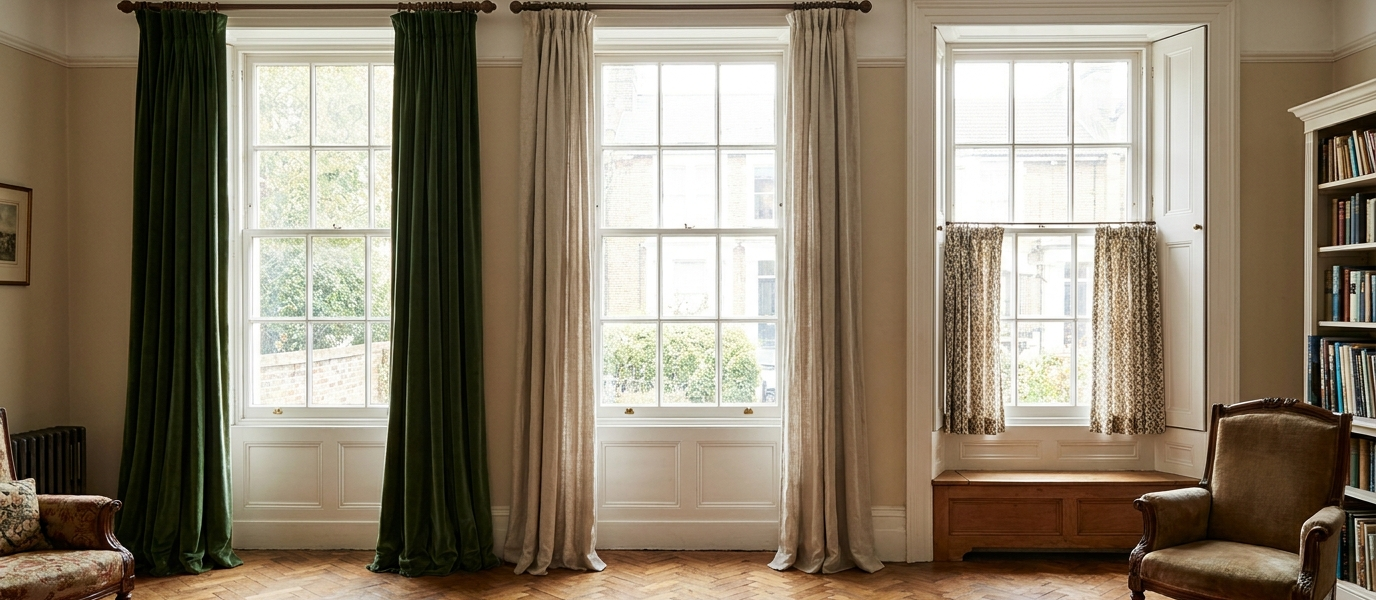
Your window is the starting point, not your personal taste. A tall sash window, the kind you find in a Georgian terrace or a Victorian conversion, is built for drama. It wants length. Floor-length panels that break slightly on the floor create a vertical line that makes the ceiling feel higher and the room feel grander. Don’t fight it with sill-length curtains; they’ll make the window look stunted, like a tall person in a too-short coat.
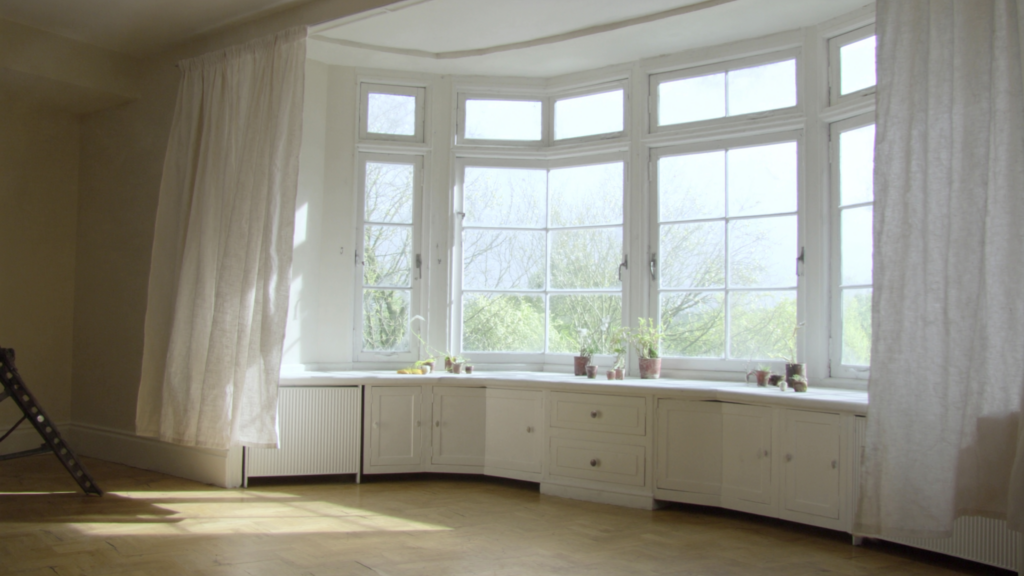
Wide casement windows with low sills are a different story. Here, sill-length curtains can work beautifully, especially in a kitchen or bathroom where you need to keep the sill clear and the fabric away from moisture. The trick is to measure precisely: the hem should hover just above the sill, no more than half an inch. Anything higher looks like the curtain shrunk in the wash. Bay windows need extra care, each section may require its own drop to avoid a sagging middle that makes the whole thing look tired.
The puddle romantic, but not for every room
Let’s talk about the puddle. That deliberate two to four inches of fabric pooling on the floor is undeniably romantic. It’s the kind of curtain you see in a formal living room or a master bedroom in a period property, where the fabric, usually a heavy velvet or a substantial linen, gathers like a silk gown at a ball. It reads as luxurious, slightly decadent, and completely intentional.
But here’s the honest truth: a puddle is not for every room. In a high-traffic hallway, a kitchen, or any space where the vacuum cleaner visits daily, that pool of fabric will collect dust, trip the dog, and drive you quietly mad. Homes with pets or small children should probably skip it entirely, fur and paw prints cling to pooled fabric in a way that feels less “design statement” and more “laundry emergency.” The fabric matters too: velvet and heavy linen hold a puddle beautifully, folding into soft, organic shapes. Cotton or polyester blends just look messy, like the curtain fell off the rail and you couldn’t be bothered to fix it.
Sill-length practical, not apologetic
Sill-length curtains have a bad reputation, and it’s largely undeserved. They’re not a compromise; they’re a solution. They’re perfect for windows above sinks, worktops, or radiators where fabric must not block heat or access. In a small bathroom, a sill-length curtain in a light linen can make the room feel airy without the bulk of floor-length fabric pooling in a damp space.
The key is precision. The hem should hover just above the sill, no more than half an inch. Any higher and the curtain looks like it’s shrinking away from the window. Pair it with a Roman blind or a layered sheer underneath for depth without bulk. And choose a fabric with a little weight: a crisp cotton or a linen-cotton blend will hold its shape and hang cleanly, while a flimsy polyester will look apologetic.
Six ways to soften a tall sash window
- Hang the rod high, almost at ceiling height, to lengthen the vertical line and make the window feel taller.
- Use full-length curtains that just kiss the floor, no break, no puddle, just a clean, precise hem that touches the floor like a whisper.
- Choose a lighter-weight fabric, a soft linen or a cotton slub, so the curtains hang straight rather than billowing into awkward folds.
- Add a subtle lining for weight without stiffness; a blackout lining in a neutral tone gives the fabric enough body to hang well.
- Consider a single panel pulled to one side, asymmetry draws the eye up and adds a relaxed, contemporary feel.
- Avoid heavy tie-backs that interrupt the clean vertical drop; if you need to hold curtains back, use a discreet magnetic tie or a simple hook.
Why texture matters more than colour
Here’s something that surprises most people: the hemline of your curtain reads differently depending on the fabric’s weight and weave, not just its colour. A linen or cotton slub fabric has a soft, organic edge that makes a slight puddle look natural, almost as if the fabric settled there of its own accord. That same puddle in a crisp cotton or a silk will look sloppy, like the curtain maker misjudged the drop.
Crisp fabrics demand precision. If you’re using a smooth cotton, a polished linen, or especially a silk, the hem needs to be exact, floor-length with no break, or a deliberate puddle that you’ve measured to the millimetre. Never in between. The texture of the fabric is what communicates intent. A soft, slubby linen says “I meant to do that.” A crisp cotton hovering an inch above the floor says “I was in a hurry.”
Pick a colour that softens with the seasons
Colour affects how the hemline reads. A neutral curtain, think oatmeal, stone, mushroom, or a soft Farrow & Ball Drop Cloth, allows the hemline to become a subtle architectural detail rather than a statement. The eye passes over the colour and lands on the line, the fold, the way the fabric meets the floor. That’s a good thing. It makes the room feel settled.
Deeper colours, charcoal, forest green, navy, make the hemline more visible. The contrast between the dark fabric and the floor draws attention to the drop, so you need to get it exact. A deep navy curtain with a sloppy hem is far more noticeable than the same mistake in a pale oatmeal. Patterned curtains distract from the hemline entirely, which can be useful if your floors are uneven or your window is a quirky shape. If the pattern is bold, floor-length with a clean break is the safest bet, it lets the pattern do the work without the hemline competing.