A window’s second chance
Low January sun slants across a kitchen table, catching the edge of a mirror propped on the far wall. For a moment, the light doubles, a pale gold stripe that stretches across the ceiling before the afternoon fades. It’s a small magic, but one that changes how you see the room.
Mirrors are rarely treated as optical tools, yet in a British home, where daylight is precious, windows face north, or neighbours loom uncomfortably close, they are exactly that. You learn to read light differently when you understand how a mirror works. Suddenly, a dark corner becomes the warmest spot in the room, and a narrow hallway feels wider than its floorplan suggests.
The geometry of borrowed daylight
A mirror placed opposite a window does more than reflect, it creates a second source of light. The room’s effective aperture widens, and the eye registers a brighter, more spacious interior before the brain catches up. The trick is angle. Tilt the mirror slightly upward, and it catches ceiling light, throwing it downward to soften shadows on a dining table or a reading chair.
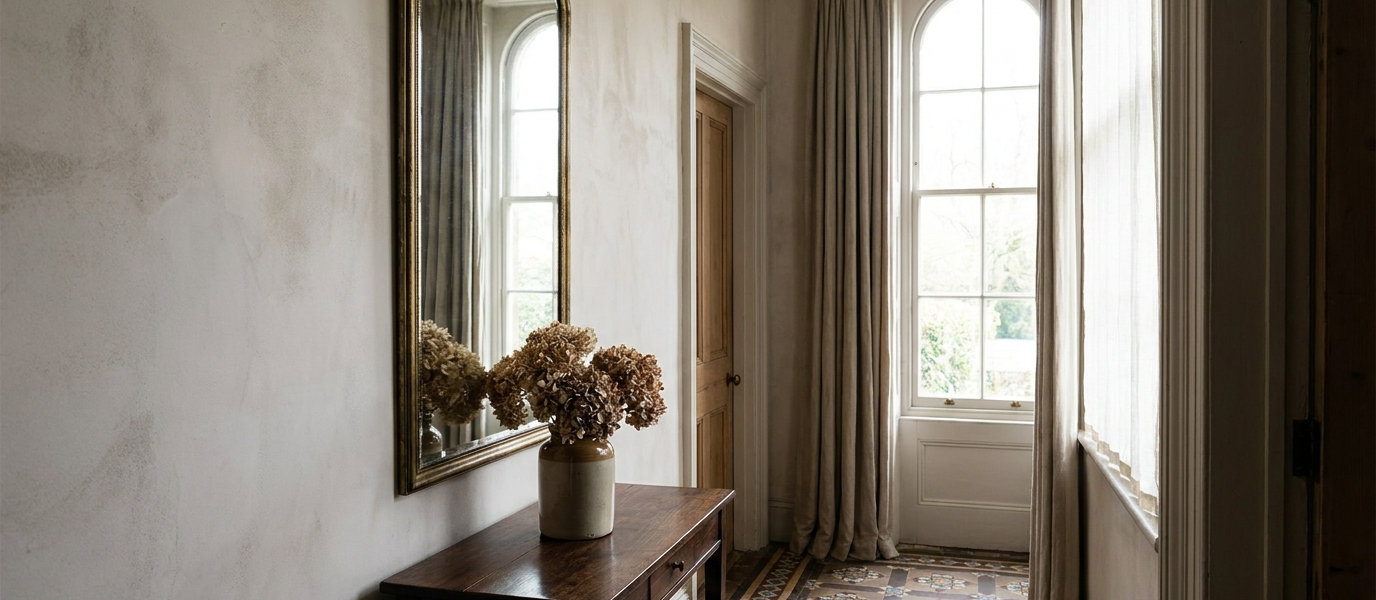
In period properties with tall sash windows, a floor-length mirror opposite the lower pane balances the vertical light beautifully. The reflection pulls the window’s glow down to floor level, where it would otherwise fall short. It’s a quiet piece of geometry that costs nothing to run and never flickers.
Three positions that change everything
Not all placements are equal. Here are three that consistently deliver more than you’d expect:
- Flanking a window with two narrow mirrors. This amplifies lateral light, especially in rooms with casement windows where the light enters from one side. The mirrors catch the spill and push it back into the room.
- Hanging a mirror between two windows. A single reflection unifies the light pool, bridging the gap where your eye expects darkness. This works brilliantly in Victorian bay windows with a chimney breast between them.
- Placing a mirror behind a lamp. The warm glow bounces outward, doubling the lamp’s reach without adding wattage. It’s the cheapest dimmer switch you’ll ever own.
Mirror reflected light behaves like water, it spreads, softens, and fills gaps the eye expects to be dark. Position it right, and you barely notice the mirror itself.
Frame matters more than you think
The frame is the transition between the mirror’s illusion and the room’s reality. A dark frame holds the reflection inside, containing it like a picture. A light frame, pale wood, silver, or unframed bevel, lets the light bleed outward, merging with the wall.
Unframed or beveled mirrors work best in rooms with minimal window trim, where you want the reflection to feel like an extension of the glass. Ornate frames suit period glazing, a gilded oval opposite a Georgian sash echoes the window’s proportions without competing. But be warned: a heavy dark frame in a small room with single-glazed windows absorbs the very light you’re trying to multiply. If the frame costs more than the mirror, you’ve probably chosen wrong.
door colour ideas, the same principle applies to paint: light frames need light walls to sing.
The trick of the opposite wall
The most powerful placement is rarely the obvious one. A mirror on the wall perpendicular to the window catches sidelong light and creates depth without glare. This is the quietest sleight of hand in interior design: light borrowed from a room you’re not standing in.
It works especially well in narrow hallways or kitchens where the window is at one end. The mirror pulls the light around the corner, making the space feel longer and more generous than its square footage. You walk through and catch a glimpse of brightness where there should be shadow, the brain reads it as another room, another source of daylight.
In a 1930s suntrap bay, a mirror on the side wall catches the morning light that slides past the window frame, throwing it across the room’s darker half. It’s a trick that costs nothing but repositioning.
When the window is the problem
Sometimes the window itself is the limitation, obscured glass in a bathroom, deep reveals that swallow the light, or a view of a brick wall. In these homes, a mirror opposite the window reflects the available light rather than the view, effectively replacing the window’s purpose.
This is where mirror reflected light becomes a genuine design solution, not just a trick. It rescues a room from its own architecture. A well-placed mirror in a north-facing kitchen can make the space feel bright enough for breakfast at any hour, even when the sky outside is stubbornly grey.
window film ideas, for obscured windows, a mirror opposite can double the light while the film handles the privacy.
Layering with glazing and glass
The quality of the reflected light depends on the window glass itself. Double or triple glazing reduces distortion and trues up colour, so the reflection feels sharper and more natural. A mirror works best when the window is clean and clear, fogged or old glazing mutes the effect, softening the edge of the reflection until it feels muddy.
The quietest luxury in any home is a room that feels brighter than the sky outside. A well-placed mirror is the only tool that never needs a bulb, never flickers, and never adds to your electricity bill. It simply catches what’s already there and hands it back, doubled. That’s a trick worth learning.