The draught that started it
There is a particular cruelty to the cold spot in a period home. You know the one, the invisible finger that finds the gap between skirting and floorboard, or the draught that curls around a sash window at four in the afternoon, just as you’ve settled into the sofa. You stuff a rolled-up towel against the sill, and for a moment, you feel clever. But the real question, the one that nags, is what to do about it that doesn’t involve a lorry-load of pink fibreglass and a weekend of itchy misery.
The answer, it turns out, is something you might actually want to look at. The shift in thinking about insulation, from a hidden necessity to something that improves how a room feels and looks, is not a trend. It is a quiet return to older instincts, when a wall’s surface was part of the room’s character, not a problem to be plastered over. And the materials leading this change are not new; they are wool, hemp, and lime, and they have been doing this work for centuries.
A texture you want to touch
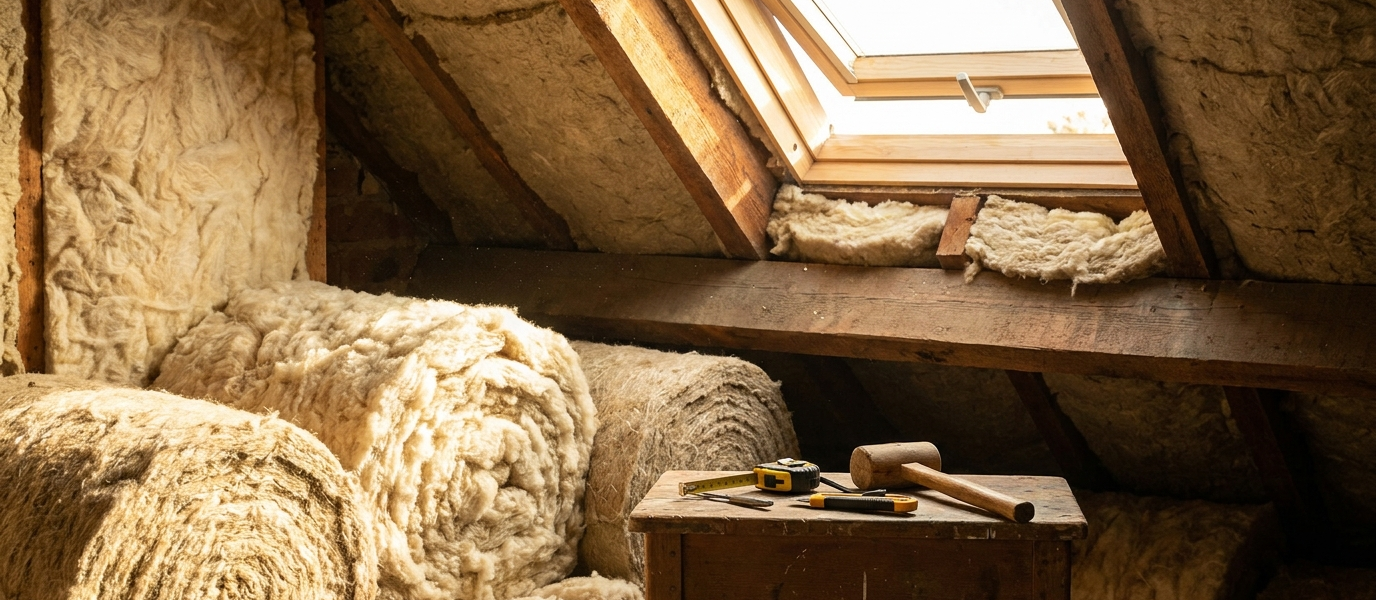
Walk into a loft space where sheep’s wool batts sit between the rafters, left exposed rather than hidden behind plasterboard. The effect is immediate. The wool’s natural crimp gives it a cloud-like softness, a visual warmth that no synthetic slab can mimic. The light catches the fibres differently depending on the angle, a soft, honeyed glow in the morning, a deeper ochre in the evening. And the sound. The room absorbs noise in a way that feels less like silence and more like a held breath.
This matters. When insulation feels good to the touch, you stop wanting to cover it up. A friend who recently renovated a 1930s semi left a section of sheep’s wool visible behind a sheet of toughened glass in the hallway. “It’s like a landscape,” she said, “the way the light moves through it.” She was right. It is not a technical feature; it is a texture that changes the atmosphere of the room.
Hemp’s quiet structure
Move now to a wall being built with hemp-lime render. The mix is poured into a timber frame, tamped down, and left to dry. What emerges is a surface that is pale, stone-like, and faintly irregular. Run your hand across it and you feel the subtle grain of the hemp shiv, the woody core of the plant, and the soft give of the lime binder. It is not smooth. It is not uniform. And that is precisely its point.
Compare this to the sharp, sterile lines of synthetic insulation boards. Hemp breathes. It regulates moisture, holds warmth, and its subtle variations in tone and texture become part of the room’s character. A wall finished in hemp-lime does not look like a wall that has been insulated; it looks like a wall that has been made. The colour is a pale flax-grey, warm in the morning, cooler in the afternoon, never the same twice.
Pick a colour that softens with the seasons
The natural palette of these materials is not a limitation, it is a gift. Cream, flax, warm grey, the soft ochre of raw hemp. These colours shift with the light in a way that static white fibreglass never can. A sheep’s wool batt in a north-facing room will read as a deeper, more golden tone than the same wool in a south-facing loft. A hemp-lime wall in winter catches the low sun and glows; in summer, it recedes into cool shadow.
Consider leaving a section of insulation visible behind glass or in a recessed niche. Treat it as a design element that changes with the day. A deep window reveal lined with sheep’s felt, for instance, softens the light that enters the room, turning a harsh afternoon glare into a gentle diffusion. The colour is not a choice you make once; it is a relationship you live with, season to season.
Why texture matters more than colour
Step into a room where a lime-hemp wall has been left unfinished, no plaster, no paint, just the material itself. The surface is uneven, slightly rough, absorbing light rather than reflecting it. It does not glare at you. It does not demand attention. Instead, it makes the space feel deeper, quieter, more settled.
Modern interiors have forgotten the pleasure of a wall you can rest your palm against. We have become accustomed to surfaces that are smooth, flat, and indifferent. But a wall that retains its texture, the grain of the hemp, the softness of the wool, the faint undulation of the lime, invites a different kind of engagement. It is tactile. It is present. It reminds you that the room is made of something real, not just a series of surfaces to be decorated over.
Eight ways to soften a tall sash window
Tall sash windows are the glory of a period home and its greatest source of heat loss. Here are eight small interventions using natural insulation materials that change the light, the sound, and the edge of the room, without hiding the window itself.
- Wool-wrapped window seat. Line the deep sill with sheep’s wool batts, then cover with a breathable linen cushion. The wool muffles street noise and keeps the seat warm even on cold days.
- Hemp-lime reveal. Fill the deep internal reveals with hemp-lime, then paint with a breathable clay paint in a soft, warm white. The texture remains readable beneath the paint, softening the transition between glass and wall.
- Sheep’s felt ledge. Cut a strip of dense sheep’s felt to sit on the window ledge itself. It catches condensation, adds a tactile edge, and can be lifted and aired when damp.
- Cork-filled pelmet. Build a simple wooden pelmet above the window and fill it with cork granules. The cork absorbs sound and reduces the echo that often accompanies tall windows in bare rooms.
- Hemp rope draught excluder. Twist a length of hemp rope into a coil and tuck it along the bottom of the sash. It looks like a decorative detail; it works like a seal.
- Lime plaster reveal. Replace a damaged plaster reveal with a lime-based mix. The lime breathes, preventing the condensation that rots timber sashes, and its soft, chalky surface catches the light differently to gypsum.
- Wool-filled curtain tie-backs. Stuff a fabric tube with raw sheep’s wool and use it to hold back a heavy curtain. The wool adds weight and a soft, organic shape to the window dressing.
- Felt-lined shutter panels. If you have internal shutters, line the back of each panel with a thin layer of sheep’s felt. The felt adds insulation and deepens the shadow when the shutters are closed, making the room feel cocooned.
The moment you decide not to cover it up
End in a room where the insulation is the wall. A finished hemp-lime surface, painted with a thin limewash, the texture of the hemp still readable beneath the colour. The room is warm, yes, but that is not the point. The point is that the wall does something. It holds the heat, softens the sound, and changes the light. It is not a problem that has been solved; it is a material that has been allowed to be itself.
The real gain of natural insulation is not a warmer room, though you will have that. It is a room that feels more like itself. A room where the structure is not hidden but expressed. Where the materials you live with are honest, tactile, and alive to the day. And where the cold spot that started it all, that draught, that nagging annoyance, becomes the thing that led you to a wall you want to rest your hand against.