The season that asks us to slow down
There’s a particular dimness that arrives around four o’clock on an October afternoon, the light turns the colour of old honey, and for a moment your living room looks like a painting. This is autumn’s real gift: not the countdown to winter bills, but a quiet invitation to reacquaint yourself with your home’s rhythms. The shift in temperature, the way a room feels when the heating hasn’t clicked on yet, the softness of a space that’s been left to its own devices, noticing this is the first act of autumn home preparation.
What follows isn’t a checklist of draught-proofing or boiler service reminders. It’s something more subtle: a guide to making your home feel like a sanctuary before the clocks change. Because the best preparation isn’t about fighting the season, it’s about leaning into it.
Let your front door do the heavy lifting
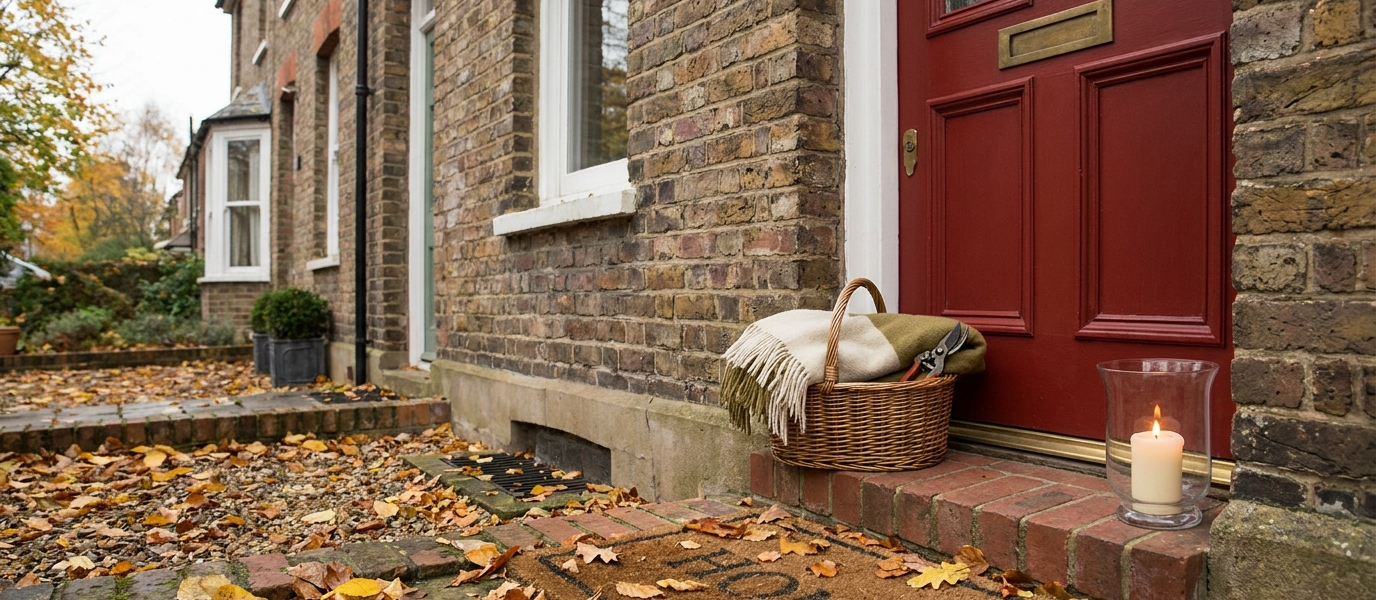
The entrance sets the tone for the entire season. A front door painted in a deep, weathered colour, think burnt umber, charcoal, or a forest green that’s almost black, signals warmth before anyone steps inside. Farrow & Ball’s Studio Green or Little Greene’s Rolling Fog work beautifully here, holding their own against the wet leaves and grey skies that are about to arrive.
But colour is only half the story. A simple draught excluder in a tactile fabric, a faded velvet, a chunk of wool, or a linen tube that looks like it belongs on a sofa, becomes a decorative object, not a utility. Lean it against the bottom of the door, and suddenly the entrance feels intentional. When you come home to a door that’s been thought about, the whole house exhales with you.
Pick a colour that softens with the seasons
Here’s something that surprises most homeowners: rooms painted in muted earth tones or chalky neutrals actually change character as autumn light fades. They grow cosier rather than colder. A wall in Farrow & Ball’s Setting Plaster pink or Little Greene’s Slaked Lime deep will feel warm and enveloping by November, whereas a crisp white can start to feel clinical when the sun disappears at 3:30pm.
You don’t need to repaint an entire room. Consider a single wall or an alcove in a rich ochre, clay pink, or slate grey, it will feel like a hug by the time the heating bills arrive. The real gain here is psychological: you stop fighting the season and start working with it. Your home becomes a place that welcomes grey skies rather than resenting them.
Why texture matters more than colour
A room can be entirely beige and still feel alive if you layer linen, wool, brushed cotton, and matte wood. This is the secret that interior designers know and most homeowners overlook: autumn home preparation isn’t about buying new things, it’s about pulling out the things you already own that feel like they belong to this moment.
Swap one throw, one cushion, and one rug. That’s enough to shift the energy without redecorating. A chunky knit blanket draped over the arm of a sofa, a velvet cushion in a deep rust, a wool rug that feels soft under bare feet, these three moves transform a summer room into an autumn one. The trick is to choose textures that want to be touched. If you wouldn’t run your hand over it, it doesn’t belong in an autumn room.
Eight ways to soften a tall sash window
Tall sash windows are the glory of a Victorian or Edwardian home, but they can feel draughty and exposed as the temperature drops. Here’s how to make them work for autumn without losing their charm:
- Hang curtains high and wide to frame the view of falling leaves rather than shrink it, the rod should sit just below the ceiling
- Use a roman blind in a nubby fabric for a clean, warm line that still lets light filter through
- Add a deep windowsill shelf for a row of candles or a single branch of dried eucalyptus
- Place a low stool or a pile of floor cushions beneath the window to create a reading nook that catches the last of the light
- Choose a curtain weight that moves with the breeze, heavy enough to block a draught, light enough to feel alive
- Install a simple wooden pelmet to hide the track and add architectural warmth to the frame
- Layer a sheer behind a heavier curtain so you can adjust light and privacy by mood
- Paint the window frame a tone darker than the wall to anchor the view and make the glass feel like a picture frame
The kitchen window as a seasonal frame
Treat the view from your kitchen sink as a living still life. A row of herbs on the sill, a single branch turning colour in a small vase, a bird feeder just outside, these cost almost nothing and change the room’s heartbeat entirely. The kitchen is where you spend the most time in autumn, standing at the sink, watching the light drain from the day. Make that view worth looking at.
Swap summer’s bright tea towels for darker, heavier ones in rust or indigo. Move a small vase of dried grasses or seed heads onto the sill. It sounds trivial, but it’s not. The kitchen window is the most-seen view in the house during autumn; treating it as a seasonal frame transforms the room from functional to soulful.
Let the hallway hold the season’s weight
The hallway is the room that welcomes you first, yet most of us treat it as a pass-through. Autumn is the season to change that. A console table with a bowl for gloves, a hook for a waxed jacket, and a place for wet boots makes coming home feel like a ceremony rather than an afterthought.
Use a deep-toned runner that hides mud but feels plush underfoot, wool or sisal with a stripe works beautifully. A dark charcoal or a deep burgundy will look intentional even when it’s been trampled by wet shoes. The gain here is psychological: when your hallway is set up to receive you properly, the rest of the house feels like a reward. You step inside, shed the outside world, and the season settles around you.
This is what autumn home preparation really means. Not a checklist, not a panic about energy costs, but a deliberate, gentle shift in how your home receives you. The best preparation is the kind that makes you want to stay in.