The Smell of a Damp Home and the Slow Steady Fix
You notice it first on a humid morning, just as you step through the front door. That particular mustiness, not quite mould, not quite rot, but something in between, settles in your throat before your eyes have even registered a thing. We diagnose our homes by sight first: a stain on the ceiling, a crack in the plaster, a corner where the wallpaper lifts. But the nose catches trouble long before the eyes do. That damp smell is not just an odour to mask with a plug-in diffuser. It is a language. And if you learn to listen to it, your home will tell you exactly what it needs.
This piece is about that conversation. It is about the slow, steady fix that does not begin with a dehumidifier or a can of anti-mould spray, but with a window latch, a hygrometer, and a willingness to let your house breathe on its own terms. Because the smell of damp is rarely a disaster. It is a message. And the answer is often simpler, and cheaper, than you think.
Let the air move before you spend a penny
The cheapest fix is the one you already own: cross-ventilation. Open two windows on opposite sides of a room for fifteen minutes each morning. That simple act shifts the entire microclimate of a house. It flushes out the moisture that has settled overnight, the breath of sleepers, the steam from a kettle, the damp that rises from a bathroom floor. You do not need a ventilation system. You need a breeze.
There is a difference between a stuffy room and a damp room, and your nose knows it. A stuffy room smells stale, flat, tired, like air that has been sitting too long. A damp room smells wet, heavy, clingy, with a note of wet wool or damp earth. Pause at the threshold and breathe deeply. Which one is it? If it is damp, the first move is not a scented candle. It is a window latch. That costs nothing and changes everything.
Place a simple hygrometer in the hallway, the most ignored room in the house. Hallways trap moisture from every room they connect, and they rarely get direct airflow. A hygrometer will show you where moisture is pooling, not just where you smell it. That data is the beginning of the fix.
The hidden reservoir what your walls are holding
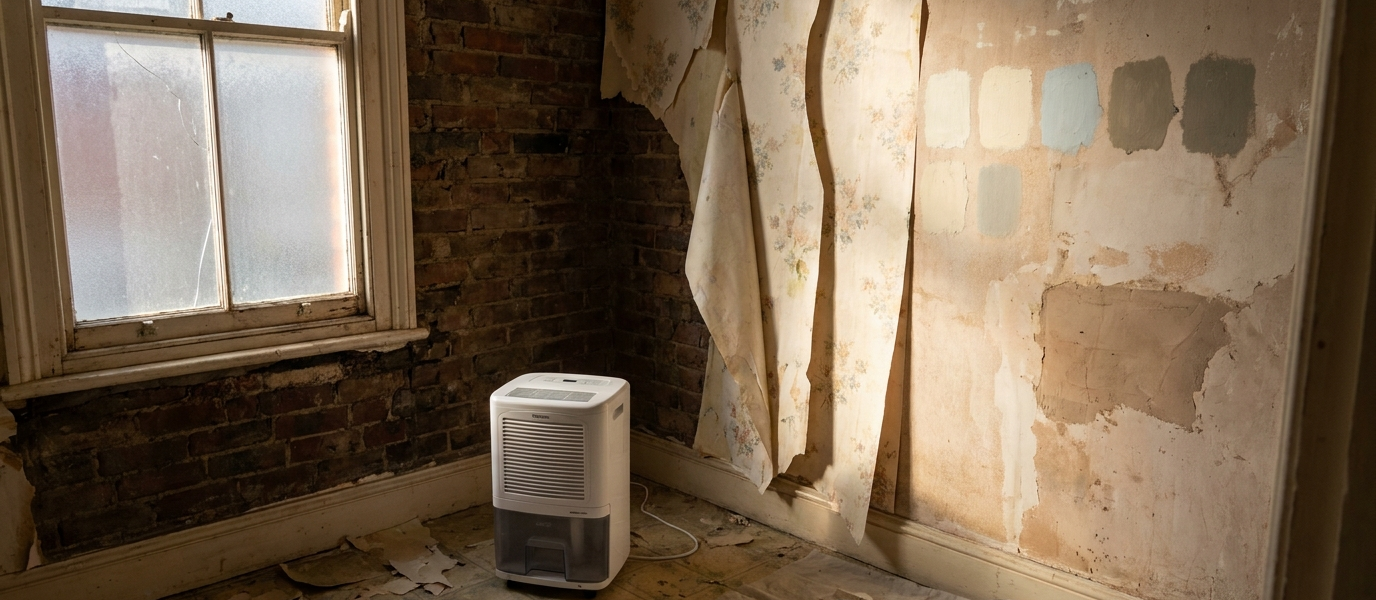
The smell of damp lingers because materials act like sponges. Plaster, brick, old lime render, they absorb moisture from a single wet season and hold it for months. A wall can look dry to the touch but still release that musty odour into the air, day after day, until the moisture has a way out.
This is where the age of your home matters. A Victorian terrace expects to breathe. Its walls are built with lime mortar and soft brick, built to let moisture evaporate slowly through the fabric. A 1980s cavity wall is the opposite, sealed, tight, with a vapour barrier that can trap moisture inside the wall cavity if it gets in. That trapped moisture becomes a slow-release odour that no dehumidifier can fully address. The fix depends entirely on which skeleton you are working with.
If you live in an older home, the answer is often to let the wall dry naturally. If you live in a modern one, the answer is to find the source of the leak and seal it properly. Either way, the wall is holding more than you think.
Eight ways to soften a tall sash window
Sash windows are the worst offenders for condensation and the musty smell that follows. They are beautiful, but they are cold, and cold surfaces attract moisture. Here are eight low-intervention ideas that do not ruin the sightline or require a full replacement:
- Add a discreet draught excluder that sits between the sashes, thin, felt-backed, invisible from the street.
- Fit a secondary glazing panel that can be removed in summer. It does not need to be permanent, just present when the air is heavy.
- Place a moisture-absorbing tray of charcoal on the sill. It is cheap, silent, and surprisingly effective.
- Use a dehumidifying crystal pot behind a curtain. It will collect water silently for weeks.
- Install a trickle vent above the frame. It lets a trickle of air in without opening the window fully.
- Train a climbing jasmine outside to wick ground moisture away from the brick. The roots drink the damp before it reaches the wall.
- Paint the frame with a microporous finish, not a gloss. Gloss seals moisture in; microporous lets it out.
- Place a small fan on the floor, angled upward, to keep air circulating at window level. Still air is damp air.
A sash window, properly treated, becomes the best ventilation asset in the room rather than the source of the smell. It is a slow fix, but it is a permanent one.
Pick a colour that softens with the seasons
Colour changes how we perceive air. Cool blues and greys can make a room feel damper, even if the humidity is normal. Warm ochres, clay pinks, and soft terracottas absorb light and make the air feel drier. It is not magic. It is psychology, but it works.
The real trick, though, is the paint itself. Mineral-based paints, limewash, clay paint, silicate finishes, regulate humidity naturally. They absorb moisture when the air is wet and release it when the air is dry. They do not peel or bubble the way vinyl emulsions do. The wall stays intact, the smell stays outside, and the room feels alive rather than sealed.
Repainting with the right finish can take a room from “damp-smelling” to “earthy” in perception, even as the underlying moisture slowly dries out. It is a slow fix, but it changes how the room feels in the meantime.
Why texture matters more than colour
A room that smells damp often feels slick, cold, and flat. The surfaces are smooth, the air is still, and the room has no warmth. Texture changes that. Rough linen curtains, a wool rug, a matte plaster finish, they absorb both sound and moisture vapour. They change the microclimate of the room.
Contrast that with high-gloss surfaces and synthetic fabrics. They repel moisture. They leave it hanging in the air, where the nose catches it. A room full of gloss paint and polyester curtains will always smell wetter than a room with a sisal mat and a linen sofa cover.
Add a single textured element to a damp room, a chunky knit throw, a wool rug, a matte clay wall, and see if the room’s smell shifts from wet to merely warm. It is a small change, but it is a sensory one.
The slow fix let the house dry on its own terms
The hardest thing to do is nothing. When you smell damp, the instinct is to blast a fan heater or run a dehumidifier on full for days. Resist that urge. Rapid drying can crack plaster and push moisture deeper into brickwork. It creates a dry surface over a wet core, and the smell returns the moment you stop the machine.
A damp wall needs weeks of gentle, consistent airflow. Not a weekend of aggressive intervention. Open the windows in the morning, close them at night, and let the house breathe. The payoff is not just a dry home. It is a home that smells neutral, not of bleach, not of lavender, not of damp. Just of air. That is the slow, steady fix, and it is the only one that lasts.