Before The door that tried too hard
The old uPVC door had become a kind of apology. The bottom edge had warped where rain pooled against the threshold, leaving a crescent-shaped gap that let in a thin draught every autumn. The handle had faded to a chalky grey, and the lock mechanism had developed a habit of sticking just long enough to make you jiggle the key with a small, private swear word. Every time you came home, the door said something, and what it said was tired.
There was a particular moment, standing in the hallway with the post in your hand, when you realised the door no longer felt secure. Not in a dramatic, burglar-alarm way. More in the way your grandmother’s back door used to feel, like it had simply given up trying. The neighbours glanced at it. You glanced at it. And every time you unlocked it, there was a faint embarrassment, as though the door was a reflection of something you hadn’t got around to fixing.
Replacing it felt like a small act of defiance. You wanted to come home to something that felt like you, not a leftover from a previous owner’s taste, not a compromise, but a front door that stood up straight and said, “This is the house. This is who lives here.”
After The door that settled in
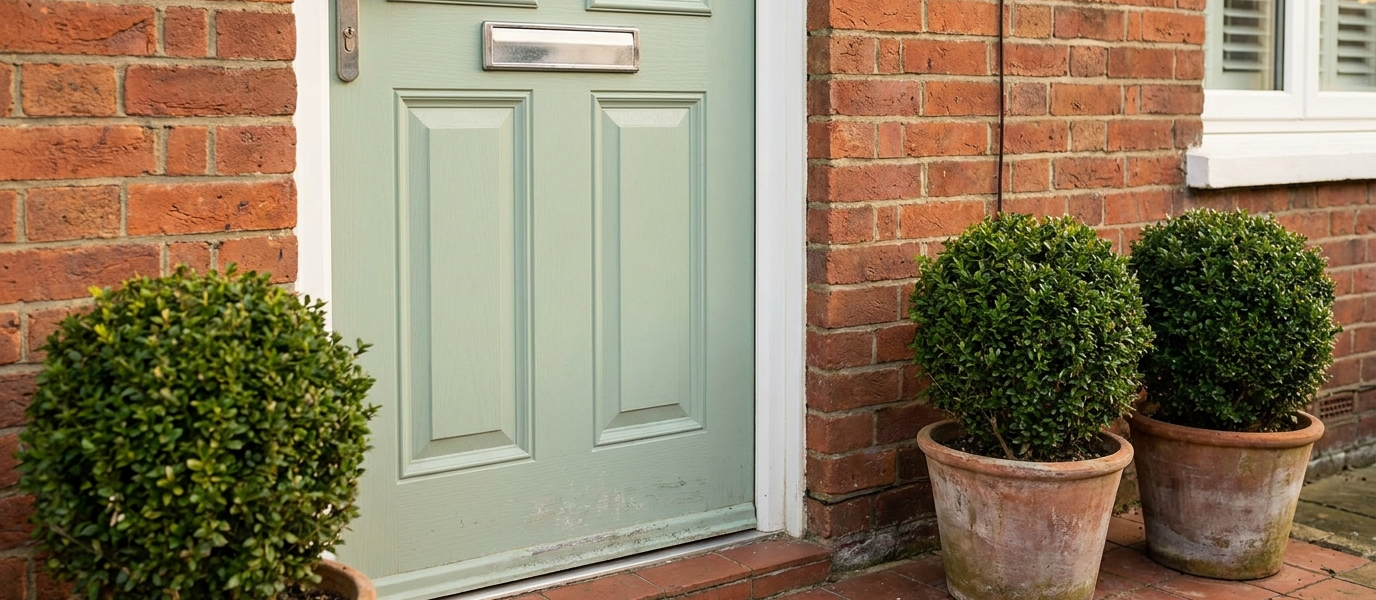
The composite door on day one was almost too crisp. The lock clicked with a satisfyingly heavy thud, the timber-grain surface looked impossibly clean, and the handle, a brushed stainless steel lever, felt cool and substantial in your hand. You found yourself opening and closing it just to hear the sound. Solid. Final. Right.
Five years later, the same door is better. The handle has developed a slight patina where your thumb rests, not worn, just softened, like a favourite leather wallet. The timber grain has mellowed from something that looked printed to something that looks almost organic, catching the low winter sun in a way that feels deliberate. The door has weathered storms, the kind where horizontal rain batters the street for hours, and emerged without a single swollen panel or faded patch.
There is a quiet pride in owning a door that has lived through five British summers, five damp Novembers, five frosty February mornings, and still closes with that same low thud. It doesn’t scream for attention. It doesn’t need to. It simply stands there, doing its job, looking better every year.
Let your front door do the heavy lifting
Your front door is the first impression your home gives, and it matters more than any interior renovation you could undertake. A new kitchen is for you. A new bathroom is for you. But the front door? That’s for everyone. The postman sees it. The delivery driver sees it. The friend arriving for dinner sees it. And the neighbour who walks past every morning sees it too, whether you realise it or not.
The door is a silent host. It greets people before you do. It absorbs the weather, the rain, the wind, the frost, and asks for nothing in return. When it’s done well, it makes the rest of the house feel cared for by association. A tired door makes even a freshly painted hallway look neglected. A confident door makes a modest house feel intentional.
Choosing a composite door isn’t just about replacing something broken. It’s about giving your home a voice, one that says, without words, that someone lives here who cares about the details.
Pick a colour that softens with the seasons
The best composite door colours aren’t the ones that shout on the showroom floor. They’re the ones that settle into their surroundings, changing subtly with the light and the weather. A charcoal grey, for instance, can take on a blueish cast in the thin winter light of a January afternoon, while looking almost black against a summer sunset. A sage green, like Farrow & Ball’s “Green Smoke” or Little Greene’s “Olive”, turns mossy and rich in autumn, when the leaves pile up around the doorstep and the air smells of damp earth.
The trick is to avoid trend colours that feel dated after two years. That vivid teal that looked so daring on Pinterest? It might feel like a regret by the time the third winter rolls around. Instead, choose a shade that has depth, something that changes, rather than fades. The best composite door colours age gracefully because they were never trying to be fashionable in the first place.
Sunlight, rain, and frost all interact with the finish in different ways. A matte black door will show water spots if you live in a hard-water area, while a textured grey will hide them. A deep navy will look almost purple in certain evening light, which can be stunning or surprising depending on your expectations.
Why texture matters more than colour
Colour gets all the attention, but texture is what makes a door feel real. A composite door isn’t flat plastic, it’s a surface that mimics wood grain, brushed metal, or smooth slate. Run your hand over it and you feel the subtle ridges, the grain that catches your fingernail just enough to convince you it’s not a sticker.
Texture matters because it hides the small marks of daily life. A scuff from a dog’s paw, a scrape from a bicycle handlebar, a dropped key that skids across the surface, on a flat, glossy door, these marks would scream for attention. On a textured door, they disappear into the grain. The door looks lived-in, not damaged.
There’s also the way a textured door catches light at dusk. The low sun hits the ridges and casts tiny shadows, giving the facade depth without any effort on your part. It’s the difference between a flat photograph and a painting, one is information, the other is atmosphere.
Eight ways to soften a tall sash window
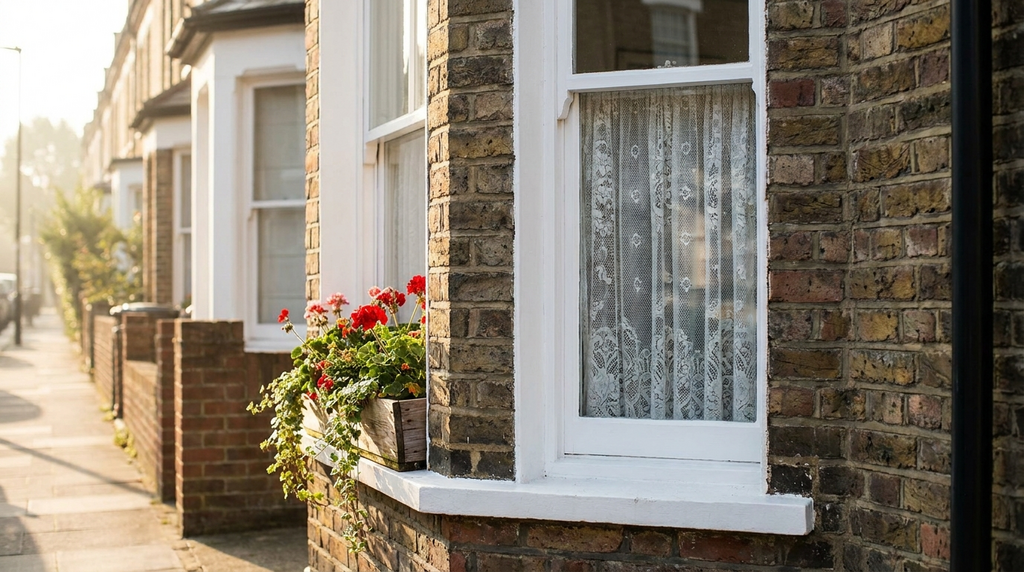
If your composite door is paired with a tall sash window, the kind that runs from mid-height almost to the ceiling, you’ve got a geometry problem. The door is solid and horizontal in its mass; the window is vertical and fragile. Here’s how to balance them.
- Add a slim timber sill to break the vertical line. Even a shallow oak or painted pine sill gives the eye somewhere to rest.
- Hang a Roman blind in a natural linen, not too tight, not too loose. The soft folds counteract the window’s rigid lines.
- Place a low planter with trailing ivy at the base. The greenery softens the bottom edge and connects the window to the ground.
- Use a matte black or bronze handle on the door that echoes the window’s hardware. Consistency is calming.
- Let a single pendant light hang inside, visible from the street. It draws the eye into the room rather than up the window.
- Paint the window frame a tone slightly lighter than the door. This reduces contrast and makes the window feel like part of the whole, not a separate element.
- Install a discreet trickle vent that doesn’t interrupt the sightline. Modern vents are slim enough to be almost invisible.
- Keep the glass clear, no frosted film, no sticker grids. Tall sash windows look best when they’re honest about what they are.
The hinge that still feels new
There’s a reason composite doors still feel solid after five years, and it’s not magic. It’s engineering. Multi-point locking systems, with hooks and rollers that engage at three, four, or even five points along the frame, spread the load so no single point takes the strain. Compression seals around the edges keep out draughts and noise, and stainless steel hinges, the kind that don’t rust, don’t squeak, don’t sag, mean the door opens and closes the same way every time.
The sound difference is telling. A uPVC door closes with a hollow rattle, the plastic vibrating against the frame. A composite door closes with a low thud, the sound of mass meeting mass, of something built to last. After five years, that sound hasn’t changed. It’s still the same reassuring thunk that made you smile on day one.
This matters because the best doors are the ones you don’t think about. You don’t jiggle the handle. You don’t push the bottom corner to make it latch. You don’t wince when the wind picks up. The door just works, every single time, and you stop noticing it, which is exactly the point.
Why this matters, the door you forget is there
The best home improvements are the ones you stop noticing because they never fail, never creak, never need a shove. A composite door that looks as good at year five as it did at day one gives you back something valuable: the mental space to focus on the rooms inside. You don’t stand in the hallway and think, “I must do something about that door.” You just walk through it, into your home, and get on with your life.
The quiet luxury of a thing done well, once, and then forgotten, until someone compliments it. A friend arrives for dinner, pauses on the doorstep, and says, “That’s a lovely door. Is it new?” And you smile, because it’s five years old, and it looks even better now than it did then.
That’s composite door longevity. Not a number on a warranty. Not a sales brochure. It’s the feeling of coming home to a door that still says, without words, that someone lives here who cares.