The quiet difference between a treatment and a transformation
There is a moment, just after you’ve had a new bathroom fitted or finally tackled that overlooked front door, when you stand back and realise the glass is the problem. Not the frame, not the handle, not the tile, the glass. Too clear, too exposed, too much of a window where you needed a screen. And so you find yourself weighing up two options that the internet insists are roughly equivalent: window film or frosted glass. But they are not equivalent. They are not even the same category of thing.
Film is a surface treatment. It sits on top. It can be peeled off, swapped out, reconsidered. Frosted glass is the surface itself, it has been etched, sandblasted, or manufactured with its opacity built in. One changes what you see; the other changes what you feel when you touch it. The real question isn’t which is cheaper, though that matters, but whether you want to alter the light or alter the material. Get that distinction right, and you won’t find yourself squinting at peeling edges two years in, wondering why it doesn’t look the way it did in the Instagram photo.
Let your front door do the heavy lifting
A front door is a threshold in every sense. It announces the character of the house before anyone has crossed it. Frosted glass in a front door, whether a full-length panel or a neat fanlight above, reads as intentional. It belongs to the architecture. It says someone thought about this. Window film on a front door, by contrast, can feel like a renter’s compromise. The sort of thing you install because the landlord won’t let you change the glass, and you’re tired of the postman seeing your shoes.
There is a permanence to frosted glass that film cannot fake. When the light hits it from inside at dusk, the grain is consistent, the diffusion soft. Film can look flat in that same light, applied, not integral. If the front door is the handshake of your home, frosted glass is the firm grip. Film is the hesitant one.
The bathroom test steam, splashes, and staying power
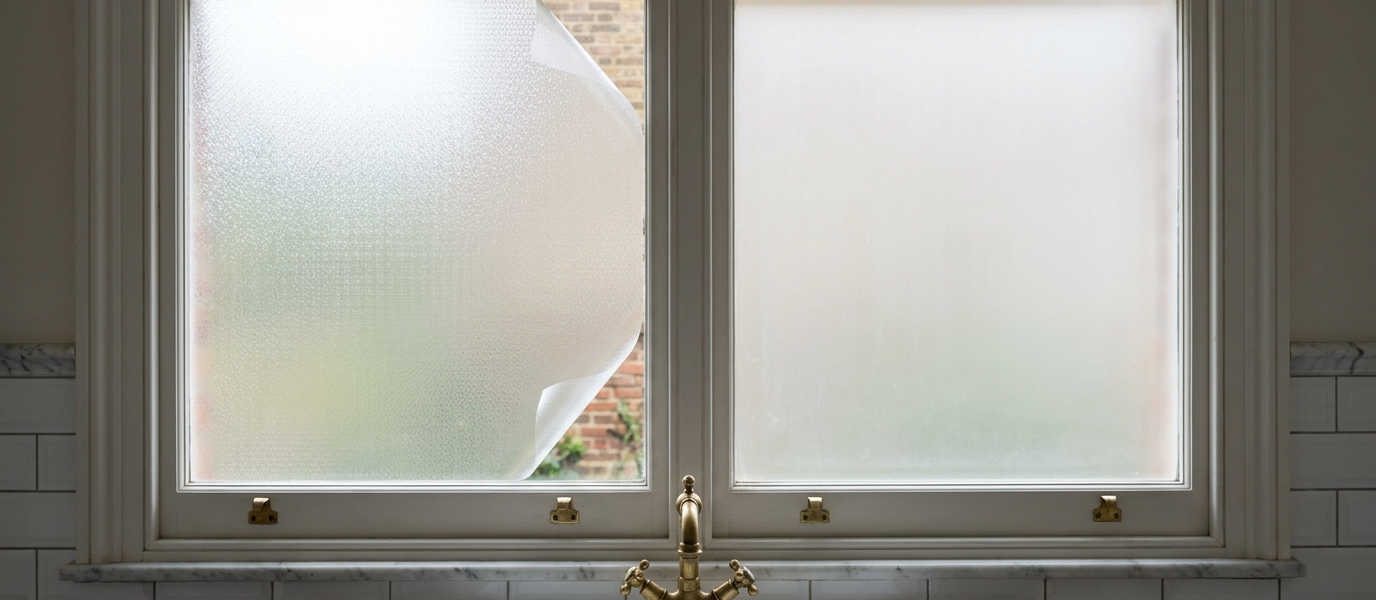
Bathrooms are the great revealers. They expose every shortcut, every material that wasn’t quite up to the job. Window film in a shower enclosure faces a losing battle from day one. Steam finds the edges. Splashes work their way behind the adhesive. Within a year, sometimes less, you notice a corner lifting, a trapped bubble of condensation that no amount of squeegeeing will fix. The film looked good on installation day. It looks tired by the second autumn.
Frosted glass handles humidity as part of its nature, not as an endurance test. It does not peel. It does not bubble. It does not require you to remember that it is film and therefore vulnerable. It is glass, doing what glass does. The difference is between something that endures moisture and something that merely tolerates it for a while. In a bathroom, that distinction is everything.
Why texture matters more than colour
Film offers pattern and opacity, geometric repeats, frosted bands, subtle gradients. But its texture is flat. Run your finger across it and you feel the smoothness of the adhesive layer, not the glass beneath. It changes what you see, but not what you feel. Frosted glass has depth, a physical grain that responds to the angle of the light throughout the day. In the morning, when the sun is low, the etched surface catches the rays and glows. By afternoon, it is cool and matte to the touch.
The difference shows most in that dim, quiet hour just before dawn. Film looks like what it is, a layer applied to something else. Frosted glass looks like it was born that way. If you care about the tactility of your home, if you run your hand along surfaces without thinking, frosted glass will reward you in a way film never can.
Three places where film is the smarter choice
For all that frosted glass wins on permanence and presence, film has its rightful place. Three, in fact.
First, rented homes. If you cannot alter the glazing, film is the only honest option. It comes off when you leave, and if you choose a decent brand and install it carefully, it leaves no trace. Second, large fixed panes, the kind of stairwell window or landing light that would cost thousands to replace. The structural cost of swapping the glass is disproportionate to the problem. Film solves it for under a hundred pounds. Third, temporary privacy needs. A home office that has appeared in a corner of the living room. A child’s room that will become a guest room in a few years. Film lets you change your mind without changing your windows.
The light test what happens at dusk
Evening is when the choice reveals itself most honestly. Frosted glass scatters the last of the daylight softly, creating a gentle glow that feels ambient, almost atmospheric. The light passes through but loses its sharp edges, it becomes a warm diffusion that fills the room without glare. Film, depending on its finish, can create a harsher diffusion. The light still passes through, but the quality changes. It can feel flattened, as if the room has been covered with a thin veil rather than wrapped in light.
If you have ever sat in a room at dusk and felt that the light was somehow wrong, too clinical, too dead, the glass might be the culprit. Frosted glass holds the evening light like a paper lantern. Film holds it like a shower screen.
Eight ways to soften a tall sash window
Tall sash windows are a gift, but they are also an exposure problem. Here are eight ways to handle them without losing what makes them special.
- Use film on the lower third only, leaving the upper sash clear for sky and outlook. The eye travels up to the light.
- Pair frosted glass with a deep window sill to create a shelf for objects that catch the light, a ceramic vase, a piece of sea glass, a single stem.
- Combine with roman blinds in linen for layered privacy that moves with you throughout the day.
- Consider etched patterns that mimic period detail rather than modern opacity, a delicate fern or a repeating fan shape.
- Use film in a geometric repeat on a Georgian window to echo the original glazing bars without altering the frame.
- Frost the central pane of a three-part window and leave the sides clear for borrowed light from the edges.
- Apply film to the inside of a secondary glazing panel rather than the original glass, it protects the historic surface.
- Leave one sash unfrosted entirely. Asymmetry feels intentional in older houses, like a deliberate choice rather than an oversight.
The one question that settles everything
There is a single question that cuts through the indecision. Ask yourself: do I want to change how this window looks, or how this room feels? Film changes appearance. It alters the pattern, the opacity, the view. Frosted glass changes atmosphere. It alters the quality of light, the texture of the surface, the way the room breathes.
The right answer is the one you won’t think about again after it’s done. If you choose film, you will know it is film. If you choose frosted glass, you will forget it was ever a choice at all. And that, in the end, is the test that matters.
door colour ideas
bathroom window privacy