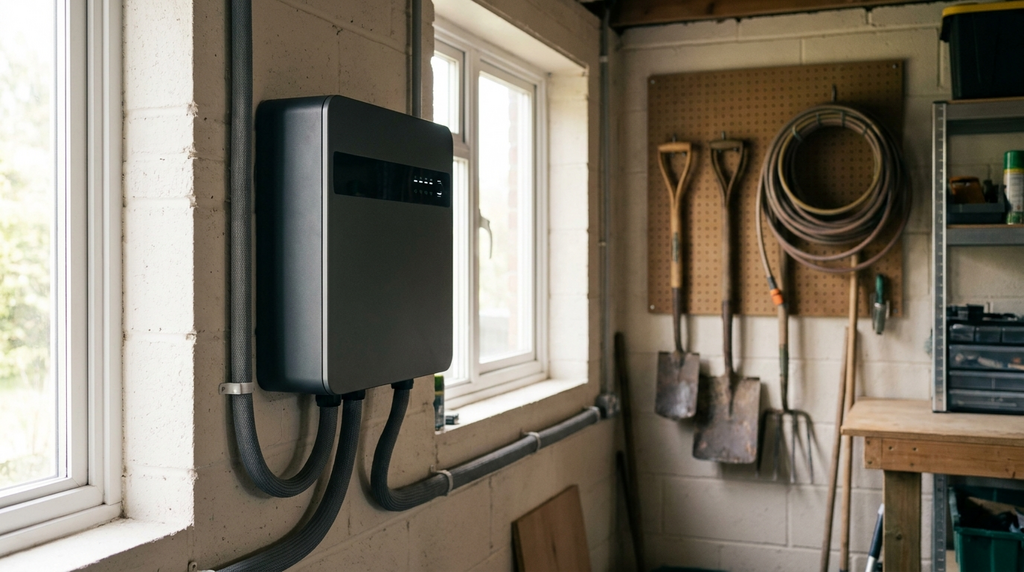
Tesla Powerwall 3 costs from £5,500 to £7,500 installed in the UK in 2026
If you are looking at home battery storage in 2026, the Tesla Powerwall 3 is the most talked-about option. Its UK price is a key factor in deciding whether it makes financial sense for your home. The direct answer is that a single Powerwall 3 unit costs £5,500 before installation, and a fully installed system with a Gateway typically lands between £6,500 and £7,500.
A Tesla Powerwall 3 costs £6,500 to £7,500 installed in the UK in 2026. It stores 13.5 kWh and delivers 10 kW peak output. That makes it a top choice for high-demand homes.
- Installed cost is £6,500 to £7,500 for a single Powerwall 3.
- Stores 13.5 kWh usable energy with 89% round-trip efficiency.
- Delivers 5.8 kW continuous and 10 kW peak output.
- 0% VAT on battery-only installations applies in 2026.
- ECO4 grant eligibility can reduce upfront costs further.
- Tesla Powerwall 3 costs from £5,500 to £7,500 installed in the UK in 2026
- It stores 13.5 kWh usable, delivers 5.8 kW continuous, and peaks at 10 kW
- Glazing is standard-rated for VAT at 20%. The zero rate for energy-saving materials covers insulation, heat pumps and solar panels; HMRC names secondary and double glazing as excluded (VAT Notice 708/6).
- Quick numbers, capacity, cost, and savings in 2026
- The direct answer is the Tesla Powerwall 3 worth it in 2026?
- How to verify your installer is MCS-certified and eligible for grants
- How the Powerwall 3 compares to the Powerwall 2 and key rivals in 2026
- The warranty, lifespan, and degradation guarantee for UK buyers
The base unit price of £5,500 (excl. VAT) is listed on Tesla’s UK portal (Tesla UK, 2026). Installation costs vary: a straightforward install in a garage or utility room adds roughly £1,000, while a more complex install involving external siting or electrical board upgrades can add £2,000. This puts the total installed cost at £6,500–£7,500 for a single Powerwall 3 with the required Gateway. For comparison, the Powerwall 2 cost £5,900–£6,700 installed in 2025 (Energy Saving Trust, 2026).
It stores 13.5 kWh usable, delivers 5.8 kW continuous, and peaks at 10 kW
The Powerwall 3’s core specifications determine how much energy it can store and how much power it can deliver at once. Usable capacity is 13.5 kWh, meaning you can use that much energy before the battery needs recharging (GOV.UK product register, 2026). Continuous output is 5.8 kW, which is the power it can supply steadily. Peak output is 10 kW for up to 10 seconds, which covers short bursts from high-demand appliances like induction hobs or kettles.
Round-trip efficiency is 89%, meaning 11% of the energy is lost in the charge-discharge cycle (GOV.UK product register, 2026). This is competitive with other lithium-ion batteries on the market. The 10 kW peak output is the standout figure, most home batteries peak at 4–7 kW, so the Powerwall 3 can handle larger loads without drawing from the grid.
Glazing is standard-rated for VAT at 20%. The zero rate for energy-saving materials covers insulation, heat pumps and solar panels; HMRC names secondary and double glazing as excluded (VAT Notice 708/6).
Two major financial incentives reduce the effective cost of the Powerwall 3 in 2026. The 0% VAT rate on battery-only installations applies to all UK households until March 2027, regardless of income (GOV.UK, HMRC VAT notice 708/6, 2026). This saves you 20% on the installation cost.
The ECO4 grant is more restricted. Eligibility is limited to households on means-tested benefits such as Universal Credit, Pension Credit, or Income Support, and the home must have an Energy Performance Certificate (EPC) rating of D through G (DESNZ, ECO4 scheme guidance, 2026). The Smart Export Guarantee (SEG) is available to any Powerwall 3 owner who uses an MCS-certified installer. This allows you to sell surplus solar power back to the grid (Ofgem SEG guidance, 2026).
Quick numbers, capacity, cost, and savings in 2026
| Specification | Tesla Powerwall 3 | Tesla Powerwall 2 |
|---|---|---|
| Usable capacity (kWh) | 13.5 | 13.5 |
| Continuous output (kW) | 5.8 | 5.0 |
| Peak output (kW) | 10.0 | 7.0 |
| Round-trip efficiency (%) | 89 | 90 |
| Installed cost (£) | 6,500–7,500 | 5,900–6,700 |
| Annual savings for typical 3-bed home (£) | 400–600 | 350–550 |
| Payback period (years) | 8–12 | 9–13 |
Savings estimates are based on a typical 3-bedroom home with a 3.5 kWp solar array, using the Energy Saving Trust solar battery savings calculator (2026). The payback period assumes you use the stored energy to offset grid electricity at 28p/kWh (Ofgem typical domestic consumption values, 2026).
The direct answer is the Tesla Powerwall 3 worth it in 2026?
Yes, for most UK homes with solar panels, because its 10 kW peak output handles high-demand appliances like induction hobs and heat pumps better than rivals. No, if your daily electricity use is under 8 kWh, a smaller battery like the GivEnergy 9.5 kWh or Fox ESS 9.3 kWh is cheaper and still adequate. The payback period is 8–12 years on savings alone, falling to 5–7 years if you also claim the SEG tariff at 12p/kWh (Ofgem SEG average rate, 2026).
For a home with a heat pump or an electric vehicle, the 10 kW peak output is a genuine advantage, it can power both without grid support during peak times. For a home with only solar panels and no major electric loads, the payback is longer and a smaller, cheaper battery may be more cost-effective. Compare home battery storage options
How to verify your installer is MCS-certified and eligible for grants
Glazing is standard-rated for VAT at 20%. The zero rate for energy-saving materials covers insulation, heat pumps and solar panels; HMRC names secondary and double glazing as excluded (VAT Notice 708/6). You can check the MCS Register online at mcsregister.co.uk, search by installer name or postcode to confirm their certification is current. For ECO4-funded installations, the installer must also be registered with TrustMark (DESNZ, ECO4 installer requirements, 2026).
Do not rely on the installer’s word alone. Verify both certifications before signing any contract. Glazing is standard-rated for VAT at 20%. The zero rate for energy-saving materials covers insulation, heat pumps and solar panels; HMRC names secondary and double glazing as excluded (VAT Notice 708/6). Find an MCS-certified solar installer
How the Powerwall 3 compares to the Powerwall 2 and key rivals in 2026
The Powerwall 3 and Powerwall 2 share the same 13.5 kWh usable capacity, but the Powerwall 3 has higher continuous output (5.8 kW vs 5.0 kW) and a much higher peak output (10 kW vs 7.0 kW) (Tesla spec sheets, 2026). This makes the Powerwall 3 better suited for homes with high-load appliances like heat pumps or electric car chargers.
Against the GivEnergy 9.5 kWh, which costs £3,500–£4,500 installed, the Powerwall 3 is significantly more expensive. However, the GivEnergy unit delivers only 3.0 kW continuous output, insufficient for a large heat pump or electric vehicle charging without grid support (Energy Saving Trust, 2026). The Fox ESS 9.3 kWh, at £3,000–£4,000 installed, has a 3.6 kW continuous output, similar limitation (Fox ESS spec sheet, 2026). If your peak demand is under 4 kW, these rivals offer better value. If you need to run a heat pump or charge a car overnight, the Powerwall 3’s higher output justifies the premium.
The warranty, lifespan, and degradation guarantee for UK buyers
The Powerwall 3 comes with a 10-year warranty covering unlimited cycles and guarantees 70% capacity retention at the end of the term (Tesla warranty document, 2026). Degradation is estimated at 0.5–1.0% per year, so after 10 years you can expect 90–95% of the original 13.5 kWh capacity to remain usable. This is consistent with real-world data from Tesla’s 2025 UK fleet report.
The unlimited cycles clause is important, some rival batteries cap cycles at 6,000 or 10,000. With daily cycling, the Powerwall 3’s warranty effectively covers the full 10-year lifespan without risk of voiding it through heavy use. After 10 years, the battery will still function but with reduced capacity, and Tesla offers replacement units at a reduced cost. For most UK homeowners, the battery will outlast its payback period comfortably.
Frequently Asked Questions
A fully installed Tesla Powerwall 3 costs £6,500 to £7,500 in the UK in 2026, according to Tesla UK pricing. The base unit is £5,500, with installation adding £1,000 to £2,000 depending on complexity.
The usable capacity is 13.5 kWh, as listed on the GOV.UK product register for 2026. This means you can store and use that much energy before recharging.
Yes, battery-only installations of the Powerwall 3 qualify for 0% VAT in 2026 under UK government rules. This applies to installations by MCS-certified installers.
The Powerwall 3 costs £6,500 to £7,500 installed, compared to £5,900 to £6,700 for the Powerwall 2 in 2025, per the Energy Saving Trust. The Powerwall 3 offers higher peak output at 10 kW versus the Powerwall 2's 7 kW.
The peak output is 10 kW for up to 10 seconds, as per the GOV.UK product register. This is higher than most home batteries, which peak at 4 to 7 kW.