Air-source heat pump installation costs £7,000–£13,000, while ground-source heat pumps cost £14,000–£19,000 after the Boiler Upgrade Scheme grant in 2026
If you are deciding between an air-source and a ground-source heat pump, the upfront cost is probably your first question. The answer is that air-source heat pumps cost roughly half as much to install as ground-source systems after the 2026 Boiler Upgrade Scheme grant.
For a standard 3–4 bedroom detached home with existing radiators, an air-source heat pump (ASHP) costs £7,000–£13,000 after the £7,500 grant. The total before the grant is £14,500–£20,500 (Energy Saving Trust, 2026). A ground-source heat pump (GSHP) costs £14,000–£19,000 after the same £7,500 grant, with a pre-grant total of £21,500–£26,500 (DESNZ, Boiler Upgrade Scheme: April 2026 data release).
Ground-source costs vary significantly by ground loop type. Horizontal trenches are cheaper than vertical boreholes, which can add £3,000–£5,000 to the installation (Energy Saving Trust, 2026). These figures are typical for UK homes in 2026 and assume a standard heating system with existing radiators.
Running costs for an air-source heat pump average £800–£1,100 per year
Running costs depend on your home’s heat demand and the heat pump’s efficiency. The 2026 Typical Domestic Consumption Values (TDCVs) for a medium-usage home are 2,900 kWh for electricity and 12,000 kWh for gas (Ofgem, 2026).
For an air-source heat pump with a seasonal coefficient of performance (SCOP) of 3.0, annual electricity for heating and hot water is roughly 4,000 kWh. At the October 2026 price cap of 24.5p/kWh, that costs £980 per year (Energy Saving Trust, 2026). For a ground-source heat pump with SCOP 3.8, annual electricity is roughly 3,160 kWh, costing £774 per year at the same rate.
Ground-source efficiency is more stable year-round because ground temperatures stay between 8°C and 12°C. This reduces winter peak demand and can save £100–£200 annually compared with air-source systems (Energy Saving Trust, 2026).
Air-source heat pumps achieve a seasonal coefficient of performance (SCOP) of 2.8–3.2, while ground-source heat pumps achieve 3.5–4.0 in UK homes in 2026
The seasonal coefficient of performance (SCOP) is the ratio of heat output to electricity input over a full heating season. A higher SCOP means lower running costs (MCS, 2026).
Air-source heat pumps typically achieve an SCOP of 2.8 in a poorly insulated home during a cold winter, up to 3.2 in a well-insulated home in a mild climate (Energy Saving Trust field trials, 2026 update). Ground-source heat pumps typically achieve an SCOP of 3.5 with a horizontal loop in clay soil, up to 4.0 with a vertical borehole in sandy soil.
Ground-source’s higher SCOP results from stable ground temperatures of 8–12°C year-round. Air-source systems rely on fluctuating outdoor air temperatures, which drop in winter and reduce efficiency (MCS, 2026).
Quick numbers air versus ground source heat pump cost comparison for 2026
| Cost category | Air-source heat pump | Ground-source heat pump |
|---|---|---|
| Installation cost (after Boiler Upgrade Scheme grant) | £7,000–£13,000 | £14,000–£19,000 |
| Installation cost (before grant) | £14,500–£20,500 | £21,500–£26,500 |
| Annual running cost (medium home, Oct 2026 price cap) | £800–£1,100 | £600–£900 |
| SCOP range | 2.8–3.2 | 3.5–4.0 |
| Groundwork required | None (wall-mounted unit) | Trench or borehole (garden area needed) |
| Boiler Upgrade Scheme grant available | £7,500 | £7,500 |
Sources: Energy Saving Trust, 2026; Ofgem, 2026; MCS, 2026
Ground-source heat pumps typically require a garden area of 50–200 square metres, while air-source units need only a 1-square-metre external wall space
The space available on your property is a key factor in choosing between the two systems. Ground-source heat pumps need significant garden area for the ground loop.
Horizontal ground loops require 50–100 square metres of garden per kW of heat output. A typical 8kW ground-source heat pump needs 100–200 square metres of undisturbed land (Energy Saving Trust, 2026). Vertical boreholes need only 5–10 square metres of garden space, but they require specialist drilling rig access and cost £3,000–£5,000 extra per borehole (MCS, 2026).
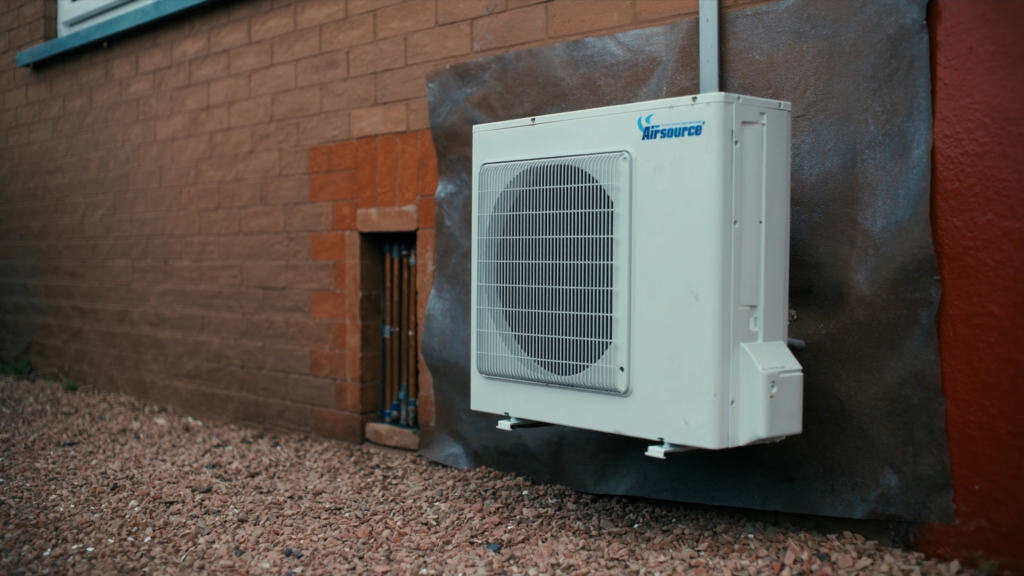
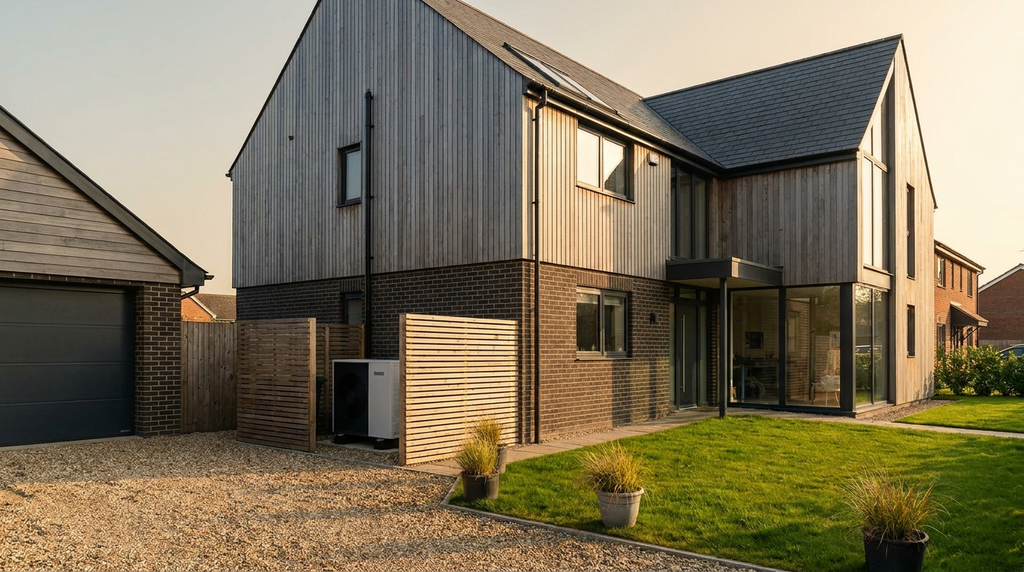
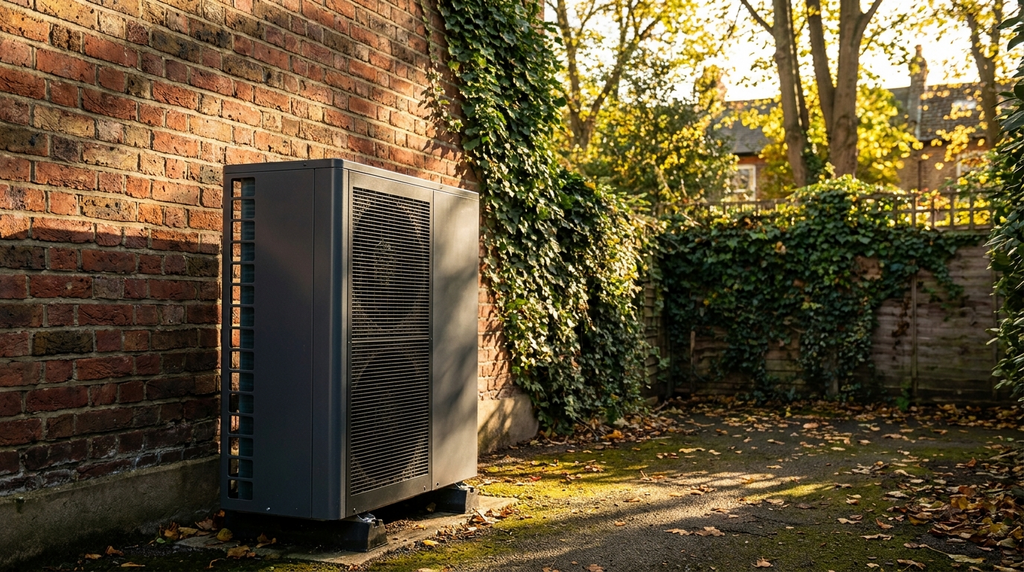
Air-source units are mounted on an external wall or on the ground with a 1 square metre footprint. They require no garden excavation. Homeowners with small gardens, listed buildings, or conservation-area restrictions may be limited to air-source installations only (Energy Saving Trust, 2026). heat pump space requirements for small gardens
The Boiler Upgrade Scheme pays a flat £7,500 grant for both air-source and ground-source heat pumps in 2026, with no income cap
The Boiler Upgrade Scheme provides a fixed £7,500 grant for both heat pump types. The grant is applied as a discount by MCS-certified installers, so you do not need to claim separately (GOV.UK, 2026).
Eligibility requires your property to have a valid Energy Performance Certificate (EPC) with no outstanding recommendations for loft or cavity wall insulation. Exceptions apply for certain property types, such as solid-wall homes (DESNZ, April 2026).
The grant is available to homeowners in England and Wales only. Scotland has a separate Home Energy Scotland loan and grant scheme. The grant is not means-tested. Any homeowner replacing a fossil-fuel heating system (gas, oil, LPG, or electric) is eligible, subject to installer availability (GOV.UK, 2026).
The direct answer ground-source heat pumps have lower running costs but higher upfront costs than air-source, making air-source the cheaper choice for most UK homeowners in 2026
For a typical 3–4 bedroom home, the total cost over 10 years (installation plus running costs) is roughly £19,000–£25,000 for an air-source heat pump and £20,000–£28,000 for a ground-source heat pump (Energy Saving Trust, 2026). Air-source is cheaper upfront by £7,000–£9,000 after the grant. The running-cost savings from ground-source are £100–£200 per year, which would take 35–90 years to offset that difference.
Ground-source makes financial sense only for homes with very high heat demand, such as large, poorly insulated properties, or where garden space is abundant and ground conditions are ideal (MCS, 2026). For the majority of UK homeowners replacing a gas boiler in 2026, an air-source heat pump is the most cost-effective option.
The running cost comparison assumes the October 2026 price cap of 24.5p/kWh for electricity (Ofgem, 2026). If electricity prices rise faster than gas, the payback period for ground-source would lengthen further. heat pump running costs vs gas boiler 2026
You must use an MCS-certified installer to qualify for the Boiler Upgrade Scheme grant, verify via the MCS register before hiring
The Boiler Upgrade Scheme requires your installer to be MCS-certified for the specific heat pump type, whether air-source or ground-source. You cannot self-install and claim the grant (GOV.UK, 2026).
Check the MCS public register at mcscertified.com to confirm the installer’s certification and that their specific heat pump model is listed (MCS, 2026). Additional certifications include TrustMark for consumer protection and Gas Safe Register if the installer also works on gas systems, though Gas Safe registration is not required for heat pumps alone.
For ground-source heat pumps, the installer must also comply with the Ground Source Heat Pump Association (GSHPA) guidelines for borehole or trench installation. This is not a separate certification requirement but is part of MCS standards (MCS, 2026). how to choose a heat pump installer
Frequently Asked Questions
Air-source heat pumps are cheaper to install, costing £7,000–£13,000 after the £7,500 Boiler Upgrade Scheme grant, compared to £14,000–£19,000 for ground-source (Energy Saving Trust, 2026).
Ground-source heat pumps are cheaper to run, costing £600–£900 per year versus £800–£1,100 for air-source at the October 2026 price cap of 24.5p/kWh (Energy Saving Trust, 2026).
A ground-source heat pump costs £14,000–£19,000 after the £7,500 Boiler Upgrade Scheme grant in 2026 (DESNZ, April 2026 data release).
No, ground-source heat pumps have more stable efficiency year-round because ground temperatures stay between 8°C and 12°C, while air-source efficiency drops in winter (Energy Saving Trust, 2026).
For a standard 3–4 bedroom detached home with existing radiators, a typical air-source heat pump has a seasonal COP of 3.0, requiring roughly 4,000 kWh of electricity per year for heating and hot water (Energy Saving Trust, 2026).