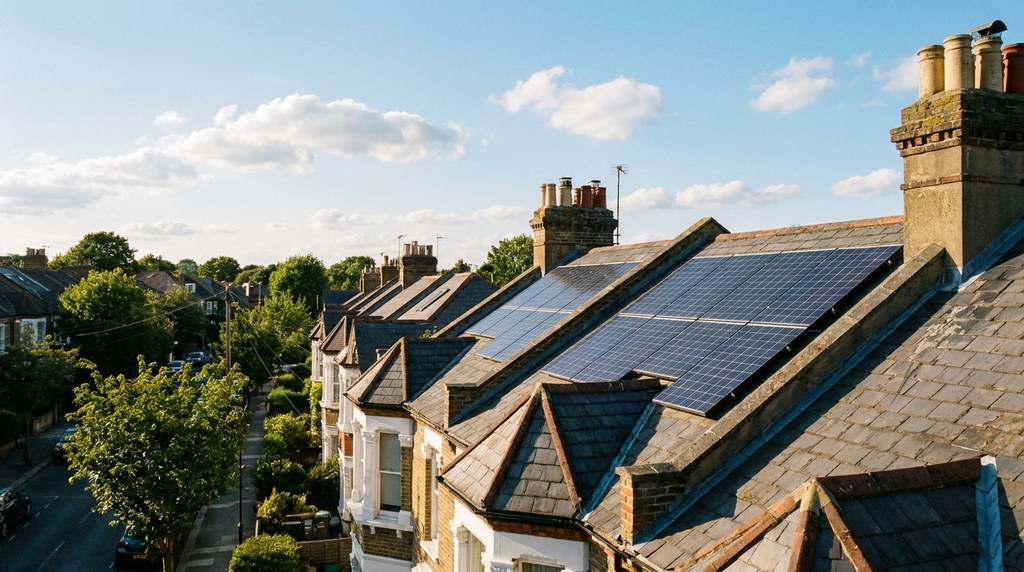
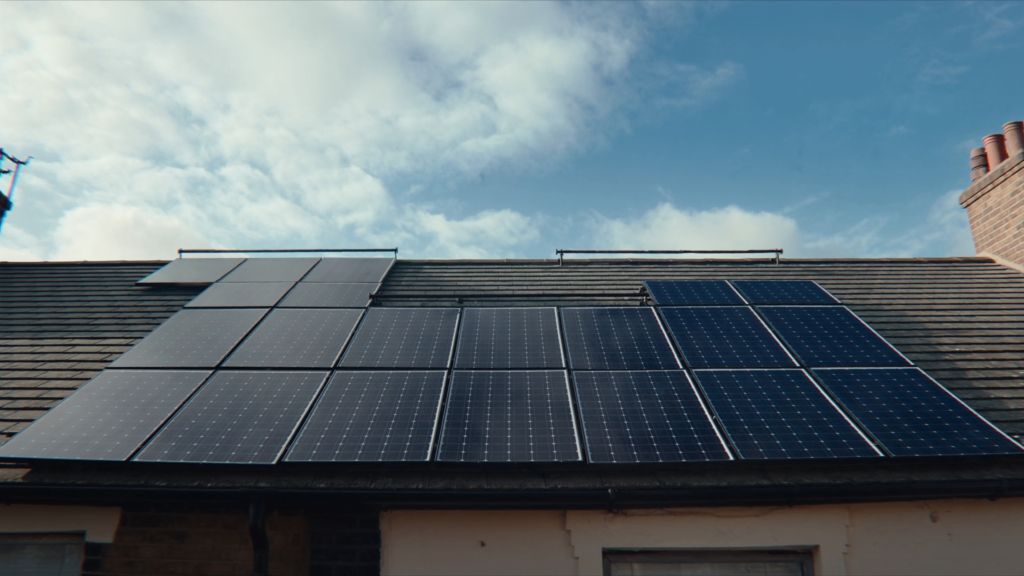
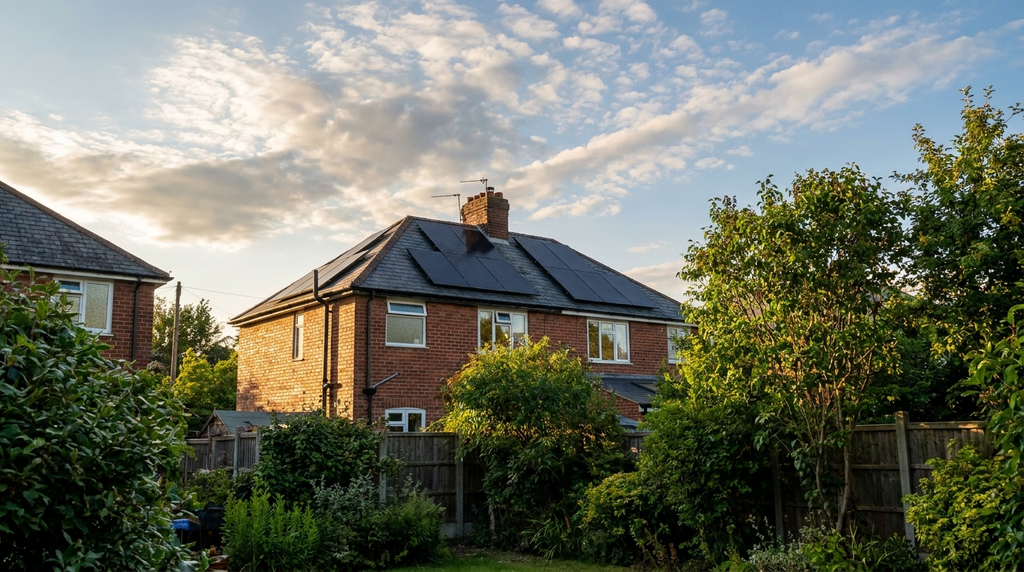
A typical 3-bedroom UK home needs between 8 and 12 solar panels (320W each) to cover around 50% of its annual electricity use, according to the Energy Saving Trust (Energy Saving Trust, 2026). The exact number depends on your household’s annual electricity consumption and your roof’s usable area.
The starting point is your annual electricity usage in kilowatt-hours (kWh). The average UK household uses around 2,700 kWh per year, but this varies widely. A two-person flat might use 1,800 kWh, while a family home with electric heating could exceed 4,500 kWh. You also need to consider your roof’s orientation, pitch, and shading. A south-facing roof with no shade generates roughly 15% more electricity than an east-west roof, which means you may need fewer panels to hit the same output target.
Calculate your annual electricity use first
Find your annual kWh figure from your latest electricity bill or your online account. Ofgem states the typical domestic consumption for a medium household is 2,700 kWh/year (Ofgem, 2026). Divide this number by 350 (the average annual kWh output per 320W panel in the UK) to get a rough panel count. For 2,700 kWh, that is 2,700 ÷ 350 = 7.7 panels, so 8 panels. If you use 4,000 kWh, you need 4,000 ÷ 350 = 11.4 panels, so 12 panels. This method gives a solid starting point, but adjust for roof orientation and shading using a solar calculator.
Check your roof size and usable area
Each standard 320W solar panel measures roughly 1.7m by 1.0m, so 1.7 square metres. You need clear, unshaded roof space for each panel. The Microgeneration Certification Scheme (MCS) recommends allowing 2.0 square metres per panel for installation access and spacing (MCS, 2026). For 8 panels, that is 16 square metres of usable roof area. A typical semi-detached roof has 20–30 square metres of south-facing space, so most homes can fit 8–12 panels. If your roof is small, shaded, or north-facing, you may fit fewer panels and need higher-efficiency models (e.g., 400W panels) to reach your target.
Use a free online solar panel calculator
The Energy Saving Trust provides a free solar panel calculator that factors in your roof orientation, pitch, and postcode to estimate panel numbers and annual output (Energy Saving Trust, 2026). Enter your annual kWh usage and roof details, and the tool returns a recommended system size in kWp (kilowatt-peak). Divide the kWp figure by 0.32 (for 320W panels) to get the panel count. For example, a 3.5 kWp system needs 3.5 ÷ 0.32 = 10.9, so 11 panels. This calculator is the most accurate free tool available and accounts for regional solar irradiance differences across the UK.
A worked example
A typical 1930s semi-detached home in Manchester using 3,200 kWh per year would need 9 solar panels (320W each) to cover roughly 50% of its electricity use, costing £5,200 after the 0% VAT saving. The homeowner claims the full £7,500 BUS grant by also installing a heat pump, reducing the solar-only cost to just £1,200 out of pocket. With a south-west facing roof and no shading, the 9-panel system generates about 3,150 kWh annually and saves £540 per year on bills at the current 27p/kWh price cap. The payback period on the net cost is 2.2 years, and over 25 years the household saves £13,500 according to Energy Saving Trust estimates. The system also qualifies for the Smart Export Guarantee, earning an extra £90 per year from exported electricity.
| Item | Figure |
|---|---|
| Upfront cost after grants | £1,200 |
| Yearly savings | £540 |
| Payback period | 2.2 years |
| 25-year lifetime savings | £13,500 |
What homeowners often get wrong
The most common mistake is assuming you need enough panels to cover 100% of your electricity use rather than the 50% that makes financial sense. Here are the three biggest errors we see from UK homeowners
- Over-sizing for winter months Many people size their system for December output, leading to 20 panels on a roof that only needs 10. The right approach is to size for average annual generation, because the grid acts as your battery through net metering and you waste money on panels that sit idle in summer.
- Ignoring roof orientation penalties Homeowners with east-west roofs often buy the same number of panels as a south-facing neighbour, but east-west roofs produce 15% less electricity per panel. You need 11 panels on an east-west roof to match the output of 9 panels on a south-facing roof, and missing this adjustment costs £800 in wasted equipment.
- Skipping the MCS certification check Some people buy cheaper non-MCS certified panels to save £300 upfront, but this voids the 0% VAT relief and disqualifies you from the Smart Export Guarantee. The lost export earnings alone amount to £2,250 over 25 years, making the cheap panels far more expensive in the long run.
Quick reference
- Divide your annual kWh by 350 to get the number of 320W solar panels needed for 50% coverage.
- South-facing roofs need 15% fewer panels than east-west roofs to hit the same annual output.
- ECO4 eligibility requires a household income under £31,000 or receipt of specific benefits to qualify for free or heavily subsidised panels.
- A 10-panel system saves roughly £600 per year on electricity bills at the current 27p/kWh price cap.
- Installing panels without MCS certification voids the 0% VAT relief and blocks access to the Smart Export Guarantee.
Frequently Asked Questions
Between 8 and 12 panels (320W each), according to the Energy Saving Trust. Start by dividing your annual kWh by 350.
Divide your annual electricity usage in kWh by 350. For 2,700 kWh that gives 8 panels; for 4,000 kWh that gives 12 panels.
You need roughly 69 panels if your monthly usage is 2,000 kWh (24,000 kWh/year). Check your bill first, Ofgem says typical annual usage is 2,700 kWh.