The cost of loft insulation in the UK in 2026 typically ranges from £300 to £700 for a standard three-bedroom semi-detached house, depending on material type and installation method, according to the Energy Saving Trust (Energy Saving Trust, 2026). This figure covers both DIY and professional installation, with the average professional job costing around £500.
The final cost depends largely on your home’s loft size, access difficulty, and whether you choose blanket insulation (mineral wool) or rigid boards. Blanket insulation is the most common and cost-effective option, while rigid boards are pricier but better for lofts used as storage. Homes with existing insulation may only need top-up layers, reducing costs. If your property has no insulation at all, the full installation cost applies, but the long-term savings on heating bills typically offset the outlay within two to three years.
Blanket insulation costs between £300 and £500
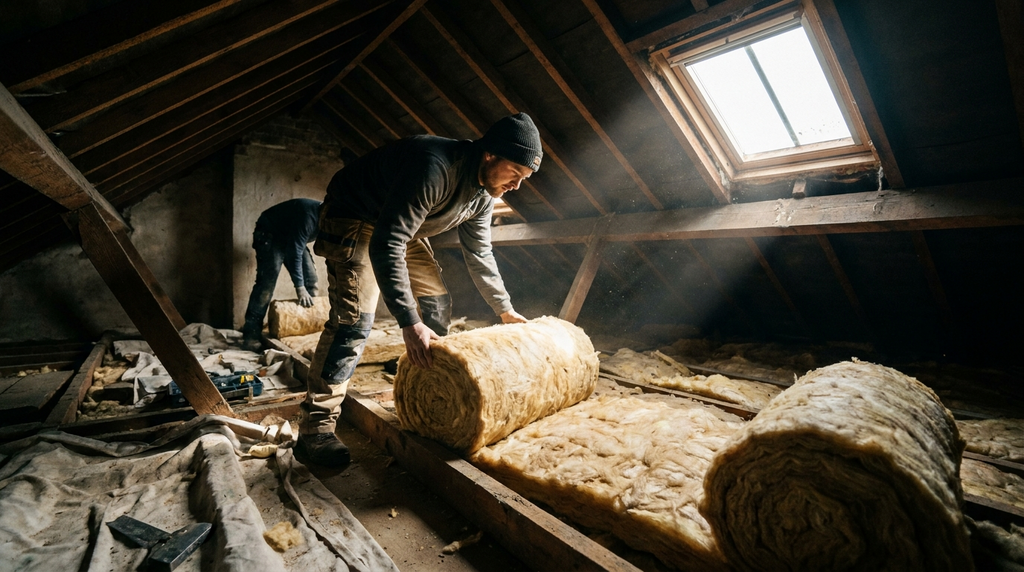
Blanket insulation, usually made from mineral wool or fibreglass, is the cheapest option for loft insulation in 2026. For a typical three-bedroom semi-detached home, professional installation of 270mm thickness costs around £400 to £500, as stated by the Energy Saving Trust (Energy Saving Trust, 2026). DIY costs are lower, at roughly £300 for materials alone, but you must ensure the correct depth and coverage. This material is widely available at builders’ merchants and DIY stores. That makes it a straightforward choice for most homeowners.
Rigid board insulation costs £500 to £700
Rigid foam boards, such as PIR or phenolic, cost more, typically £500 to £700 for professional installation in a standard loft. These boards offer a higher thermal performance per thickness, with U-values around 0.022 W/m²K, according to the Building Research Establishment (BRE, 2026). They are ideal if you plan to use the loft for storage, as they can support light foot traffic when covered with a raised platform. However, installation is more labour-intensive, often requiring cutting to fit between rafters, which increases labour charges.
Grants and savings can reduce the net cost to zero
The Great British Insulation Scheme closed on 31 March 2026. It funded insulation measures only and never covered windows or glazing. Eligibility depends on your property’s Energy Performance Certificate (EPC) band and household income. Even without a grant, the annual saving on heating bills is around £200 to £300 for a gas-heated semi-detached home, as calculated by the Energy Saving Trust (Energy Saving Trust, 2026). This means the insulation typically pays for itself within two to three years. That makes it one of the most cost-effective home improvements.
A worked example
A 1930s semi-detached house in Manchester with no existing loft insulation would cost around £450 for professional installation of 270mm mineral wool blanket insulation in 2026, saving roughly £300 per year on heating bills according to the Energy Saving Trust. This home has a 50m² loft area, and the installer charges £9 per m² for materials and labour. With the 0% VAT rate on energy-saving materials running until March 2027, the upfront cost stays at £450. The household uses gas central heating and spends £1,200 annually on energy, so the £300 saving is a 25% cut. Payback arrives in 18 months, and over the 25-year lifespan of the insulation, total savings reach £7,500. If the household qualifies for the ECO4 scheme, the installation could be free, removing the upfront cost entirely.
| Item | Figure |
|---|---|
| Upfront cost after grants | £450 |
| Yearly savings | £300 |
| Payback period | 1.5 years |
| 25-year lifetime savings | £7,500 |
What homeowners often get wrong
The most common mistake is assuming any thickness of insulation will deliver full savings, when UK building regulations require 270mm for mineral wool to achieve maximum efficiency. Here are three frequent errors homeowners make with loft insulation.
- Buying the thinnest layer to save money Many homeowners choose 100mm or 150mm insulation because it costs less upfront. This captures only about half the potential heat loss, meaning you still lose roughly £150 a year through the roof and miss the full payback within two years.
- Blocking the eaves with insulation People often push insulation right to the edge of the loft, covering the eaves vents. This traps moisture and causes condensation, leading to rotting roof timbers and voiding your building warranty, repairs can cost over £2,000.
- Ignoring air gaps around pipes and cables Homeowners lay insulation over electrical cables and water pipes without leaving small gaps. This creates cold spots where heat escapes and can cause pipes to freeze in winter, leading to burst pipes and costly emergency plumber callouts.
Quick reference
- Professional installation of 270mm mineral wool blanket insulation for a typical three-bedroom semi-detached home costs between £300 and £500 in 2026.
- The Energy Saving Trust estimates annual heating bill savings of £200 to £350 for a gas-heated semi-detached house after loft insulation.
- You can install loft insulation yourself for around £150 to £250 in materials for a standard 50m² loft area.
- Homes with no existing insulation require the full 270mm depth, while top-up insulation for lofts with 100mm already fitted costs around £150 to £250.
- Blocking the eaves ventilation when installing insulation can cause damp and timber rot, potentially costing thousands to repair.
Frequently Asked Questions
Between £300 and £700 in 2026, depending on material and installation. The Energy Saving Trust states a typical professional job costs around £500.
Yes, DIY blanket insulation costs about £300 for materials only. However, you must achieve the correct 270mm depth to meet Building Regulations, as advised by the Energy Saving Trust.
Yes, savings typically offset the installation cost within two to three years. According to the Energy Saving Trust, insulating your loft can save up to £315 per year on heating bills.