1930s semi-detached homes account for over 4 million UK dwellings, with the average wall U-value around 1.6 W/m²K, roughly four times worse than a modern building regulation target
1930s semi-detached homes are one of the most common housing types in the UK, with the English Housing Survey 2024-25 stock profile estimating over 4 million such dwellings across the country (DESNZ / MHCLG, 2026). These homes were built to a pre-war standard that prioritised rapid construction over thermal performance, leaving many with uninsulated cavity walls and single-glazed windows. The typical wall U-value for a 1930s cavity wall is around 1.6 W/m²K, compared to a modern building regulation target of 0.18 W/m²K for new walls (BRE, 2026). This means a 1930s semi loses roughly four times more heat through its walls than a home built to current standards.
For a typical 3-bedroom semi, this poor fabric performance translates into annual heating bills that are £800–£1,200 higher than a modern equivalent, according to Energy Saving Trust modelling (Energy Saving Trust, 2026). Retrofitting insulation is the single most effective step a homeowner can take to reduce energy waste and lower bills, but the right approach depends on the specific construction of the property, not all 1930s semis are identical.
The three main insulation interventions for a 1930s semi cavity wall
Three primary insulation measures apply to a 1930s semi: cavity-wall insulation (if the cavity exists and is clear), loft insulation (top-up to 270 mm), and solid-wall insulation (internal or external) for solid-brick sections. Many 1930s semis have cavity walls on the main structure but solid-brick walls on bay windows, porches, or extensions, so a survey is essential before deciding which approach to take.
The Energy Saving Trust recommends loft insulation to a depth of 270 mm for optimal performance (Energy Saving Trust, 2026). For cavity walls, the National Insulation Association advises that the cavity must be at least 50 mm wide, clear of debris, and free from structural issues such as damp or mortar droppings (National Insulation Association, 2026). Solid-wall insulation is the only option for solid-brick sections, but it costs significantly more and requires careful planning.
Quick numbers, typical costs, savings, and payback periods for each insulation type
| Insulation type | Typical installed cost (GBP) | Annual fuel bill saving (GBP) | Simple payback period (years) | Typical U-value after retrofit (W/m²K) |
|---|---|---|---|---|
| Cavity-wall insulation | £500–£1,500 | £200–£350 | 2–6 years | 0.35–0.55 |
| Loft insulation (top-up to 270 mm) | £200–£700 | £150–£300 | 1–3 years | 0.16–0.20 |
| Internal wall insulation (50 mm PIR) | £4,000–£7,000 | £300–£500 | 8–14 years | 0.30–0.40 |
| External wall insulation (100 mm EPS) | £8,000–£12,000 | £350–£600 | 14–20 years | 0.25–0.35 |
Costs and savings are based on Energy Saving Trust and National Insulation Association installer surveys for 2026 (Energy Saving Trust, 2026). Savings assume a gas-heated, 3-bedroom semi with average occupancy. Payback periods are simple calculations dividing cost by annual saving and do not account for future energy price rises or inflation. U-values after retrofit are sourced from BRE and CIBSE Guide A (BRE, 2026).
Cavity-wall insulation is the cheapest option
Cavity-wall insulation is the most cost-effective structural upgrade for a 1930s semi, provided the cavity is suitable. The National Insulation Association states that the cavity must be at least 50 mm wide, clear of mortar droppings and debris, and free from damp or structural defects (National Insulation Association, 2026). A pre-installation survey by a CIGA-registered installer will assess these conditions using a borescope inspection.
Many 1930s semis have partial solid walls, for example, the front bay window or rear extension may be solid brick, and some cavities are blocked by decades of accumulated debris. If the cavity is unsuitable, injecting insulation can cause damp bridging, which leads to internal mould and rot. Typical installed cost ranges from £500 to £1,500 for a 3-bedroom semi (Energy Saving Trust, 2026). Annual savings of £200–£350 give a payback of 2–6 years. That makes this a strong option if your cavity passes inspection.
Loft insulation is the simplest DIY-friendly measure
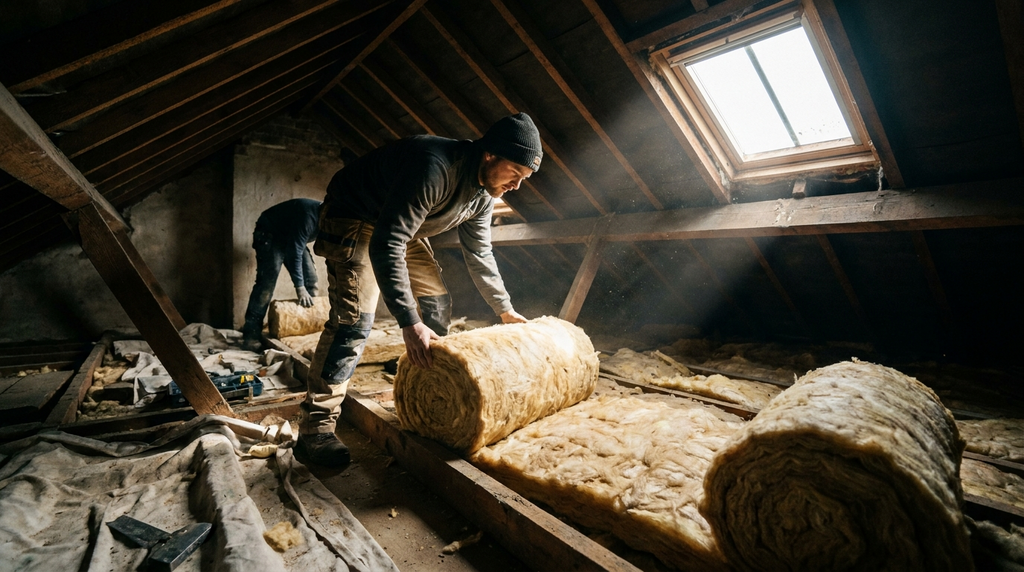
Loft insulation is the least disruptive and most DIY-friendly measure for a 1930s semi. The Energy Saving Trust recommends topping up to a depth of 270 mm, which for most 1930s semis means adding a second layer over existing insulation (Energy Saving Trust, 2026). DIY cost is typically £200–£400 for mineral wool rolls, while professional installation costs £400–£700.
Before topping up, check for damp patches, condensation, or blocked ventilation. 1930s semis often have cold-water tanks in the loft that need insulating separately with a tank jacket and pipe lagging. The loft hatch should also be insulated and draught-proofed. Annual savings of £150–£300 give a payback of 1–3 years, making this the fastest-returning insulation measure for any UK home.
Solid-wall insulation (internal or external) is the only option for solid-brick sections, but it costs significantly more and affects internal space or appearance
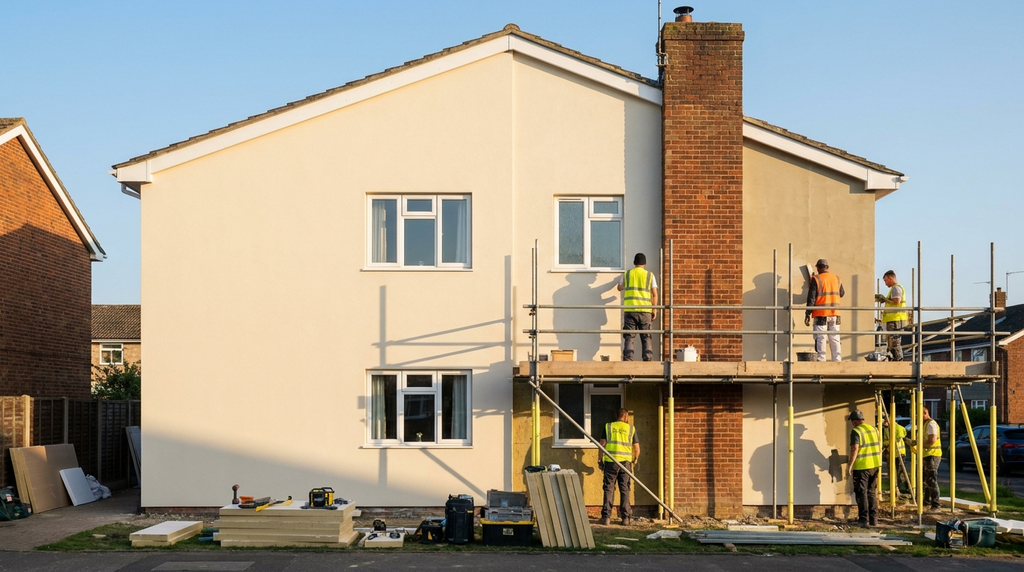
Solid-brick walls have no cavity to fill, so the only option is to add insulation to the internal or external face. External wall insulation (EWI) typically costs £8,000–£12,000 for a semi-detached home and involves fixing insulation boards to the outside, then rendering or cladding over them (Energy Saving Trust, 2026). This reduces the U-value from around 2.1 W/m²K to 0.25–0.35 W/m²K (BRE, 2026). EWI changes the external appearance of the house, so it may require planning permission if the property is in a conservation area.
Internal wall insulation (IWI) costs £4,000–£7,000 and involves fixing rigid insulation boards (typically 50 mm PIR) to the inside of external walls, then plastering over them (Energy Saving Trust, 2026). IWI reduces room size by 50–70 mm per wall and requires re-routing of electrical sockets and pipework. Annual savings of £300–£600 give payback periods of 8–20 years, depending on the system chosen and the area of solid wall treated.
Which insulation gives the best value for a 1930s semi in 2026?
Loft insulation offers the fastest payback (under 2 years) and is the least disruptive measure for a 1930s semi. Cavity-wall insulation is the most cost-effective structural upgrade if the cavity is suitable, with a payback of 2–6 years. Solid-wall insulation is necessary for solid-brick sections but requires the largest upfront investment and a longer payback of 10–20 years (Energy Saving Trust, 2026). The best value approach for most 1930s semis is to start with loft insulation, then add cavity-wall insulation if the cavity is clear, and finally consider solid-wall insulation for any solid-brick sections once the cheaper measures are in place.
How to verify a qualified installer for insulation work on a 1930s semi MCS
For cavity-wall insulation, the installer must be registered with the Cavity Insulation Guarantee Agency (CIGA) and hold TrustMark certification (GOV.UK, 2026). CIGA registration ensures the work is covered by a 25-year guarantee against defects. For solid-wall insulation, the installer should be MCS-certified if the system integrates with renewable heating (e.g. heat pumps) and must hold TrustMark (MCS, 2026). For loft insulation, no mandatory scheme exists, but TrustMark or NICEIC/NAPIT registration is recommended to ensure work meets building regulations (TrustMark, 2026). Always check the installer’s registration number on the relevant scheme’s website before commissioning any work. Guide to finding a TrustMark-registered installer What to expect from a cavity wall insulation survey
Frequently Asked Questions
The best approach combines cavity wall insulation (if the cavity is clear), loft insulation topped up to 270 mm, and solid-wall insulation on any solid-brick sections like bay windows. The Energy Saving Trust recommends a professional survey to identify which walls are cavity and which are solid before starting.
Cavity wall insulation for a typical 1930s semi costs between £500 and £1,500, depending on property size and access. The Energy Saving Trust estimates annual savings of £200-£400 on heating bills after installation.
Yes, most 1930s semis have cavity walls on the main structure, but solid-brick walls are common on bay windows, porches, and extensions. A survey by a National Insulation Association member is essential to confirm wall construction before any insulation work.
The typical wall U-value for a 1930s cavity wall is around 1.6 W/m²K, which is roughly four times worse than a modern building regulation target of 0.18 W/m²K. Retrofitting insulation can improve this significantly, reducing heat loss by up to 70% according to BRE data.
Yes, loft insulation is one of the most cost-effective measures for a 1930s semi. The Energy Saving Trust recommends topping up to 270 mm, which can save £200-£300 per year on heating bills and costs around £300-£500 to install professionally.