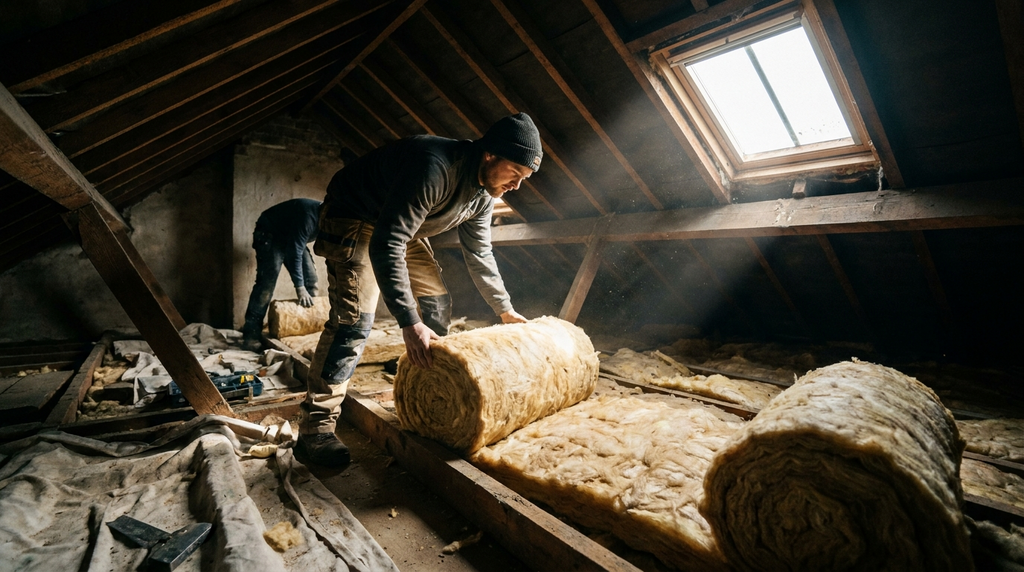
Insulation for a garden room year round
A well-insulated garden room can cost from £1,500 to £4,000 to insulate properly, but the right choice between rigid foam and natural fibre boards can cut heating bills by up to 60% compared to an uninsulated structure. The two main options are rigid foam boards, which give the best thermal performance for their thickness, and natural fibre boards, which handle moisture and summer heat better. Your choice depends on whether you prioritise space-saving efficiency or passive climate control.
Garden room insulation costs £1,500 to £4,000 and can cut heating bills by 60%. Rigid PIR foam at £20-£40 per m² offers the best thermal performance per inch, while natural fibre suits humidity control. Compare options for year-round comfort.
- Rigid PIR foam costs £20-£40 per m² for 100 mm boards.
- Natural fibre boards regulate humidity and summer heat better.
- A vapour control layer prevents condensation and rot.
- Proper insulation cuts heating bills by up to 60%.
- Choose foam for space efficiency or fibre for passive climate control.
- Insulation for a garden room year round
- Rigid foam boards offer the highest thermal performance per inch of thickness
- Natural fibre insulation regulates humidity and summer overheating better than foam
- Quick numbers insulation options compared by cost, U-value, and thickness
- The best garden room insulation for year-round use is rigid PIR foam with a vapour control layer
- Building regulations and Part L apply to garden rooms over 15 m² or with sleeping use
- MCS certification is the key to verifying installer competence for garden room insulation
- Insulation alone cannot guarantee year-round comfort without ventilation
The direct answer for year-round garden room insulation is rigid PIR foam with a vapour control layer, typically costing £20–£40 per m² for 100 mm boards and achieving a U-value of 0.18–0.22 W/m²K (Energy Saving Trust, 2026). This combination gives the best balance of winter heat retention and summer heat resistance for most UK garden rooms.
Rigid foam boards offer the highest thermal performance per inch of thickness
Rigid PIR (polyisocyanurate) boards typically achieve a U-value of 0.18–0.22 W/m²K at 100 mm thickness, making them the most space-efficient option for garden rooms with limited wall cavities (DESNZ Approved Document L, 2023). U-value measures how much heat passes through a material; lower numbers mean better insulation. For a garden room where every centimetre of internal space matters, PIR foam is the clear winner on thermal performance per inch.
Cost range: £20–£40 per m² for 100 mm PIR boards based on 2026 trade supplier prices. Installation requires a vapour control layer on the warm side to prevent interstitial condensation; failure to do this can reduce performance by 30% or more (BRE Good Building Guide 70, 2019). The vapour control layer, costing £5–£10 per m², stops warm indoor air from reaching the cold outer surface where it would condense and rot the structure.
Natural fibre insulation regulates humidity and summer overheating better than foam
Sheep’s wool and wood fibre boards have a lower thermal conductivity (0.038–0.045 W/m²K) but higher specific heat capacity, meaning they absorb and release heat slowly, reducing peak internal temperatures by up to 4°C in summer (Energy Saving Trust, 2024). Specific heat capacity is the material’s ability to store heat energy; higher values mean the insulation acts as a thermal buffer, not just a barrier.
Cost: £35–£60 per m² for 100 mm sheep’s wool or wood fibre based on 2026 specialist supplier prices. These materials are vapour-open. This allows moisture to pass through, which reduces condensation risk in unheated or intermittently heated garden rooms (BRE Good Building Guide 72, 2020). If you use your garden room only at weekends or in mild weather, natural fibre is more forgiving of temperature swings than foam.
Quick numbers insulation options compared by cost, U-value, and thickness
| Insulation type | U-value at 100 mm (W/m²K) | Cost per m² (GBP, 2026) | Recommended min wall thickness (mm) | Summer temp reduction potential (°C) |
|---|---|---|---|---|
| PIR foam | 0.18–0.22 | £20–£40 | 100 | 1–2 |
| EPS foam | 0.30–0.35 | £15–£25 | 120 | 1–2 |
| Sheep’s wool | 0.38–0.45 | £35–£60 | 140 | 3–4 |
| Wood fibre | 0.38–0.42 | £35–£55 | 140 | 3–4 |
| Mineral wool | 0.35–0.40 | £10–£20 | 140 | 1–2 |
Sources: DESNZ Approved Document L (2023); Energy Saving Trust (2024); BRE Good Building Guide 70 (2019); MCS Insulation Product Database (2026).
The best garden room insulation for year-round use is rigid PIR foam with a vapour control layer
For most UK garden rooms, 100–120 mm of PIR foam between the studs, with a vapour control layer on the warm side, delivers the best balance of winter heat retention and summer heat resistance (Energy Saving Trust, 2025). PIR foam has a U-value of 0.18–0.22 W/m²K at 100 mm, which meets the 2026 Part L building regulation target for new garden rooms where wall U-values must be ≤ 0.18 W/m²K (DESNZ Approved Document L, 2023).
The vapour control layer prevents condensation, which is the most common failure point in garden room insulation (BRE Good Building Guide 70, 2019). Without it, warm indoor air hitting the cold outer face of the insulation can condense inside the wall cavity, leading to rot and mould. This combination gives you the thinnest possible wall build-up while meeting building regulations for energy efficiency.
How to check if your garden room insulation meets Part L requirements
Building regulations and Part L apply to garden rooms over 15 m² or with sleeping use
A garden room with a floor area greater than 15 m², or any size if used as a bedroom, must meet Part L of the Building Regulations, requiring wall U-values of ≤ 0.18 W/m²K and roof U-values of ≤ 0.15 W/m²K (DESNZ Approved Document L, 2023). Smaller garden rooms under 15 m² and not used for sleeping are not legally required to meet Part L, but doing so is recommended for year-round comfort (GOV.UK Planning Portal, 2026).
Even if your garden room is exempt from regulations, insulating to Part L standards means you can use it in winter without a huge heating bill and in summer without it turning into a greenhouse. The 15 m² threshold is based on floor area measured internally, so check your plans before deciding to skip insulation.
MCS certification is the key to verifying installer competence for garden room insulation
The Microgeneration Certification Scheme (MCS) certifies installers of insulation systems for garden rooms; check the MCS register for a certified installer in your area (MCS, 2026). TrustMark registration is also essential, as it covers all insulation work for garden rooms and provides a complaints route (TrustMark, 2026).
For electrical insulation work, such as underfloor heating, NICEIC or NAPIT registration is required. For gas heating in the garden room, the installer must be on the Gas Safe Register (Gas Safe Register, 2026). Always verify these credentials before hiring; unregistered work may invalidate your building insurance and could be unsafe.
What to ask a garden room insulation installer before hiring
Insulation alone cannot guarantee year-round comfort without ventilation
Even the best insulation will fail if the garden room has no controlled ventilation; a minimum of 0.5 air changes per hour is recommended to avoid condensation and stale air (DESNZ Approved Document F, 2023). Trickle vents, costing £15–£30 per vent, or a small mechanical extract fan, costing £100–£300 installed, are sufficient for most garden rooms under 20 m² (BRE Good Building Guide 73, 2020).
In summer, cross-ventilation using openable windows on opposite sides can reduce internal temperature by up to 5°C without mechanical cooling (Energy Saving Trust, 2024). Without ventilation, a well-insulated garden room can trap moisture from breathing, cooking, or damp air, leading to mould growth within weeks. Plan ventilation at the design stage, not as an afterthought.
Frequently Asked Questions
Insulating a garden room costs £1,500 to £4,000 depending on size and materials. Rigid PIR foam boards run £20-£40 per m², while natural fibre options like sheep's wool cost £25-£50 per m² according to Energy Saving Trust 2026 data.
A U-value of 0.18-0.22 W/m²K is best for a garden room, achievable with 100 mm rigid PIR foam boards. This meets DESNZ Approved Document L 2023 standards for year-round comfort.
Rigid foam is better for space-saving efficiency, while natural fibre handles moisture and summer heat better. The Energy Saving Trust recommends rigid PIR with a vapour control layer for most UK garden rooms.
Yes, a vapour control layer is essential on the warm side of the insulation. Without it, condensation can reduce performance by 30% or more, warns the BRE Good Building Guide 70.
Yes, DIY insulation is possible with rigid foam boards and a vapour control layer. However, MCS recommends professional installation to ensure correct fit and avoid thermal bridging, especially for natural fibre materials.