Thinking about insulating your solid walls? You have two main options: internal and external wall insulation. Both stop heat escaping through your walls, but they work in very different ways and come with very different price tags and practical impacts.
Internal wall insulation costs £55–£100 per m², and external costs £100–£200 per m². The key trade-off is lower cost and less disruption with internal, versus no floor space loss and better thermal performance with external.
- Internal insulation costs £55–£100 per square metre.
- External insulation costs £100–£200 per square metre.
- External work may add £500–£1,500 for scaffolding.
- ECO4 grants target low-income homes with EPC D or below.
- Choose based on floor space loss vs exterior look changes.
- Internal wall insulation costs roughly £55–£100 per m²; external costs £100–£200 per m²
- Eligibility for grants depends on your property type, income, and EPC rating
- Quick numbers annual savings, payback, and heating bill reduction
- Internal wall insulation reduces floor space and requires redecoration; external does not
- The direct answer to "internal vs external wall insulation" is external is better for thermal performance and avoids condensation risk, but costs more
- You must use an MCS-certified installer for grant-funded wall insulation; TrustMark registration is also required
- Planning permission and building regulations apply to external insulation; internal may need permitted development
Internal wall insulation costs roughly £55–£100 per square metre, while external wall insulation costs £100–£200 per square metre. The choice affects not just your heating bills but also your floor space, your home’s look, and how much disruption you can handle.
Internal wall insulation costs roughly £55–£100 per m²; external costs £100–£200 per m²
The Energy Saving Trust publishes 2026 cost data that sets internal wall insulation at £55–£100 per square metre and external wall insulation at £100–£200 per square metre (Energy Saving Trust, 2026). The internal figure applies to standard solid-wall properties where you fix insulation board directly to the inside face. The external figure typically doubles that because it uses thicker insulation, a weatherproof render or cladding system, and more labour.
Neither figure includes scaffolding, which can add £500–£1,500 for external work. Your final cost depends on three variables: total wall area, how easy it is to access the walls, and the finish you choose. A plasterboard finish for internal insulation is cheaper than a specialist render for external insulation.
Eligibility for grants depends on your property type, income, and EPC rating
Two main government schemes can help with wall insulation costs. The Energy Company Obligation (ECO4) prioritises low-income households with an Energy Performance Certificate rating of D or below, and solid-wall insulation is a primary measure under that scheme (DESNZ, 2026). The Great British Insulation Scheme closed on 31 March 2026. It funded insulation measures only and never covered windows or glazing.
Private landlords must meet Minimum Energy Efficiency Standards (MEES), which require an EPC rating of E or above for new tenancies from 2025, now enforced in 2026. To check your eligibility, use the gov.uk “Find ways to save energy in your home” tool or contact your energy supplier directly.
Quick numbers annual savings, payback, and heating bill reduction
| Measure | Annual saving (detached) | Annual saving (semi-detached) | Payback period | Heating bill reduction (%) |
|---|---|---|---|---|
| Internal wall insulation | £200–£400 | £150–£300 | 10–15 years | 20–30% |
| External wall insulation | £250–£500 | £200–£400 | 12–18 years | 25–35% |
These figures come from the Energy Saving Trust and Ofgem (Ofgem, 2026). Payback assumes gas central heating. If you use oil or LPG, your payback period is shorter because fuel costs are higher. Savings also vary by wall type (solid walls lose more heat than cavity walls) and by climate zone within the UK.
Internal wall insulation reduces floor space and requires redecoration; external does not
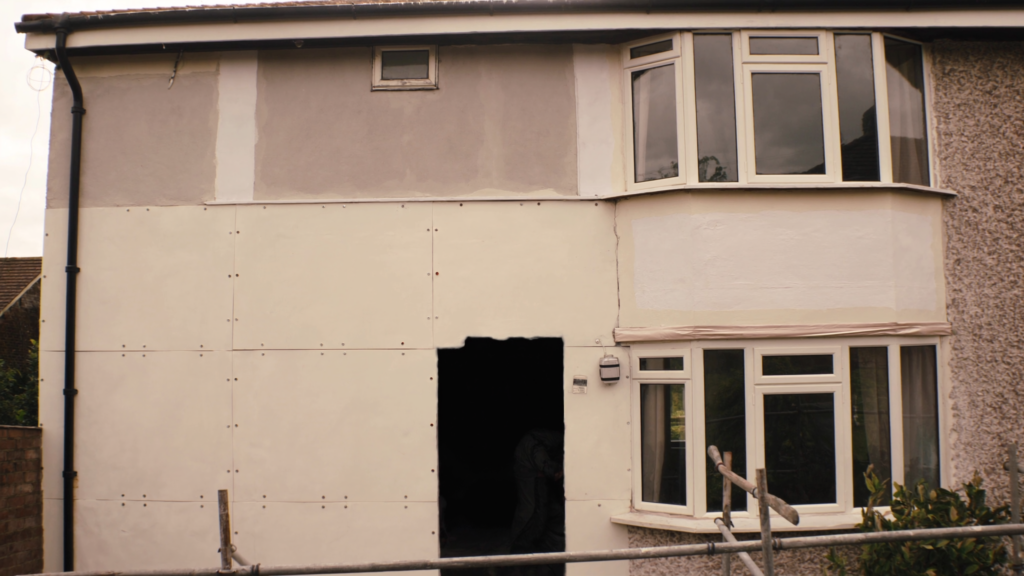
Internal wall insulation typically uses 50–100mm of insulation board fixed to the inside of your external walls. That reduces room width by 5–10cm. You also have to move skirting boards, sockets, and radiators, and redecorate the whole room afterward (Energy Saving Trust, 2026).
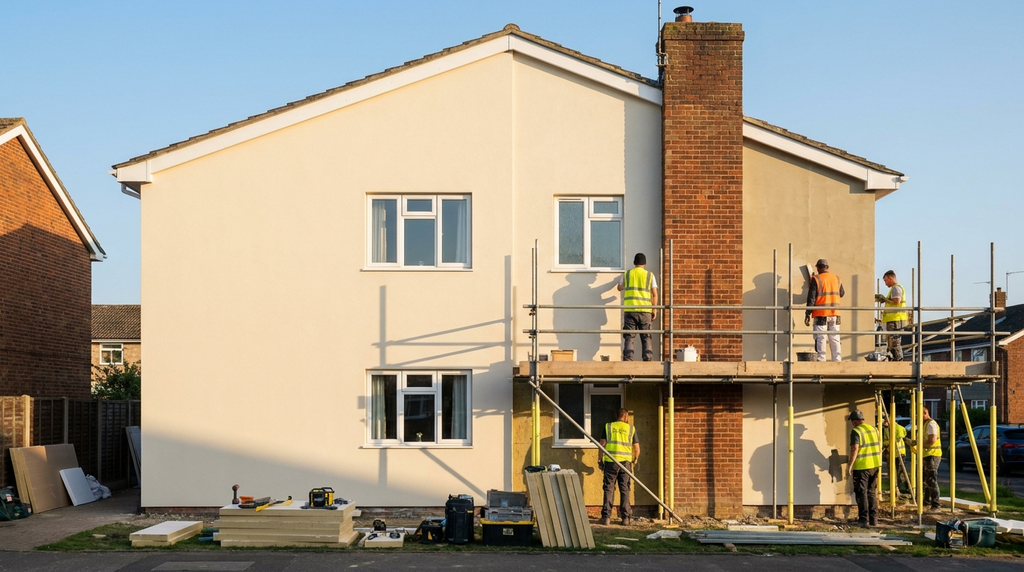
External wall insulation adds 60–100mm of insulation and a render or cladding system to the outside of your home. That increases the building footprint slightly, and window reveals need to be extended. But it leaves your internal floor space unchanged and avoids the need to redecorate rooms.
Internal is cheaper but more disruptive. External is more expensive but preserves your room sizes. Both require professional installation to avoid thermal bridging, which is where heat escapes through gaps in the insulation layer.
The direct answer to “internal vs external wall insulation” is external is better for thermal performance and avoids condensation risk, but costs more
The Building Research Establishment confirms that external wall insulation wraps the entire wall, eliminating cold bridges at floor and ceiling junctions (BRE, 2026). Internal insulation can create condensation problems if the vapour control layer is not correctly fitted. External is the preferred retrofit for listed buildings and conservation areas, though you still need planning permission.
For most homeowners, the choice comes down to budget, how much disruption you can tolerate, and whether planning constraints apply. If you plan to stay in the house long term and can afford the higher upfront cost, external gives better thermal performance. If you need a cheaper, quicker fix and can accept losing some floor space, internal works.
You must use an MCS-certified installer for grant-funded wall insulation; TrustMark registration is also required
ECO4 and GBIS both require that the insulation product and installer hold MCS certification (MCS, 2026). The installer must also be registered with TrustMark, which ensures they follow the PAS 2035/2030 retrofit standard (TrustMark, 2026).
Check both registers at mcs-certified.com and trustmark.org.uk before hiring anyone. For external insulation, also confirm the installer holds a relevant manufacturer accreditation, for example from Sto or K-Rend, which proves they have been trained on that specific system.
how to find an MCS-certified installer for wall insulation
Planning permission and building regulations apply to external insulation; internal may need permitted development
External wall insulation in a conservation area, on a listed building, or within a National Park requires planning permission from your local authority (GOV.UK, 2026). Internal wall insulation is usually permitted development, but you still need to comply with Building Regulations Approved Document L, which sets a U-value target of 0.30 W/m²K for solid walls (Approved Document L, 2026).
Both types of insulation require building regulations approval. A competent installer can self-certify through a registered scheme, so you do not need to apply separately. Check with your local planning authority before starting work to avoid enforcement action later.
what U-value you need for solid wall insulation
Frequently Asked Questions
Internal wall insulation costs £55–£100 per square metre, according to the Energy Saving Trust (2026). This covers insulation board fixed to the inside face of solid walls.
External wall insulation costs £100–£200 per square metre, as reported by the Energy Saving Trust (2026). The higher price reflects thicker insulation and a weatherproof render system.
The better choice depends on your priorities. Internal insulation reduces floor space but is cheaper, while external insulation preserves room size but changes your home's exterior and costs more, per Energy Saving Trust guidance.
The Great British Insulation Scheme closed on 31 March 2026. It funded insulation measures only and never covered windows or glazing.
Yes, both internal and external wall insulation can reduce condensation by keeping wall surfaces warmer. However, internal insulation requires a vapour control layer to prevent moisture buildup, as advised by the Energy Saving Trust.