The room before the curtain went up
Do you remember that awkward window? The one that sat there, bare and stark, a too-tall Victorian sash or a too-wide 1930s bay that seemed to dare you to do something with it. You’d walk past and feel the unfinished edge of the room, that cold slice of glass that refused to become part of the house. And then came the hesitation: pole or track? A decision that felt almost trivial, like choosing between two kinds of screw, yet somehow it changed how the whole room breathed.
After the right choice, the window stops being a hole in the wall. It becomes a frame for light, soft, held, deliberate. The morning sun falls differently; the evening shadow settles with a weight that feels earned. That quiet debate, the one you had with yourself in the curtain shop, turns out to be the hinge on which the room swings.
A pole announces itself; a track disappears
The first fork is simple: do you want the hardware to speak or to vanish? A pole is furniture. A length of brass, a warm wooden rod, finials that catch the eye like a full stop at the end of a sentence. It anchors the room’s personality, a chunky oak pole in a country kitchen, a slender black metal one in a minimalist sitting room. It says, I am here, and I matter.
A track, by contrast, is a quiet servant. It sits close to the ceiling or recessed into the window frame, letting the curtain do all the work. The fabric seems to float, no metal shouting at the plasterwork, no finial competing with the view. This matters because you gain a room that either celebrates its window dressing or lets the fabric, and the light, take centre stage. There is no wrong answer, only the one that suits your home’s temperament.
The bay window test
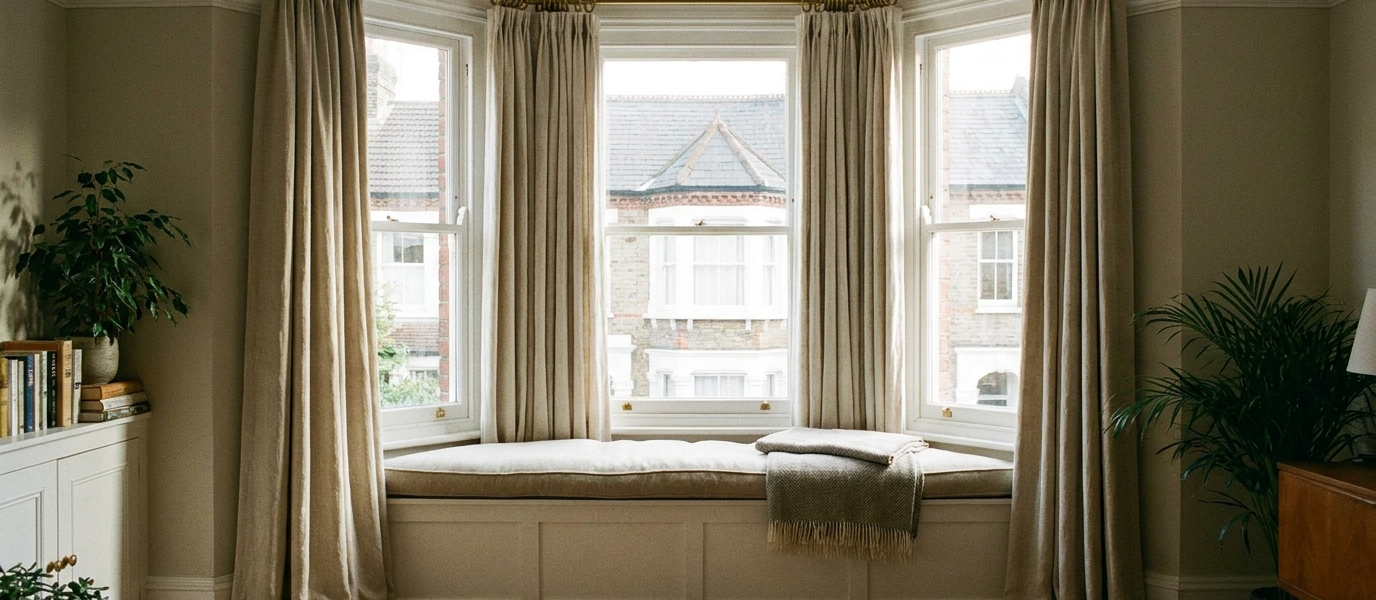
Three windows, one corner, no easy answer. The bay window is the great equaliser in this debate. Poles struggle with angles, bends and connectors that can look like an afterthought, a metal joint that interrupts the flow. You stand in the curve and see how the light pools differently: a straight pole forces the curtain to bunch, leaving a gap where the cold creeps in.
Tracks, however, flex around the geometry. They follow the architecture without forcing a straight line, curving gently to match the room’s bones. Standing in that curve, you feel the difference: the track disappears into the fabric, and the curtains sweep around the bay as if they were always meant to. The light falls evenly, and the window becomes a single, smooth gesture.
When the ceiling height makes the choice for you
Tall sash windows, the kind that run from floor to ceiling in a Georgian terrace, can be unforgiving. A pole, no matter how elegant, can dwarf the glass or lift the eye too high, creating a visual tug-of-war between the rod and the window’s proportions. You measure the drop, imagine the rod against the sky, and realise something is off.
A track mounted at the ceiling line changes everything. It disappears into the cornice, letting the fabric fall from the very top of the room. The curtain becomes a column of colour or texture, uninterrupted, stretching the eye upward. It is the quieter, taller choice, one that makes the room feel grand without the hardware shouting about it. For rooms with high ceilings or delicate architraves, the track is often the only answer that feels right.
Five ways a pole changes the light
Sometimes the pole wins, and when it does, the light changes in small, beautiful ways.
- The shadow of the finial on the wall at dusk. A brass pineapple or a turned wooden ball casts a long, soft shadow that moves as the evening light fades. It is a tiny sculpture, a moment of stillness.
- The ring’s clink when you pull the curtain. That small sound, metal on metal, or wood on wood, says home in a way no track ever can. It is a ritual, a comfort.
- The way a wooden pole warms a north-facing room. A rich walnut or a pale ash rod catches what little light there is, adding a warmth that the fabric alone cannot provide.
- The gap between rod and wall. That sliver of light, just a few millimetres, softens the edge of the curtain. It keeps the window from feeling sealed, letting the room breathe.
- The finial as a full stop. A polished end to the window’s sentence, a brass ball, a glass sphere, a carved wooden leaf. It finishes the room, gives it a sense of resolution.
Texture matters more than colour
The quiet debate becomes a sensory one. It is not about whether the pole is brass or black, or whether the track is white or grey. It is about what you touch when you close the curtains at night. Velvet on a brass pole has a weight, a drag, a soft resistance that feels luxurious. Linen on a white metal track glides, silent and cool, a whisper against the ceiling.
Heavy curtains need the grip of a chunky pole, something to hold onto, something that says this is substantial. Sheers want to float, and a track lets them do that, no fuss, no interruption. The choice becomes tactile: what do you want your hand to feel at the end of the day?
The final pull, what the room says back
Circle back to that awkward window, the one that felt unfinished. Now, with the hardware chosen, pole or track, brass or wood, visible or vanished, the room feels settled. The window is no longer a question mark. It is a frame, a source, a quiet participant in the day’s rhythm.
The best choice, in the end, is the one you stop noticing. Because the light, the fabric, the room itself have all become one thing. The pole or the track fades into the background, and all you see is the curtain falling, the shadow pooling, the room breathing easy. That is the quiet victory, a window that finally belongs.
door colour ideas