The door that used to disappear
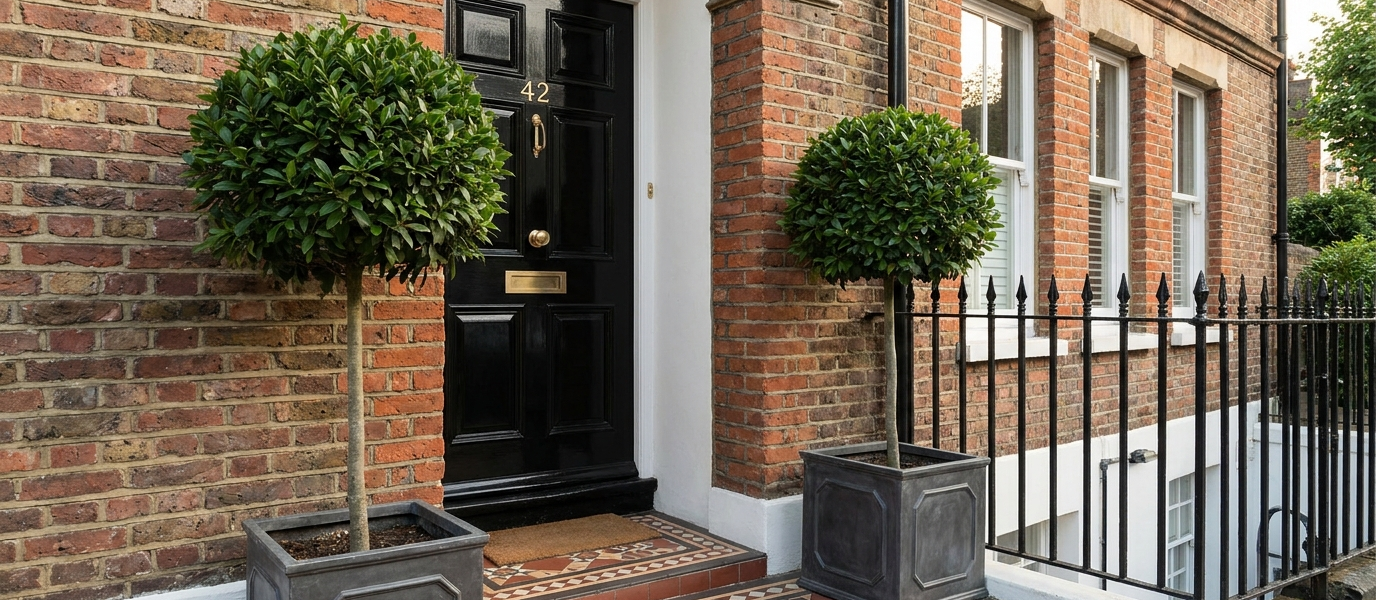
You know the scene. A front door that could belong to anyone, a flat rectangle of timber, flush with brickwork, doing its job and nothing more. The eye slides past it on the way to the letterbox. The entrance announces itself only by function, not by presence. Now picture the shift: flanked by clipped box spheres in lead-coloured planters, the same deep olive as the frame, and suddenly that door reads as an entrance. An arrival. The change wasn’t a new door or a coat of paint. It was the way the eye is held, framed, invited to pause before you even reach for the key.
This piece is about what happens when you stop treating your front door as a single object and start treating it as the centre of a composition. Symmetry, topiary, and the quiet authority of a well-considered threshold.
Why symmetry works where statement doors fail
A bold front door colour can feel like shouting. A shocking pink or a screaming yellow demands attention but rarely earns it. Symmetry does the opposite. Matching planters, identical topiary, balanced lanterns, these create quiet authority without a single renovation. The human eye craves equilibrium at thresholds. It signals safety, welcome, intention. Think of a terraced house with black paint and matching bay trees in glazed pots. The door itself is unremarkable. The whole composition is memorable. That’s the trick.
The best front door planters aren’t about the plants at all. They’re about the structure they create. A pair of identical containers grounds the door in the same way a threshold stone does. They give the eye something to land on, something to mirror, something to complete.
Pick a colour that softens with the seasons
Paint colours that shift in daylight add depth without demanding attention. A deep olive that reads charcoal in winter and sage in summer. A soft grey that warms in afternoon sun. The planter finish matters as much as the plant. Weathered zinc, aged lead, matte black, these hold their own against changing foliage and shifting light. You want a door that feels like it belongs to the house, not one that competes with it.
Consider Farrow & Ball’s Studio Green, almost black in shadow, a rich pine in direct light, paired with box spheres in lead-coloured pots. The effect is architectural without being theatrical. The door becomes part of the facade’s rhythm, not a disruption to it.
Let your front door do the heavy lifting
The door is the largest single surface in the composition. If it’s tired, nothing else will fix the balance. A re-glazed panel or restored timber changes the light that falls on the topiary, the shadow it casts across the step. Old sashes with draughty seals can be upgraded without changing the sightlines that make symmetry work. sash window draught proofing is one of those quiet improvements that transforms how a door feels without altering how it looks.
The same applies to windows. A restored frame with clear glass and crisp paintwork lets the planters do their work. If the door or window is shabby, the topiary reads as a distraction. If the architecture is sound, the greenery reads as an extension of it.
Eight ways to soften a tall sash window
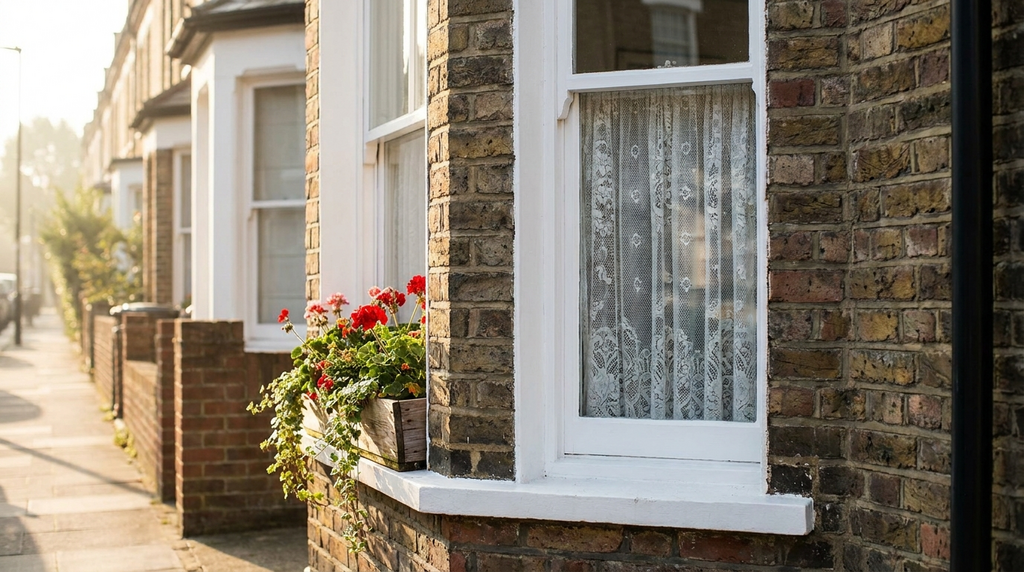
Tall sash windows are beautiful but can feel severe. The verticality needs to be balanced, not echoed. Here’s how:
- Place a single clipped ball on each side, not centred but pulled slightly forward to echo the window’s verticality.
- Use a low box hedge in a long trough beneath the sill, repeating the window’s width.
- Choose a planter material that picks up the frame colour, not the brick.
- Keep foliage dense and low, nothing that grows above the meeting rail.
- Introduce a second height (a taller topiary behind, a lower one in front) to mirror the window’s own proportions.
- Paint the window frame a shade darker than the wall so the planters read as extension of the architecture.
- Leave the glass itself clear, no film, no frost, no clutter on the sill, so the greenery is the only texture.
- Repeat the same plant on both sides of every window on the facade, even if the door gets a different arrangement.
This last point is important. Consistency across the facade creates a rhythm. The eye moves from window to door to window, and each one is anchored by the same dark green spheres. The house reads as intentional, not decorated.
What front door planters do that paint alone cannot
Planters add mass, shadow, and seasonal change, three things paint can’t deliver. The trick is not the plant but the pot. A pair of identical containers grounds the door in the same way a threshold stone does. Walk a Georgian terrace in Bath: the doors are all the same heritage white, but the houses with symmetrical topiary read as complete. The others read as waiting for something. front door colour ideas can get you part of the way, but without the physical presence of planters, the composition stays flat.
The cost? A pair of decent lead-effect planters runs around £100 to £300. Clipped box spheres, established and healthy, another £80 to £150 each. Compare that to a new door at £1,500 to £3,000. The planters do more for less.
The quiet lesson of the clipped sphere
Topiary is not about grandeur but about patience. A shape that takes years to form, then holds. The same principle applies to windows and doors: the best improvements are the ones that look like they were always there. A door flanked by dark green spheres, the fanlight above catching the last of the afternoon, and nothing else needed. The house doesn’t shout. It simply arrives.
And that’s the point. You don’t need a renovation. You don’t need a statement. You need a pair of pots, two clipped spheres, and the confidence to place them exactly where they belong.