The third state of a window
Most of us treat windows as binary things. Open or closed. Full light or full privacy. You pull the blind down, you push it up. You draw the curtain across, you haul it back. Two states, like a light switch. But a room does not live in two states. It lives in the dim, quiet hour just before dawn, in the hard glare of a July afternoon, in the soft glow of a lamp at nine o’clock on a November evening. Sheer curtains introduce a third state: the room that breathes without being exposed. This is not about softening a view. It is about changing how a room feels when you are in it.
Sheers are not a compromise. They are a deliberate choice to stop treating your windows as either open or closed, and to start treating them as something more fluid. Here is what they actually do to a room.
The quality of light you cannot get from blinds
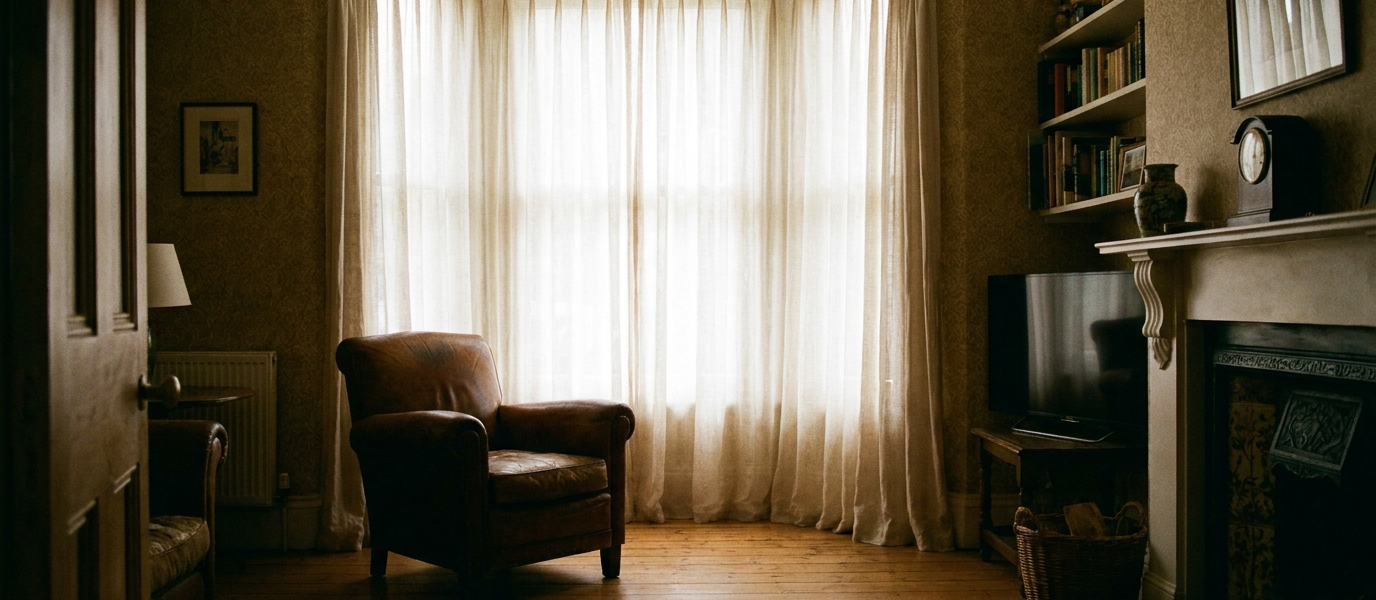
Blinds block light or they don’t. Even a Venetian blind, tilted just so, still throws hard lines across the floor. Sheers filter rather than block. The light that arrives is diffused, not direct. It eliminates harsh shadows and makes interiors feel quieter, as though someone has turned down the volume on the sun.
In north-facing rooms, sheers lift the grey flatness without adding glare. In south-facing rooms, they stop the afternoon sun from bleaching your furniture while keeping the room bright enough to read in. The reason this matters is simple: you stop fighting the light and start working with it. You stop squinting and start settling.
Let your front door do the heavy lifting
Street-facing sash windows, the kind found in a Victorian terrace or a 1930s bay, often feel like a compromise between wanting the view and wanting to live without an audience. You want the light, but you do not want the man on the bus to see what you are watching on television.
A single layer of sheer, hung from the top of the frame, blurs the boundary. You see movement and sky, not faces and car number plates. The psychological effect is immediate: the room opens up to the street without the room opening up to the street. You stop feeling like you are hiding behind a net curtain and start feeling like you are sitting in a room that happens to be on a street. It is a subtle shift, but it changes how you use the front room entirely.
Why texture matters more than colour
A white sheer is not a white sheer. Linen, cotton voile, and polyester each read completely differently in the same daylight. A friend once described linen sheers as “the ones that look like they have opinions,” and she was right. Linen sheers hold their shape and cast a soft, uneven shadow. They feel relaxed, slightly rumpled, like a linen shirt you have worn all day.
Cotton voile drapes like water and feels almost invisible. It is the fabric you forget is there until you notice how soft the light is. Synthetic blends stay crisp and clean, but they can look clinical, like a hospital cubicle curtain that has been ironed. The choice of texture changes whether the room feels relaxed, formal, or airy, before any colour decision is made. If you are choosing sheers for a room that already has a lot of pattern or colour, go for linen. If the room is neutral and you want the fabric to disappear, go for cotton voile. If you are renting and need something cheap and washable, go for polyester, but know what you are getting.
Eight ways to soften a tall sash window
- Floor-length sheers that pool slightly on the floor make a tall window feel intentional rather than gaping. That extra inch or two of fabric on the floor says: I meant to do this.
- Double-height windows in period properties can feel overwhelming. Sheers hung at the top of the frame and again at waist height break the vertical without blocking the architecture.
- Layering sheers with heavier drapes on a separate track allows the room to shift from soft to substantial in seconds. Morning sheers, evening velvet.
- Using a single panel on one side only creates asymmetry that draws the eye across the room. It works especially well in a narrow room where you want to widen the focus.
- Sheers gathered in the middle with a ribbon or clasp turns a flat window into a framed vignette. Think of it as a waist for your window.
- Hanging sheers outside the recess rather than inside it makes the window feel larger. The fabric wraps around the frame and the window reads as bigger than it is.
- A pelmet or valance above the sheers stops the fabric from looking like an afterthought in a room with high cornicing. It gives the window a brow.
- Sheers in a tone that matches the wall colour makes the window recede; a contrast tone makes it a feature. A soft Farrow & Ball Drop Cloth sheer on a Drop Cloth wall: invisible. A deep Setting Plaster pink sheer on a white wall: a statement.
The one rule about privacy at night
Sheers alone become translucent under artificial light. Anyone outside sees silhouettes and movement clearly after dark. It is the one thing nobody tells you when you fall in love with the idea of sheer curtains, and it is the reason many people give up on them.
The solution is not to abandon sheers but to pair them with a blackout roller or roman blind behind. That way, the room can switch between soft day and solid night. A good trick: install the sheer closer to the glass and the blackout layer on a separate track nearer the room, so the sheer still reads as the primary window treatment. You get the best of both worlds, and the room never has to choose.
How sheer curtains change the proportions of a room
A low ceiling feels higher when sheers are hung from the ceiling line rather than the window frame. The eye follows the fabric up, and the room grows with it. This is one of the cheapest tricks for making a 1960s house feel taller than it is.
A narrow window feels wider when the curtain pole extends beyond the window on both sides and the sheers sit outside the recess. The fabric becomes a frame around the window, and the window reads as wider than it is.
A room with multiple windows on one wall feels unified when a single continuous track runs the length of the wall and the sheers are pulled across as one soft plane. It turns a row of separate windows into a single, elegant feature. The room stops being about the windows and starts being about the wall of light.
The maintenance reality nobody mentions
Sheers collect dust visibly because they sit in the light. A room that looks pristine in the morning can look tired by afternoon if the fabric is not washed regularly. It is the one truth about sheer curtains that the Instagram accounts do not show you.
Machine-washable linen and cotton voile are practical. Polyester sheers trap static dust and can yellow over time, especially in rooms with direct sun. The trade-off is this: sheers that look effortless require more upkeep than blinds. But the difference in atmosphere, the way the room feels when you walk into it, the way the light sits on the furniture, the way you stop noticing the window and start noticing the room, is worth the extra wash cycle.