The first thing you notice isn’t the door
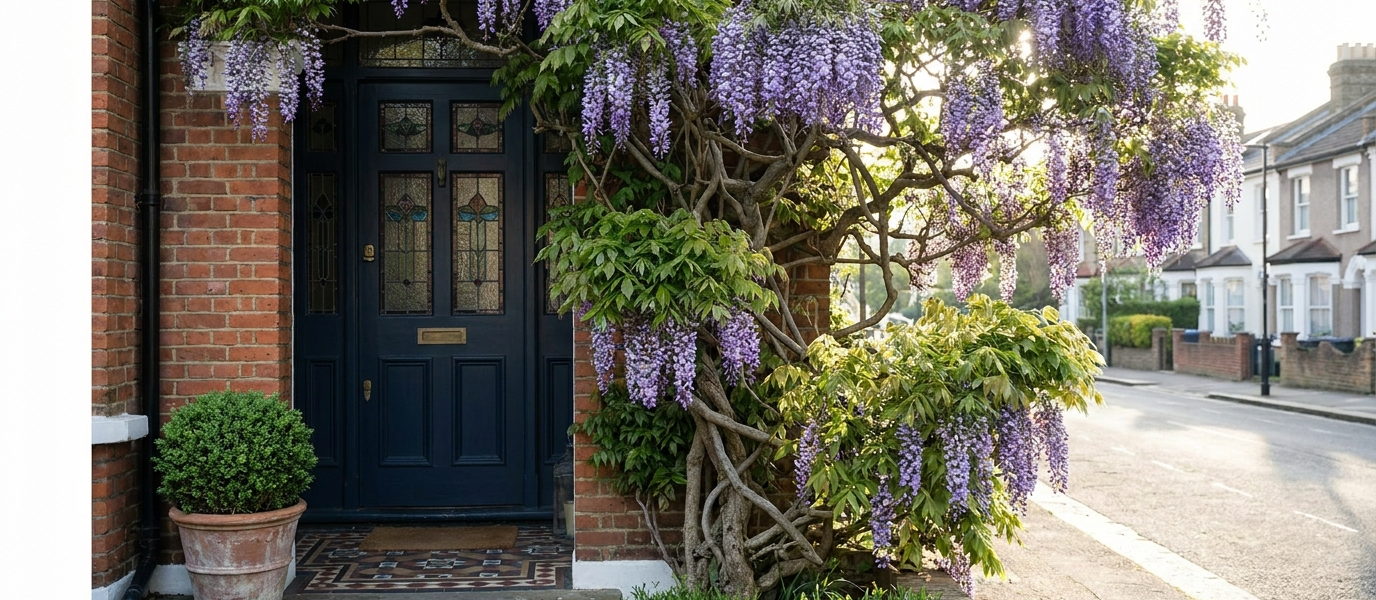
You catch the scent before you see it, a heady, violet-sweet drift that reaches you from three houses away on a still June evening. Then the dappled light on the step, the way the vine has softened the sharp geometry of the doorway into something almost painterly. The wisteria around a front door stops people mid-stride. They pull out phones. They pause. The door itself becomes a secondary detail, a frame for something that feels older and more deliberate than any front elevation you could design.
And then you live with it. The same vine that makes strangers sigh pulls gutters loose in autumn gales, finds its way through sash window frames, and leaves a carpet of petals that turns to brown mush on the doormat. This is the tension at the heart of the wisteria fantasy: the romance is real, but so is the maintenance. The trick is to design for both, to let the vine be the wildcard it wants to be, while anchoring it with choices that hold their own.
Let your front door do the heavy lifting
When the wisteria is the unpredictable element, your front door needs to be the steady one. A solid timber door, oak or engineered hardwood, with proper weatherstripping, matters more than you think when a vine creates a microclimate of damp against the frame. That constant shade and trapped moisture will test any paint finish, so choose a door that can take it.
Colour is where you set the terms. Against purple blooms, a pale door disappears. Instead, go deep: a charcoal like Little Greene Lamp Black, an olive such as Farrow & Ball Olive, or a warm ochre like Paint & Paper Library Stone V. These colours hold their own against the vine without competing. The door should read as intentional, not overwhelmed. The wisteria is the guest, not the protagonist.
Pick a colour that softens with the seasons
Here’s the thing nobody mentions in the Instagram captions: wisteria is only in flower for three to five weeks. The rest of the year, you’re looking at a tangle of grey-brown stems and green leaves against your front elevation. That’s eleven months of bare bones for one month of glory.
So choose your paint colour for the dormant phase first, and let the bloom be a bonus. Warm neutrals, Farrow & Ball Drop Cloth, Little Greene French Grey, let the winter structure of the vine read as sculptural rather than scruffy. Muted greens like Farrow & Ball Teresa’s Green echo the leaves without competing. Or go for a brick-toned stain on the door itself, so the grey stems feel like a natural extension of the house. The real trick is choosing a colour that looks good when the wisteria is bare and even better when it blooms, not the other way around.
Why texture matters more than colour
Wisteria bark has a twisted, rope-like quality that reads beautifully against smooth surfaces. Against a clean rendered wall, a flat brick elevation, or a painted timber door, the vine’s texture becomes a feature. But throw it against pebbledash or busy stonework, and it tips into chaos. The eye needs somewhere to rest.
Your window frames become the secondary texture story here. Slim-profile sash windows in black or dark bronze, think Chartwell Green or a deep anthracite, hold their own against the vine without shouting. They create a grid that the wisteria can weave around, rather than swallow. And there’s a tactile sequence to consider: the visitor pushes past soft leaves, feels the rough bark, then touches the smooth paintwork of the door. That contrast is part of the experience.
Eight ways to soften a tall sash window
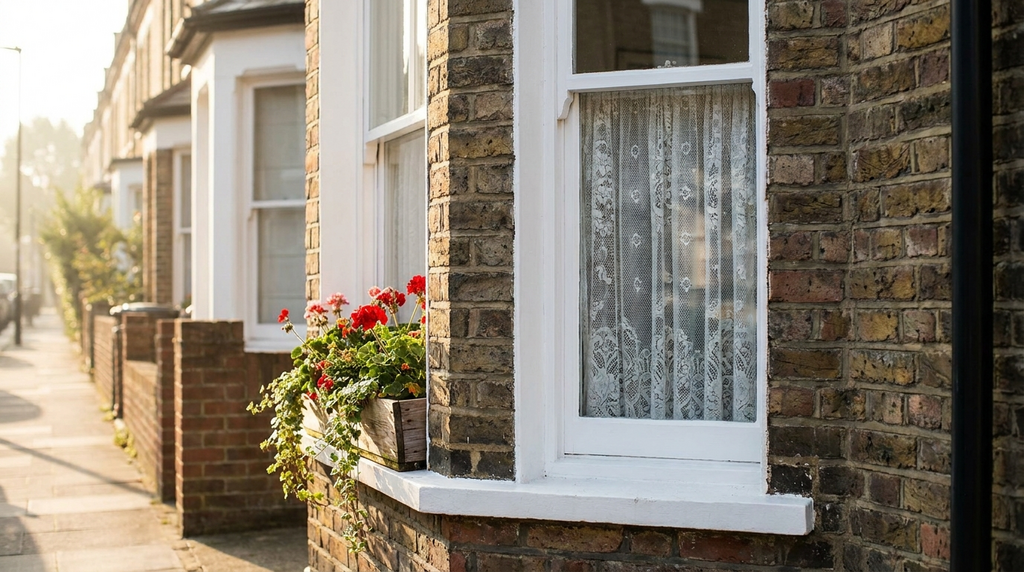
A tall sash window is the perfect canvas for wisteria, but only if you treat it like a painting, not a curtain. Here’s how to keep the romance without losing the light.
- Frame, don’t cover. Train the vine to run up the sides and across the top of the window, leaving the centre clear. The eye fills in the rest.
- Use a discreet wire system. A tensioned wire or slim trellis keeps growth off the glass and the frame’s paintwork. You avoid the scraping sound of stems against glass on windy nights.
- Prune for a loose shape. Think watercolour edges, not hedges. Wisteria trained into a tight topiary loses its romantic quality, let it drift.
- Catch the light, don’t block it. The vine’s shadow patterns across the window are often more beautiful than the vine itself. Let it cast, not obscure.
- Choose slim glazing bars. A window with narrow muntins reads as a foreground layer, not a solid obstruction. The vine becomes a veil.
- Keep the cill clear. A lantern, a potted bay tree, a simple stone, the cill is your secondary layer of interest below the vine.
- Allow one signature tendril. Let a single stem curl across the corner of the glass. It looks intentional, like a flourish.
- Accept half-dressed windows. Some windows will always be partially obscured. That’s part of the charm, a house that feels lived in, not staged.
For more on how your windows can work with, not against, the planting around them, see our guide to sash window styles for period homes.
The maintenance that makes the romance last
Let’s be honest: wisteria needs discipline. Twice-yearly pruning, once in summer (July or August) and once in winter (January), keeps it from eating your house. Without it, the vine will find your gutters, your roof tiles, and the gap between your sash window and its frame. It will pull render loose and rot the paintwork you just finished.
The parts most people forget: check behind the vine. At least once a year, pull it back from the wall and look for damp, rot, or loosened render. Keep the vine away from roof tiles and gutters, a single stem can lift a tile in a season. And if your door frame shows signs of moisture, that’s the vine telling you to cut it back further.
The romance only works when the vine feels curated, not feral. A well-kept wisteria looks effortless because someone put the effort in. That’s the secret the photographs don’t show you.
What the vine gives back
And yet. The first year you sit on the step at dusk and the scent hits you, that violet sweetness that seems to come from nowhere and everywhere at once, you’ll understand why people do it. The way the vine makes strangers slow down and smile. The way your house feels claimed by something older and slower than you.
The quiet satisfaction is in knowing you’ve balanced the picture with the practical. Your door still opens smoothly. Your windows still catch the light. The wisteria around your front door is exactly as wild as you allow it to be, and that’s the whole point. For more on keeping the entrance harmonious, see our piece on front door colour ideas.