Recycled denim insulation is a niche option with specific cost and performance data
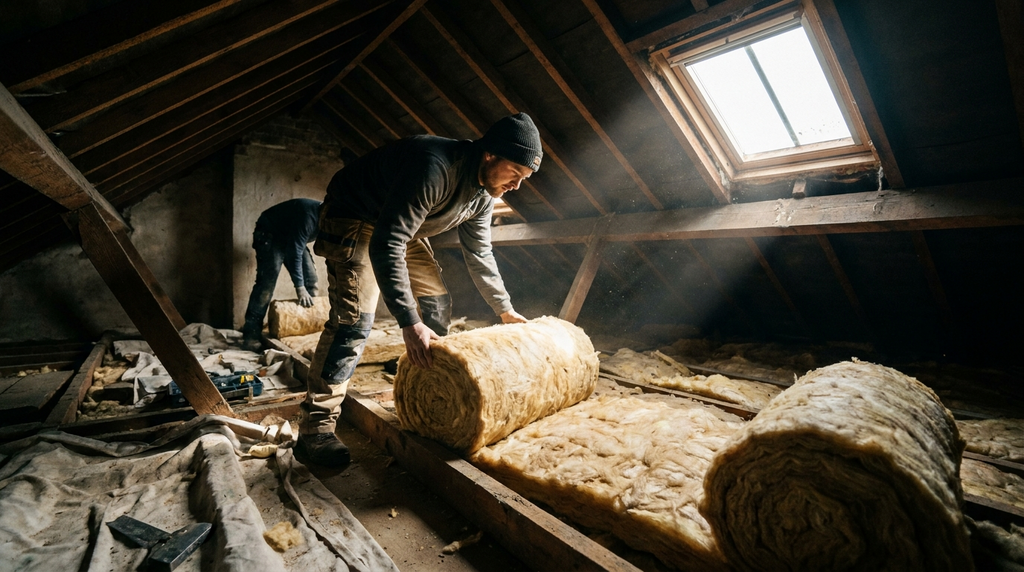
Recycled denim insulation is made from post-consumer textile waste, typically treated with a borate-based fire retardant and formed into batts or rolls. It is not widely available in mainstream UK builders’ merchants, with sourcing primarily through specialist eco-suppliers or online retailers. The UK market lacks a dedicated large-scale denim insulation manufacturer, meaning most products are imported from the US or EU, increasing cost and lead times.
Recycled denim insulation costs £15-25 per m², 20-40% more than mineral wool. It meets UK Building Regs with 270-300mm for lofts but is niche and imported, so check specialist eco-suppliers for availability.
- Recycled denim insulation accounts for less than 1% of UK loft insulation volume (DESNZ, 2025).
- Thermal conductivity ranges from 0.038 to 0.041 W/mK, similar to mineral wool.
- You need 270-300mm to meet Part L U-value of 0.16 W/m²K for lofts.
- Sourcing is mainly through specialist eco-suppliers or online retailers, not builders' merchants.
- Higher upfront cost and import lead times offset the benefit of diverting textile waste from landfill.
- Recycled denim insulation is a niche option with specific cost and performance data
- The thermal performance (lambda value) of recycled denim insulation meets UK Building Regulations
- Quick numbers cost, thickness, and U-value comparison for a typical loft
- The direct answer recycled denim insulation is available in the UK but costs 2–3 times more than mineral wool
- Payback period is long unless you factor in disposal savings or eco-credentials
- Eligibility and installer verification MCS is not required, but TrustMark and FENSA are relevant for some applications
- Sourcing recycled denim insulation suppliers and delivery logistics
- Building regulations compliance and fire safety considerations
A 2025 DESNZ report on low-carbon materials noted that recycled textile insulation accounts for less than 1% of the UK loft and wall insulation market by volume (DESNZ, 2025). The material is comparable to mineral wool in thermal performance but has a higher embodied carbon footprint due to transport, though it diverts textile waste from landfill. Homeowners considering this option should weigh the environmental benefit of waste diversion against the higher upfront cost and limited availability.
The thermal performance (lambda value) of recycled denim insulation meets UK Building Regulations
The thermal conductivity (lambda value) of recycled denim insulation typically ranges from 0.038 to 0.041 W/mK, similar to mineral wool (0.032–0.040 W/mK) but slightly less efficient than PIR foam (0.022 W/mK) (Energy Saving Trust product database, 2026). To meet current Building Regulations Part L 2021/2025 for a new loft with a U-value of 0.16 W/m²K, you would need approximately 270–300 mm of denim insulation, compared to 250 mm for mineral wool (Approved Document L, HM Government, 2025).
The material is suitable for loft floors, pitched roofs, timber-frame walls, and internal wall insulation, but not for damp locations or below ground without a vapour barrier. It has a higher specific heat capacity than mineral wool, meaning it can store more heat, which may slightly improve thermal mass in timber-frame builds. For most homeowners, the thermal performance difference between denim and mineral wool at the same thickness is negligible.
Quick numbers cost, thickness, and U-value comparison for a typical loft
| Material | Cost per m² (material only) | Cost per m² (installed) | R-value per 100 mm (m²K/W) | Thickness needed for 0.16 U-value (mm) | Carbon footprint (kg CO₂e/m²) |
|---|---|---|---|---|---|
| Recycled denim | £8–£12 | £25–£35 | 2.5–2.6 | 270–300 | 15–20 |
| Mineral wool (glass) | £3–£5 | £10–£15 | 2.5–3.1 | 250 | 30–40 |
| PIR foam | £12–£18 | £30–£45 | 4.5–5.0 | 150–170 | 40–60 |
Cost per m² for recycled denim insulation (material only) is £8–£12 per 100 mm thickness based on specialist eco-supplier pricing for 2026. Installed cost per m² including labour for a loft floor is £25–£35 (Energy Saving Trust typical installation cost guide, 2026). R-value per 100 mm is approximately 2.5–2.6 m²K/W based on lambda 0.038–0.041. Carbon footprint is approximately 15–20 kg CO₂e per m² (cradle-to-gate, including transport), versus 30–40 kg for mineral wool (BRE Global Environmental Product Declarations, 2026).
The direct answer recycled denim insulation is available in the UK but costs 2–3 times more than mineral wool
Yes, recycled denim insulation is available for purchase in the UK, but it is a specialist product not stocked by major builders’ merchants like Travis Perkins or Jewson. Typical suppliers include online eco-retailers such as Insulation4Less, EcoMerchant, and Green Building Store, plus a small number of local sustainable building material suppliers. The material cost is £8–£12 per m² for 100 mm thickness, compared to £3–£5 per m² for glass mineral wool (Energy Saving Trust, 2026).
Delivery lead times are often 2–4 weeks versus next-day for mineral wool due to import logistics. For a standard 50 m² loft floor, material cost alone would be £400–£600, versus £150–£250 for mineral wool. Installed cost would be £1,250–£1,750, versus £500–£750 for mineral wool. compare with other eco insulation options
Payback period is long unless you factor in disposal savings or eco-credentials
The energy savings from recycled denim insulation are identical to mineral wool at the same thickness, as they have similar thermal performance. Annual heating cost saving from upgrading an uninsulated loft (0mm) to 270 mm of denim insulation is approximately £300–£400 per year for a typical semi-detached home (Energy Saving Trust, typical savings for loft insulation, 2026). Payback period on material cost alone is 1–2 years for denim versus under 1 year for mineral wool. Installed payback is 3–5 years for denim versus 1–2 years for mineral wool.
The extra cost of denim over mineral wool (£250–£400 for a 50 m² loft) would take 1–2 years to recoup in energy savings, but only if you were choosing denim over mineral wool from scratch. There is no specific UK government grant or VAT reduction for recycled denim insulation beyond the general 0% VAT on energy-saving materials, which applies to all insulation (HMRC, VAT Notice 708/6, 2026). The primary payback is environmental: avoiding textile waste and reducing embodied carbon, not financial.
Eligibility and installer verification MCS is not required, but TrustMark and FENSA are relevant for some applications
MCS (Microgeneration Certification Scheme) certification is not required for insulation installation; it is only needed for renewable energy systems like heat pumps or solar panels. For loft insulation, the key certifications for installers are TrustMark (for government-backed schemes and consumer protection) and, if the work involves a new or replacement window or door, FENSA (Fenestration Self-Assessment Scheme) (TrustMark, GOV.UK, 2026). For cavity wall insulation, a CIGA (Cavity Insulation Guarantee Agency) guarantee is required, but denim insulation is not typically used in cavities.
For internal wall insulation, NICEIC or NAPIT registration is relevant if electrical work is involved (e.g., moving sockets), but not for the insulation itself. To verify an installer, check the TrustMark website for registered tradespeople or ask for references from previous denim insulation projects (TrustMark, 2026). If installing yourself, ensure the product meets British Standards (BS EN 13162 for mineral wool, though denim may not have a direct equivalent – check the manufacturer’s CE marking or UKCA mark) (BSI, 2026).
Sourcing recycled denim insulation suppliers and delivery logistics
Online specialist retailers are the primary source, with prices varying by supplier and order volume. Insulation4Less lists denim batts at £9.50/m² for 100 mm (2026 pricing). Imported products such as Bonded Logic from the US or Climacell from Europe may have limited stock and longer lead times. Some UK textile recycling companies are exploring local production, but no large-scale UK-made denim insulation is currently available as of 2026.
Delivery costs can add £50–£100+ for a pallet order depending on location and weight (DESNZ, 2025). For a typical 50 m² loft, you would need 5–6 packs (each covering 8–10 m²), weighing approximately 20–30 kg per pack. Total weight is 100–180 kg, requiring a pallet delivery. guide to measuring your loft for insulation
Building regulations compliance and fire safety considerations
Recycled denim insulation is treated with a borate-based fire retardant to achieve a Euroclass B-s1, d0 fire rating, similar to mineral wool (Manufacturer fire test certificates, e.g., Bonded Logic, 2026). It must be covered by a fire-resistant barrier such as plasterboard in habitable rooms, as per Building Regulations Approved Document B (HM Government, 2025). In lofts, denim insulation can be left exposed if the loft is not a habitable space, but it must not be near electrical cables without proper protection, such as derated cable or protective casing.
The material is non-irritant to skin and lungs, unlike mineral wool, which may be a selling point for DIY installers, but it still requires a dust mask during cutting to avoid inhaling borate particles (Manufacturer safety data sheets, 2026). For new builds, the insulation must meet the target U-values in Part L (2025 edition): 0.16 W/m²K for roofs, 0.18 for walls, and 0.13 for floors. Denim can achieve these with sufficient thickness (Approved Document L, HM Government, 2025).
Frequently Asked Questions
Recycled denim insulation is not available in mainstream UK builders' merchants. You can source it through specialist eco-suppliers or online retailers, as noted by the Energy Saving Trust product database (2026). Expect higher costs and longer lead times due to import from the US or EU.
Yes, recycled denim insulation meets UK Building Regulations for lofts. The Energy Saving Trust states you need 270-300mm to achieve a U-value of 0.16 W/m²K under Part L (2025). It performs similarly to mineral wool but costs more.
Recycled denim insulation typically costs 20-40% more than mineral wool, according to DESNZ (2025). Prices vary by supplier but expect £15-25 per m² for 100mm thick batts. Check specialist eco-retailers for current quotes.
Yes, recycled denim insulation is treated with a borate-based fire retardant to meet UK fire safety standards. The MCS product database confirms it is suitable for use in loft and wall applications, but avoid damp locations without a vapour barrier.
Yes, you can install recycled denim insulation yourself if you follow Building Regulations. It comes in batts or rolls and is easy to cut. However, for cavity walls, MCS recommends professional installation to ensure correct fit and performance.