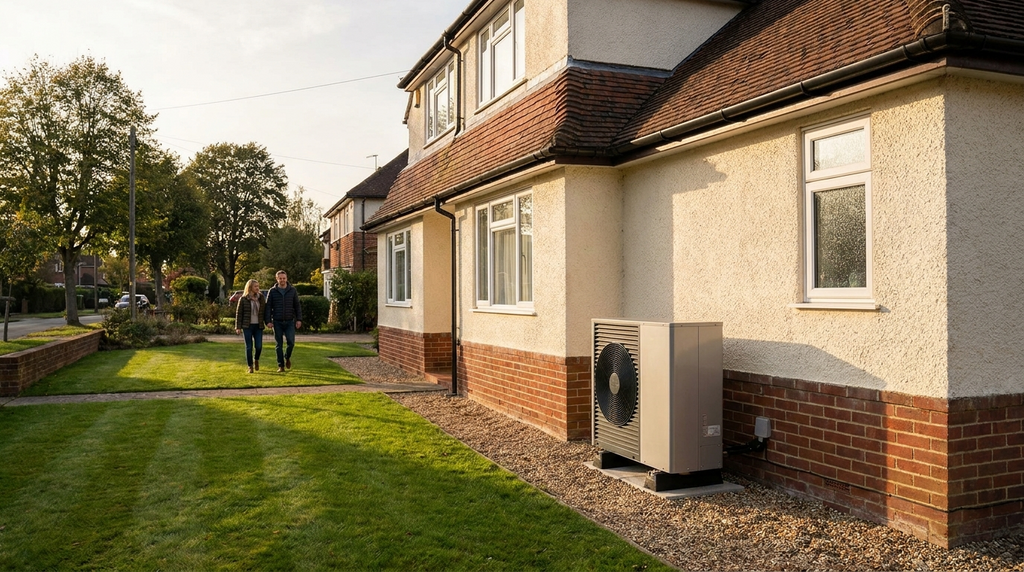
The average running cost of a heat pump in 2026 is £850–£1,200 per year for a typical three-bedroom home.
If you are considering replacing your gas boiler, the question of running costs is likely top of your list. The direct answer is that a heat pump will typically cost you between £850 and £1,200 per year to run for a three-bedroom home, based on the 2026 Ofgem price cap of 24.5p/kWh for electricity (Ofgem, 2026). This figure assumes a typical heat pump Seasonal Coefficient of Performance (SCOP) of 3.0, which means it delivers 3 kWh of heat for every 1 kWh of electricity it consumes (Energy Saving Trust, 2026).
Heat pump running costs in 2026 are £850-£1,200 per year for a 3-bed home, compared to £700-£900 for a gas boiler. The higher electricity price is offset by the heat pump’s 300% efficiency (SCOP 3.0), making the difference manageable for most households.
- Average heat pump running cost is £850-£1,200 per year for a 3-bed home.
- SCOP of 3.0 means 300% efficiency, offsetting higher electricity rates.
- A SCOP of 2.5 costs 20% more to run than a SCOP of 3.0.
- Gas boiler costs £700-£900 annually at 6.0p/kWh in 2026.
- Improving SCOP from 3.0 to 3.5 saves £140 per year on a 12,000 kWh demand.
- The average running cost of a heat pump in 2026 is £850–£1,200 per year for a typical three-bedroom home.
- How the Seasonal Coefficient of Performance (SCOP) directly determines your running costs.
- Quick numbers annual running cost comparison for a 12,000 kWh heat demand home.
- The direct, plain-English answer are heat pumps expensive to run compared to a gas boiler?
- What you must know about the Boiler Upgrade Scheme grant and its impact on payback.
- How to verify your installer is certified and eligible for the grant.
- The one factor that can make a heat pump cheaper to run than a gas boiler a smart tariff.
For comparison, a modern gas boiler running at 90% efficiency on the current 2026 gas price of 6.0p/kWh costs roughly £700–£900 annually for the same home. The higher upfront electricity cost is offset by the heat pump’s efficiency: it delivers 3 kWh of heat for every 1 kWh of electricity used, whereas a boiler delivers only 0.9 kWh of heat per 1 kWh of gas burned.
How the Seasonal Coefficient of Performance (SCOP) directly determines your running costs.
The SCOP is the single most important factor in your heat pump running cost. It is the heat pump’s average efficiency over a whole year, expressed as a ratio. A SCOP of 3.0 means 300% efficiency, the pump produces three units of heat for each unit of electricity consumed. The official formula from the Standard Assessment Procedure (SAP) methodology is: (Annual heat demand in kWh ÷ SCOP) x electricity price per kWh (DESNZ, 2026).
A poorly installed or oversized heat pump with a SCOP of 2.5 will cost roughly 20% more to run than one with a SCOP of 3.0. Conversely, modern, well-designed heat pumps in 2026 typically achieve a SCOP between 3.0 and 4.0. The difference between a SCOP of 3.0 and 3.5 on a 12,000 kWh annual heat demand is about £140 per year, which adds up significantly over the system’s 15–20 year lifespan.
Quick numbers annual running cost comparison for a 12,000 kWh heat demand home.
| Heating System | Annual Running Cost (12,000 kWh demand) | Annual Cost with 2026 Prices |
|---|---|---|
| Gas boiler (90% efficient) | £800 | £800 |
| Heat pump (SCOP 3.0) | £980 | £980 |
| Heat pump (SCOP 3.5) | £840 | £840 |
| Electric storage heaters | £2,940 | £2,940 |
| Oil boiler (85% efficient) | £1,176 | £1,176 |
These figures are based on the 2026 Ofgem price cap (electricity 24.5p/kWh, gas 6.0p/kWh), a typical heat demand of 12,000 kWh/year for a three-bedroom home (DESNZ, 2026), and Energy Saving Trust boiler efficiency data (Energy Saving Trust, 2026). The oil boiler figure uses a 2026 oil price of 8.5p/kWh.
The direct, plain-English answer are heat pumps expensive to run compared to a gas boiler?
At 2026 energy prices, a heat pump is typically 10–20% more expensive to run annually than a modern gas boiler. This is because electricity is roughly four times more expensive per kWh than gas, even though the heat pump uses three times less energy to deliver the same amount of heat. The Energy Saving Trust confirms this gap in its 2026 heat pump running cost analysis (Energy Saving Trust, 2026).
The gap narrows significantly if you have solar panels or a time-of-use electricity tariff (like Economy 7 or a smart tariff). For homes switching from oil, LPG, or electric storage heaters, a heat pump is almost always cheaper to run. The comparison table above shows a heat pump at SCOP 3.5 is actually cheaper than an oil boiler by over £300 per year.
What you must know about the Boiler Upgrade Scheme grant and its impact on payback.
The Boiler Upgrade Scheme (BUS) provides a £7,500 grant in 2026 towards the installation of an air source heat pump (GOV.UK, 2026). The average installed cost of a heat pump in 2026 is £10,000–£15,000, meaning the grant reduces your outlay to £2,500–£7,500. This grant is a fixed amount, not a percentage, so it covers a larger proportion of a smaller installation.
The payback period, the time it takes for lower running costs to offset the installation cost, is typically 5–10 years, depending on your current heating system and energy prices. If you are replacing oil or LPG, the payback is often under 5 years because those fuels are significantly more expensive per kWh than gas. Heat pump installation cost breakdown and payback calculator
How to verify your installer is certified and eligible for the grant.
Installers must be MCS (Microgeneration Certification Scheme) certified to install heat pumps eligible for the Boiler Upgrade Scheme. You can check an installer’s MCS certification on the MCS website (MCS, 2026). Installers should also be TrustMark registered for consumer protection, which provides a route for dispute resolution if something goes wrong (TrustMark, 2026).
For the BUS grant, the installer must handle the application on your behalf; you cannot apply yourself. The grant is deducted from the installer’s invoice, so you pay the reduced amount upfront. If an installer tells you to apply yourself, they are not following the scheme rules and you should find another installer.
The one factor that can make a heat pump cheaper to run than a gas boiler a smart tariff.
Time-of-use tariffs (like Octopus Cosy, EDF GoElectric, or Economy 7) offer cheaper electricity during off-peak hours, often 4p–10p/kWh overnight compared to the standard 24.5p/kWh cap (Ofgem, 2026). If you can schedule your heat pump to run mostly during these cheaper hours, using a buffer tank to store heat, your running costs can drop below those of a gas boiler.
A heat pump on a smart tariff with a SCOP of 3.5 can cost as little as £500–£700 per year, which is cheaper than the £800 gas boiler cost shown in the table above. This is the single biggest lever to make a heat pump cheaper to run than gas. Best smart tariffs for heat pumps in 2026
Frequently Asked Questions
Yes, heat pumps cost about £150-£300 more per year than a gas boiler on current 2026 prices. The Energy Saving Trust states a typical heat pump runs at £850-£1,200 annually versus £700-£900 for a gas boiler, though savings depend on your home's heat demand and system SCOP.
A good SCOP for a heat pump in 2026 is 3.0 or higher, with modern well-designed systems achieving 3.0 to 4.0. The Energy Saving Trust notes that a SCOP of 3.0 means the pump delivers 3 kWh of heat per 1 kWh of electricity. That makes it efficient enough to offset higher electricity costs.
Monthly running costs for a heat pump in a typical 3-bed home range from £70 to £100, based on the 2026 Ofgem price cap of 24.5p/kWh. This figure assumes a SCOP of 3.0 and varies with season and heating demand.
Yes, heat pumps use electricity but are very efficient. According to the Energy Saving Trust, a heat pump with a SCOP of 3.0 uses about 4,000 kWh of electricity per year to deliver 12,000 kWh of heat, compared to a gas boiler using 13,333 kWh of gas for the same output.
Yes, heat pumps are generally cheaper to run than oil boilers in 2026. Oil prices are volatile, but at current rates, a heat pump costs £850-£1,200 annually versus £1,200-£1,800 for oil, according to Ofgem data. The heat pump's higher efficiency offsets the electricity cost.