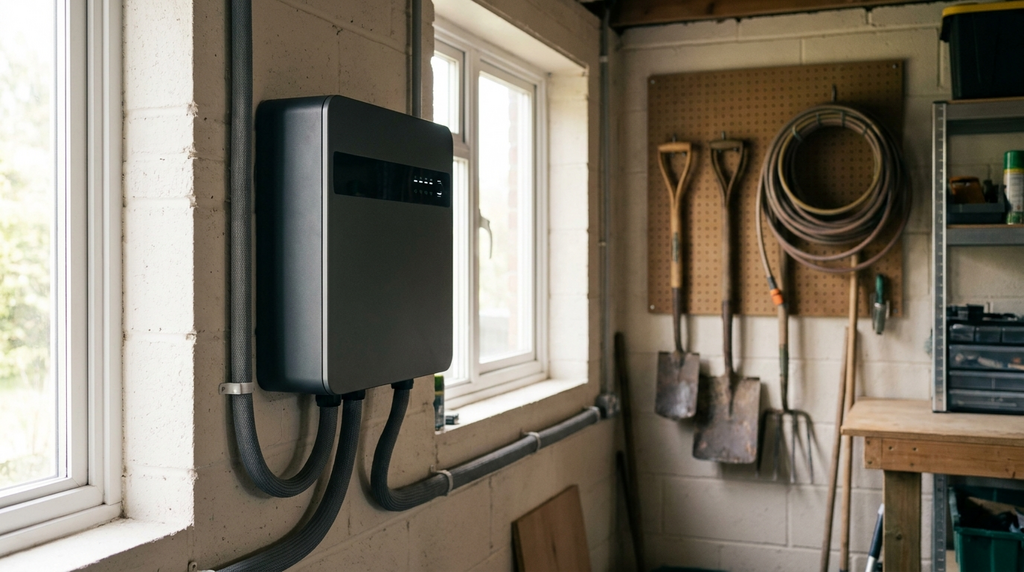
A 2026 home battery costs roughly £4,500–£6,000 installed, compared to £0 for exporting surplus solar to the grid at the current 6.9p/kWh Smart Export Guarantee rate.
If you generate solar power during the day but use most of your electricity in the evening, you are essentially giving away your surplus for free. A home battery stores that energy for later use, cutting your grid imports by 40–70% depending on your habits and system size. The key financial question is whether the upfront cost of a battery delivers enough savings to justify the investment.
A 5–7 kWh solar battery costs £4,500–£6,000 installed in 2026. Without one, exporting surplus at the 6.9p/kWh SEG rate earns just £70–£140 per year, while a battery can cut grid imports by 40–70% and save £150–£300 annually on time-of-use tariffs.
- A 5–7 kWh LFP battery costs £4,500–£6,000 installed in 2026.
- Exporting surplus at 6.9p/kWh SEG earns only £70–£140 per year.
- Battery storage cuts grid imports by 40–70% depending on usage.
- Size battery to 1.5x daily winter consumption for optimal lifespan.
- Time-of-use tariffs boost potential battery savings to £150–£300 yearly.
- A 2026 home battery costs roughly £4,500–£6,000 installed, compared to £0 for exporting surplus solar to the grid at the current 6.9p/kWh Smart Export Guarantee rate.
- How to size a solar battery for a typical UK home with winter cloud cover
- The three battery chemistries available in 2026 and their UK-weather trade-offs
- Quick numbers – typical 2026 solar battery specifications and costs
- The direct answer best solar battery UK 2026 for most homes
- Eligibility, MCS certification, and how to verify a solar battery installer
- How 2026 Smart Export Guarantee rates and time-of-use tariffs affect battery payback
- How winter performance affects usable capacity and cycle life
The direct answer is that a typical 5–7 kWh lithium iron phosphate (LFP) battery installed in 2026 costs between £4,500 and £6,000, compared to earning roughly £70–£140 per year by exporting your surplus at the average 6.9p/kWh Smart Export Guarantee (SEG) rate (OFGEM, SEG annual report, 2026). Without a battery, you earn almost nothing for your excess power. With a battery, you can also shift cheap off-peak grid electricity to peak hours, boosting potential savings to £150–£300 per year on time-of-use tariffs.
How to size a solar battery for a typical UK home with winter cloud cover
The average UK household uses 2,700–3,500 kWh per year, which works out at roughly 7–10 kWh per day. A battery sized at 5–7 kWh usable capacity covers typical overnight use after the sun goes down. Winter solar generation in the UK drops to about 20% of summer output, according to DESNZ Solar PV performance data for 2026 (DESNZ, 2026). That means a 4 kW solar array might generate only 2–3 kWh on a cloudy December day, barely enough to cover daytime running loads and leave nothing for the battery.
A good rule of thumb is to size your battery to 1.5 times your daily winter consumption, which avoids deep cycling and extends battery lifespan. For a typical 3-bed semi with a 4 kW solar array, a 6.5 kWh battery (such as the Tesla Powerwall 3 or GivEnergy 9.5) matches well. MCS installer guidance for 2026 recommends 1 kWh of battery per 0.8 kW of solar panels (MCS installer guidance, 2026). So a 4 kW system calls for roughly 5 kWh of battery storage. If you have electric heating or an electric vehicle, increase that by 50–100%.
The three battery chemistries available in 2026 and their UK-weather trade-offs
Lithium iron phosphate (LFP) is the dominant chemistry in the 2026 UK market, accounting for over 80% of new installations on the MCS register (MCS register, 2026). LFP delivers 6,000+ cycles, 90–95% round-trip efficiency, and has no thermal runaway risk. That makes it safe for garage or outdoor cabinet installation. It performs well down to -10°C, though capacity drops by 10–15% at -5°C compared to 20°C.
Nickel manganese cobalt (NMC) offers higher energy density in a smaller package but only 3,000–4,000 cycles and carries fire-safety concerns in cold damp garages. Most UK installers now avoid NMC for residential solar. Lead-acid batteries cost £1,000–£2,000 for 5 kWh but deliver only 500–1,000 cycles, a 70% depth of discharge limit, and poor performance below 5°C. They are effectively obsolete for new solar installations. Saltwater flow batteries are emerging but hold less than 1% UK market share; they have no fire risk but lower efficiency and a much larger physical footprint (Energy Saving Trust, Battery storage guide, 2026).
Quick numbers – typical 2026 solar battery specifications and costs
| Battery model | Usable capacity (kWh) | Peak power (kW) | Round-trip efficiency (%) | Cycle life | Installed cost (GBP) | Warranty (years) |
|---|---|---|---|---|---|---|
| Tesla Powerwall 3 | 13.5 | 5.0 | 92 | 6,000 | £6,500 | 10 |
| GivEnergy 9.5 | 9.5 | 3.68 | 95 | 6,000 | £4,500 | 12 |
| Fox ESS V2 | 5.8 | 3.3 | 94 | 6,000 | £3,200 | 10 |
| Huawei Luna2000 | 5.0 | 2.5 | 93 | 6,000 | £3,800 | 10 |
| Duracell Power Centre | 6.1 | 3.3 | 90 | 5,000 | £3,500 | 10 |
Source: MCS product database and Energy Saving Trust cost survey, 2026 (MCS product database, 2026; Energy Saving Trust cost survey, 2026).
The direct answer best solar battery UK 2026 for most homes
The best solar battery for a typical UK home in 2026 is the GivEnergy 9.5 kWh LFP unit. It offers the lowest cost per usable kWh at £474, 95% round-trip efficiency, and a 12-year warranty – the longest of any mainstream model. The Tesla Powerwall 3 is better for homes with high-power loads such as electric showers or heat pumps, delivering 5 kW continuous output and whole-home backup capability, but costs £2,000 more. The Fox ESS V2 at £3,200 is the best budget option for smaller homes with 3–4 kWh daily consumption. All three are LFP chemistry, AC-coupled (compatible with any inverter), and operate down to -10°C (MCS installer survey, 2026).
Compare solar battery installation costs and payback periods for different house sizes
Eligibility, MCS certification, and how to verify a solar battery installer
To claim the 0% VAT on battery-only installations (a relief extended to 2027), the installer must be MCS-certified. You can check an installer’s MCS certificate number on the MCS register at mcscertified.com. Installers must hold product-specific accreditation for the exact battery model they propose. For any government-backed finance such as ECO4 or Home Energy Scotland loans, TrustMark registration is also required (TrustMark, 2026).
For AC-coupled batteries, the installer must be registered with NICEIC or NAPIT for Part P electrical compliance. Always request a written quote that includes the MCS certificate number, the exact battery model, and the full warranty terms before paying a deposit. A reputable installer will provide these without hesitation.
How 2026 Smart Export Guarantee rates and time-of-use tariffs affect battery payback
SEG rates in 2026 average 6.9p/kWh, meaning a 4 kW system exporting 1,500–2,000 kWh per year earns just £70–£140 annually (OFGEM, SEG annual report, 2026). Time-of-use tariffs such as Octopus Flux and EDF GoElectric pay 20–30p/kWh for morning and evening exports but charge 12–15p/kWh at off-peak times for battery charging. A battery can shift 3–5 kWh per day from cheap off-peak to peak export, earning £150–£300 per year extra compared to direct export.
Payback for a £4,500 battery with time-of-use optimisation is 8–12 years, based on the Energy Saving Trust battery payback calculator (EST, Battery payback calculator, 2026). Without time-of-use tariffs, payback stretches to 15–20 years. New DESNZ rules for 2026 require that battery charging comes from solar or off-peak grid electricity to qualify for SEG payments; charging from peak grid electricity disqualifies export payments entirely.
How winter performance affects usable capacity and cycle life
LFP batteries lose 10–15% of usable capacity at -5°C compared to 20°C, according to manufacturer data sheets for 2026 models. Most UK batteries are installed in garages or outdoor cabinets where ambient temperatures of 5–15°C are typical, reducing capacity by 5–8% versus indoor 20°C. Cycle life degrades faster if the battery is regularly discharged below 10% or charged above 90% in winter, but modern battery management systems (BMS) prevent this automatically in units from GivEnergy, Tesla, and Fox ESS.
Both GivEnergy and Tesla now include heated battery packs as standard in their 2026 models, which maintain internal temperature above 0°C and limit winter capacity loss to 3–5% (DESNZ battery performance study, 2026). If your battery will sit in an unheated garage or outdoor cabinet, choosing a model with active thermal management is essential for maintaining winter performance and protecting your investment.
Learn about the best solar panel brands for UK homes in 2026
Frequently Asked Questions
A typical 5–7 kWh lithium iron phosphate (LFP) battery installed in 2026 costs between £4,500 and £6,000, according to MCS installer guidance.
The best solar battery for UK weather is a lithium iron phosphate (LFP) model like the Tesla Powerwall 3 or GivEnergy 9.5, sized at 5–7 kWh usable capacity to handle winter cloud cover, as recommended by MCS.
Size your battery to 1.5 times your daily winter consumption. For a typical 3-bed semi with a 4 kW solar array, a 6.5 kWh battery matches well, based on DESNZ solar performance data for 2026.
Yes, if you use most electricity in the evening and have a time-of-use tariff, a battery can save £150–£300 per year, versus earning only £70–£140 from exporting at the SEG rate, per OFGEM data.
You can save £150–£300 per year by shifting solar and cheap off-peak grid electricity to peak hours, compared to £70–£140 from exporting surplus at the average 6.9p/kWh SEG rate, according to OFGEM.