A conservatory can be a valuable extra room, but many homeowners find it too cold in winter and too hot in summer. The question of how to achieve year-round comfort often leads to discussions about heat pumps. However, a heat pump is rarely the most practical or cost-effective solution for the specific conditions of a UK conservatory.
The most important thing to know is that a conservatory does not need a heat pump to be comfortable year-round. The key is to match the heating and cooling method to the building’s existing regulations and the conservatory’s thermal performance. This guide covers four proven, low-capital options, underfloor heating, electric radiators, thermal blinds, and solar film, that work with or without a heat pump.
Underfloor heating, the only heating method that works with a conservatory’s thermal mass
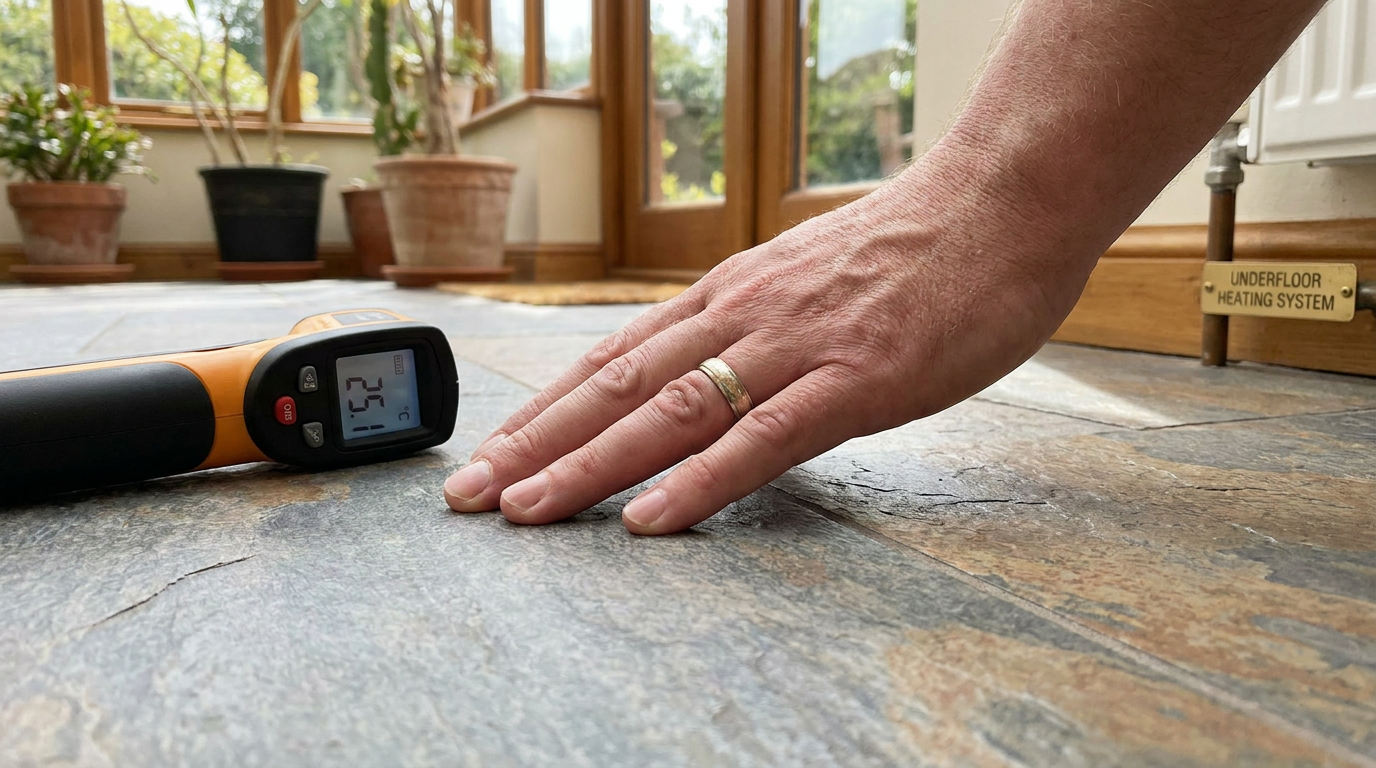
Electric underfloor heating (UFH) directly heats the concrete or screed slab, which stores heat and releases it slowly. This makes it ideal for conservatories that have a solid floor and are used for more than a few hours a day. According to the Energy Saving Trust, UFH can be 15–25% more efficient than panel radiators in rooms with a high floor-to-ceiling ratio, which conservatories often have (Energy Saving Trust, 2026).
The installation cost for a 20 m² conservatory is typically between £2,500 and £4,500 (Energy Saving Trust, 2026). The running cost is roughly 8–12 pence per kWh of input electricity. However, there is a key caveat: UFH requires a minimum 50 mm screed depth. If the conservatory was built on a suspended timber floor, UFH is not viable without structural work.
Electric radiators, the cheapest upfront option for occasional-use conservatories
For a conservatory used only a few hours a week, a 1.5–2.0 kW oil-filled electric radiator with a built-in thermostat is the lowest capital cost option. The price range is £150 to £400 per unit (Which?, 2026). At the UK average electricity rate of 28p/kWh under the Ofgem price cap for January to March 2025, a 2 kW radiator running for 4 hours costs roughly £2.24 (Ofgem, 2026). Note that the cap resets in April 2025, so running costs may change.
Do not use a heat pump for occasional heating in a conservatory. The coefficient of performance (COP) drops below 2.0 in the 5–10 °C supply temperatures conservatories often need. This makes direct electric heating cheaper per kWh of delivered heat.
Quick numbers, heating and cooling cost comparison for a 20 m² conservatory
| Method | Upfront cost (installed) | Running cost per 4-hour session | Best for | Source |
|---|---|---|---|---|
| Electric UFH | £2,500–£4,500 | £2.24 (2 kW at 28p/kWh) | Frequent use, solid floor | EST underfloor heating guide 2026; Ofgem price cap |
| Electric radiator | £150–£400 | £2.24 (2 kW at 28p/kWh) | Occasional use | Which? heating guide 2026; Ofgem price cap |
| Thermal blinds | £300–£800 | £0 (passive) | Summer heat reduction | EST window coverings guide 2026 |
| Solar control film | £200–£600 | £0 (passive) | Summer glare and heat | Glass and Glazing Federation technical note 2026 |
Thermal blinds and solar control film, how to cut summer overheating without air conditioning
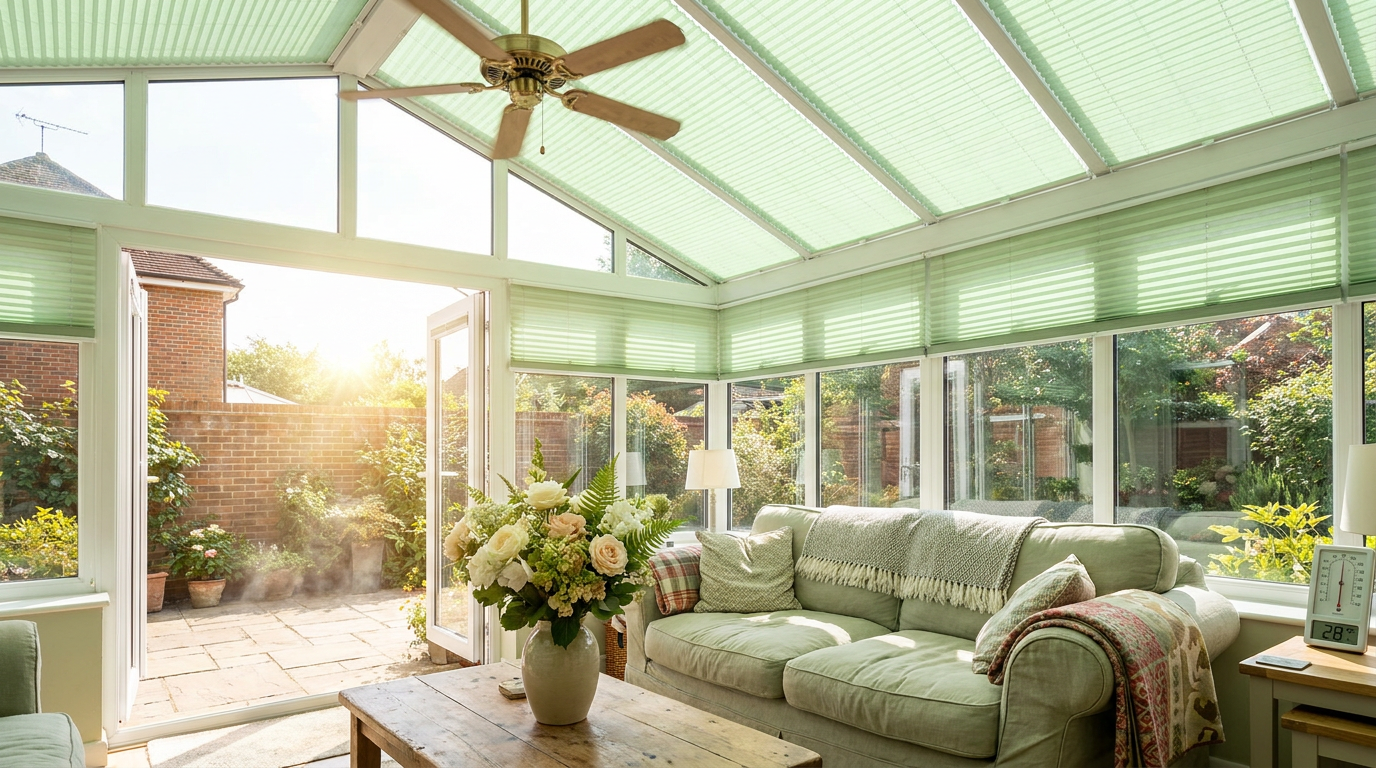
Thermal blinds, such as honeycomb or cellular blinds with a reflective backing, can reduce solar heat gain by up to 70% (Energy Saving Trust, 2026). Solar control film applied to the inside of the glass can reject 75–85% of infrared heat (Glass and Glazing Federation, 2026). Both options are passive, they cost nothing to run and have no moving parts.
For winter, thermal blinds also reduce heat loss through the glass by 30–40% (Energy Saving Trust, 2026). That makes them a year-round solution.
Can a conservatory be used all year without a heat pump?, the direct answer
 reading 25 degrees” loading=”lazy” width=”1376″ height=”768″ />
Yes, but only if the conservatory has a solid roof, not polycarbonate, and is built to current building regulations. Part L covers insulation standards, and Part O covers overheating prevention. For a conservatory built before 2010, when Part L was less strict, the answer is usually no. The glass-to-floor ratio is too high and the roof insulation too thin.
The practical solution for older conservatories is to use a combination of an electric radiator for winter and solar film plus thermal blinds for summer. This can extend usable months to 8–10 per year. For more on managing temperature extremes in extensions, see how to insulate a conservatory roof.
How to verify your installer, MCS, TrustMark, and Gas Safe registration
For any electric heating, such as UFH or radiators, the electrician must be registered with a competent person scheme such as NICEIC or NAPIT. This is a legal requirement under Part P of the Building Regulations. For gas heating, such as a radiator connected to a boiler, the installer must be Gas Safe registered. You can check the register at GasSafeRegister.co.uk.
For solar film or thermal blinds, no specific certification is required. However, the installer should be a member of the Glass and Glazing Federation (GGF) for warranty-backed work. TrustMark is a government-endorsed quality scheme covering all trades. You can verify any installer’s TrustMark registration at TrustMark.org.uk. For more on choosing a reliable tradesperson, see how to find a certified heating installer.
The eligibility trap, why most conservatories are not eligible for the Boiler Upgrade Scheme or ECO4
The Boiler Upgrade Scheme (BUS) and the Energy Company Obligation (ECO4) are designed for heat pumps and insulation, not for electric radiators or solar film. Conservatories are specifically excluded from ECO4 unless they are physically integrated into the main dwelling, meaning there is no external door between the conservatory and the house (DESNZ ECO4 guidance, 2026).
The BUS grant of £7,500 only applies to heat pumps. If the conservatory is not the primary heating zone, the grant is not available (GOV.UK, 2026). For a standard conservatory, the only government support is the 0% VAT on energy-saving materials, such as solar film, insulation, and blinds. This is confirmed by HMRC VAT Notice 708/6 (HMRC, 2026).
Frequently Asked Questions
Electric underfloor heating is the best option for daily use, costing £2,500–£4,500 installed (Energy Saving Trust, 2026). For occasional use, a 1.5–2.0 kW electric radiator from £150 is more practical.
Running an electric radiator for 4 hours a day costs roughly £1.68 at the Ofgem price cap rate of 28p/kWh (2026). Underfloor heating costs 8–12p per kWh of input electricity.
Yes, solar film blocks up to 80% of solar gain and costs £200–£500 for a typical conservatory (Which?, 2026). Thermal blinds and ventilation also help.
Yes for solid floors with 50 mm screed depth, the Energy Saving Trust says UFH is 15–25% more efficient than radiators in conservatories (2026). It fails on suspended timber floors.
An electric oil-filled radiator from £150 is the cheapest upfront option (Which?, 2026). Running costs at 28p/kWh are higher than gas, but for occasional use it is cost-effective.