A DIY boiler check reduces the risk of carbon monoxide leaks and minor breakdowns, but it never replaces a Gas Safe registered engineer’s annual service
Every gas boiler in a UK home must be serviced annually by a Gas Safe registered engineer to maintain the manufacturer’s warranty and landlord compliance. A DIY check between professional services helps homeowners spot early warning signs of developing faults. Carbon monoxide poisoning causes approximately 50 deaths per year in the UK (HSE, 2026).
A DIY boiler check costs nothing and takes 20–30 minutes. It helps spot early warning signs like low pressure or faulty alarms, but never replaces the annual Gas Safe registered engineer service required for warranty and safety.
- Test all CO and smoke alarms weekly using the test button.
- Replace CO alarm batteries immediately if it chirps.
- Replace CO alarms every 5–7 years per manufacturer label.
- Check boiler pressure on gauge: 1.0–1.5 bar when cold.
- Repressurise boiler if pressure drops below 0.5 bar.
- A DIY boiler check reduces the risk of carbon monoxide leaks and minor breakdowns, but it never replaces a Gas Safe registered engineer's annual service
- The single most important DIY task is testing all carbon monoxide and smoke alarms weekly
- Checking boiler pressure on the gauge prevents system lockouts and cold radiators
- Quick numbers, key boiler health indicators for a DIY check
- Inspecting visible pipework and the condensate pipe prevents winter freeze blockages
- Bleeding radiators and checking for cold spots maintains system efficiency
- Verifying an MCS-certified or Gas Safe registered engineer for the annual service
The homeowner’s check covers visible, accessible items only, never internal combustion chamber components, gas pressure tests, or flue integrity checks. These tasks are straightforward and take around 20–30 minutes. They are built to catch problems early, not to replace the engineer’s annual service.
The single most important DIY task is testing all carbon monoxide and smoke alarms weekly
Press the test button on each alarm every week and replace batteries immediately if the alarm chirps. CO alarms should be replaced every 5–7 years depending on the manufacturer’s stated lifespan printed on the device. Fit a CO alarm in every room containing a gas appliance, including the boiler cupboard and any room with a gas fire (HSE guidance on CO alarms, 2026).
Test alarms using the dedicated test spray for CO detectors, not by holding the alarm near the boiler, this damages the sensor. A working CO alarm is the only warning system for a flue blockage or incomplete combustion. Without one, you have no way of detecting a leak until symptoms appear.
Checking boiler pressure on the gauge prevents system lockouts and cold radiators
Normal operating pressure for a combi boiler is 1.0–1.5 bar when the system is cold (Worcester Bosch, 2026). Locate the pressure gauge on the front panel or underside of the boiler, digital models show the reading on the display. If pressure drops below 0.5 bar, repressurise using the filling loop according to the boiler manual. Pressure above 2.5 bar when cold indicates a fault requiring a Gas Safe engineer, never attempt to bleed the boiler itself.
Check the pressure once a month and after bleeding radiators. A sudden drop in pressure over a few days usually means a leak in the system. A slow drop over months is normal and can be topped up as needed.
Quick numbers, key boiler health indicators for a DIY check
| Measurement | DIY target range | When to call an engineer |
|---|---|---|
| Boiler pressure (cold) | 1.0–1.5 bar | Below 0.5 bar or above 2.5 bar |
| CO alarm age | Replace every 5–7 years | After expiry date or if test fails |
| Boiler flow temperature | 55–60°C for condensing efficiency | Above 65°C reduces efficiency (Energy Saving Trust, 2026) |
| Radiator bleeding | Every 6–12 months | Cold patches at top after bleeding |
The flow temperature is the temperature of the water leaving the boiler to the radiators. Setting it to 55–60°C allows the boiler to operate in condensing mode, which is more efficient. how to set boiler flow temperature for maximum efficiency
Inspecting visible pipework and the condensate pipe prevents winter freeze blockages
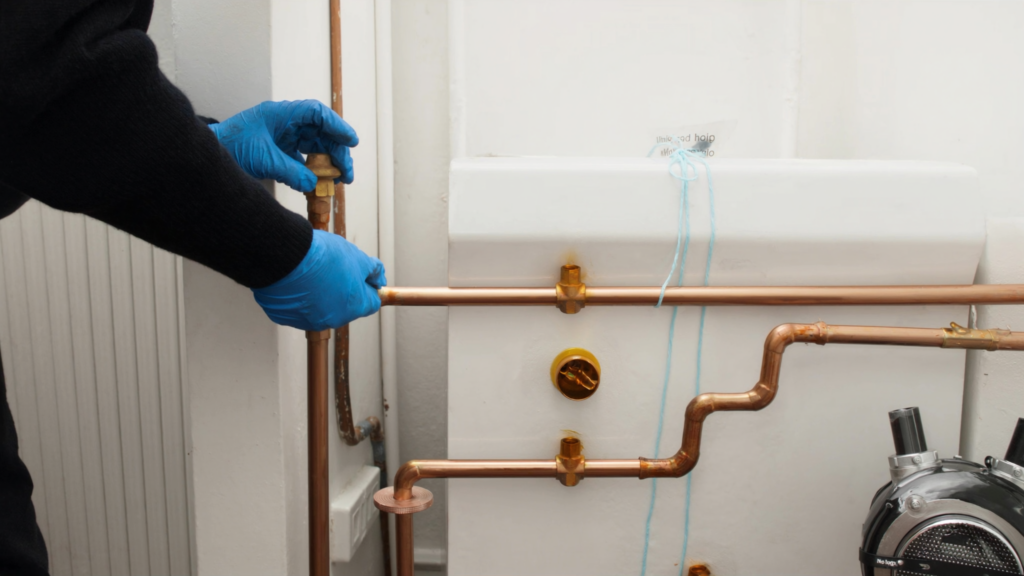
Check all visible pipe joints under the boiler and around the pump for signs of corrosion, green staining on copper, or active dripping. The condensate pipe (plastic pipe running from the boiler to an outside drain) must be insulated in unheated areas, uninsulated sections freeze at -5°C and cause boiler lockouts (OFTEC, 2026). Clear any leaves or debris from the external end of the condensate pipe termination. Look for soot marks around the boiler casing or flue terminal outside, these indicate incomplete combustion and require immediate engineer callout.
Condensate pipe blockages are the most common cause of boiler lockouts in winter. If you see water leaking from the pipe joints or the pipe is sagging, support it with pipe clips.
Bleeding radiators and checking for cold spots maintains system efficiency
Turn the heating on fully and feel each radiator from top to bottom, cold patches at the top indicate trapped air that needs bleeding. Use a radiator key to open the bleed valve until air stops hissing and water appears, then close it firmly. Check for cold radiators at the bottom, these indicate sludge buildup and may need a powerflush from a heating engineer. Bleed radiators when the system is cold to avoid scalding and to ensure accurate pressure reading afterward.
If you bleed a radiator and the cold patch returns within a week, there is likely an ongoing air ingress problem. This should be checked by a Gas Safe engineer. signs your central heating system needs a powerflush
Verifying an MCS-certified or Gas Safe registered engineer for the annual service
The annual service must be carried out by a Gas Safe registered engineer, check their ID card and note the registration number. Verify the engineer’s registration at gassaferegister.co.uk before allowing any work to begin. For oil boilers, the equivalent registration is OFTEC, check the technician’s registration at oftec.org. Keep the service record in the boiler logbook or take a photo of the certificate for warranty claims and home insurance compliance.
An unregistered engineer invalidates your boiler warranty and your home insurance. The Gas Safe Register publishes a list of all registered engineers and their qualifications. If you are unsure about any aspect of the service, ask the engineer to explain what they checked and what they found.
Frequently Asked Questions
No. A DIY check does not replace the annual service by a Gas Safe registered engineer. The professional service covers internal combustion components, gas pressure tests, and flue integrity, which are illegal and dangerous for homeowners to attempt (Gas Safe Register, 2026).
Test your CO alarm weekly by pressing the test button. Use dedicated test spray rather than holding it near the boiler, as that damages the sensor (HSE, 2026). Replace the alarm every 5–7 years.
Normal operating pressure for a combi boiler is 1.0–1.5 bar when the system is cold (Worcester Bosch, 2026). If pressure drops below 0.5 bar, repressurise using the filling loop. Above 2.5 bar indicates a fault requiring an engineer.
Safe DIY tasks include testing CO and smoke alarms, checking boiler pressure on the gauge, bleeding radiators, and visually inspecting for leaks or unusual noises. Never open the boiler casing or touch internal components (Gas Safe Register, 2026).
A thorough DIY boiler check takes 20–30 minutes. This includes testing alarms, checking pressure, bleeding radiators if needed, and a visual inspection for leaks or corrosion.