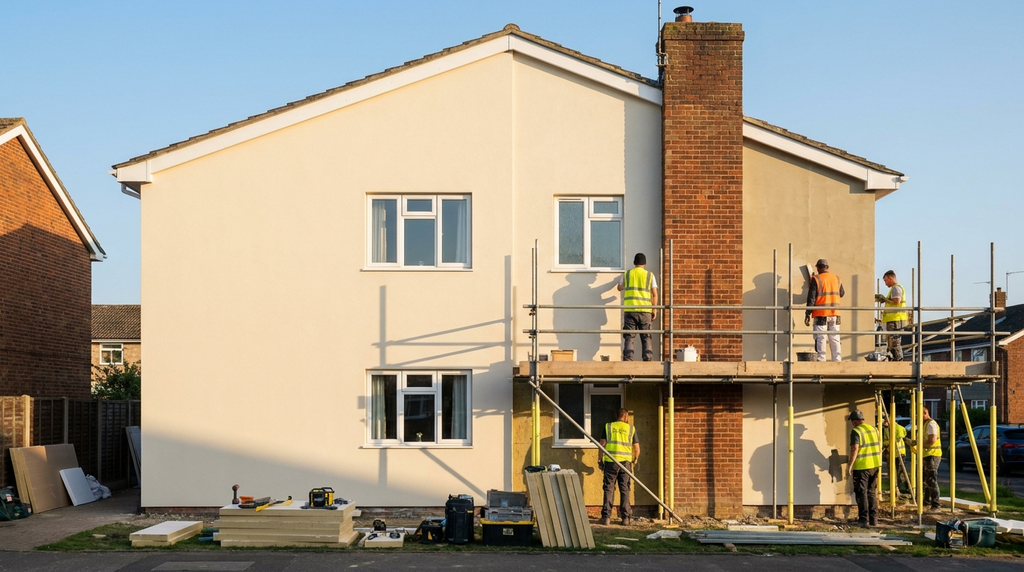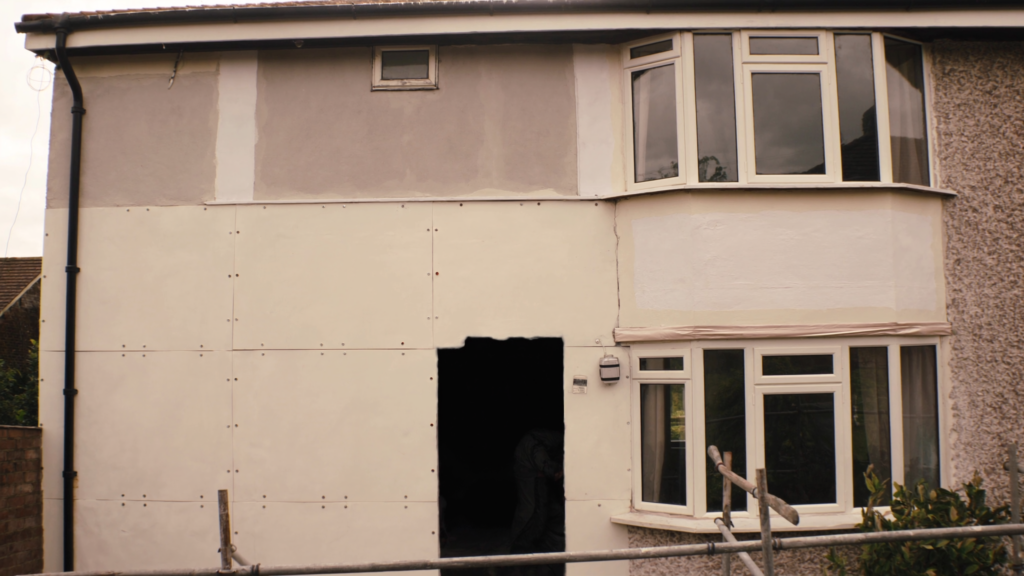
External wall insulation render is a protective and decorative coat applied over insulation boards
External wall insulation (EWI) systems are made up of insulation boards fixed to the outside walls of a house. These boards are covered with a base coat that contains a reinforcing mesh, and then a final render finish is applied on top. The render finish must be vapour-permeable, meaning it allows moisture to escape from the wall structure rather than trapping it inside, as confirmed by the Energy Saving Trust’s guidance on solid-wall insulation (Energy Saving Trust, 2026).
Silicone render costs £45-£60 per square metre installed for external wall insulation. It is the most breathable and self-cleaning finish, reducing long-term maintenance. Compare render types now.
- Silicone render costs £45-£60 per square metre installed.
- Acrylic render is durable but less breathable than silicone.
- Silicone render is self-cleaning, reducing maintenance needs.
- Render must be vapour-permeable to prevent damp issues.
- Choose render based on cost, breathability, and finish preference.
- External wall insulation render is a protective and decorative coat applied over insulation boards
- Silicone render is the most common and breathable finish for EWI systems
- Acrylic render is a durable, crack-resistant option but less breathable than silicone
- Monocouche render is a through-colour, single-layer render not typically used over EWI
- Quick numbers, cost, lifespan, and maintenance of EWI render options
- The direct answer to "external wall insulation render", the best render for UK homes is silicone
- All EWI render installations must be carried out by an MCS-certified installer with appropriate product certification
Different render types vary in their polymer content, how they are applied, and their long-term performance. These differences directly affect the cost of the EWI system and how much maintenance it will need. The render layer itself adds very little thermal resistance, so it has a negligible effect on the system’s U-value (a measure of heat loss), but it is essential for protecting the insulation boards from weather damage.
Silicone render is the most common and breathable finish for EWI systems
Silicone render is a pre-mixed, polymer-modified render that contains silicone resins. It offers high water repellency while still allowing water vapour to escape from the wall, which helps prevent damp problems. Because of its hydrophobic (water-repelling) properties, silicone render is self-cleaning. Rainwater washes dirt off the surface, reducing the need for regular cleaning and lowering long-term maintenance costs.
The typical cost for silicone render is £45 to £60 per square metre installed, according to industry cost guides referenced by the Energy Saving Trust (Energy Saving Trust, 2026). Silicone render is available in a wide range of colours and can be applied by trowel or spray. It can be finished with either a textured or smooth surface, depending on your preference.
Acrylic render is a durable, crack-resistant option but less breathable than silicone
Acrylic render contains acrylic polymers that give it high flexibility and impact resistance. This makes it a good choice for areas that may experience minor movement or vibration, such as near busy roads or railway lines. However, acrylic render is less vapour-permeable than silicone render. To reduce the risk of condensation building up inside the wall, it must be used with a vapour-check base coat, as specified in British Board of Agrément (BBA) certification for EWI systems (BBA, 2026).
The typical cost for acrylic render is £40 to £55 per square metre installed. That makes it slightly cheaper than silicone render (Energy Saving Trust, 2026). Acrylic render can be prone to algae growth in damp, shaded areas. This may require periodic cleaning or the application of a biocide treatment to maintain its appearance.
Monocouche render is a through-colour, single-layer render not typically used over EWI
Monocouche render is a cement-based, through-colour render that is applied in a single layer, usually 15 to 20mm thick. It is commonly used on new-build masonry walls but is not standard for EWI systems. This is because EWI boards can flex slightly, and monocouche render requires a rigid substrate to avoid cracking, as set out in MCS installer standards for EWI (MCS, 2026).
When monocouche render is used on an EWI system, it must be applied over a reinforced base coat and mesh. This adds cost and complexity to the installation. The typical cost for monocouche render adapted for EWI is £50 to £70 per square metre installed, which is higher due to the additional base coat requirements.
Quick numbers, cost, lifespan, and maintenance of EWI render options
| Render type | Typical cost per m² installed | Expected lifespan (years) | Cleaning frequency | Breathability rating |
|---|---|---|---|---|
| Silicone | £45–£60 | 25–30 | Low (self-cleaning) | High |
| Acrylic | £40–£55 | 20–25 | Moderate (every 5 years) | Moderate |
| Monocouche (adapted) | £50–£70 | 30+ | Low (through-colour) | Low |
Lifespan estimates are based on Energy Saving Trust guidance on EWI system durability (Energy Saving Trust, 2026). Cleaning frequency figures come from manufacturer data for each render type, such as silicone render from Sto or Weber.
The best render for UK homes is silicone
Silicone render offers the best balance of breathability, durability, and low maintenance for UK solid-wall homes, which often have higher moisture levels than cavity walls. It is the most commonly specified render in MCS-certified EWI installations (MCS register product data, 2026).
For a typical 3-bedroom semi-detached house with a wall area of around 80 square metres, silicone render adds £3,600 to £4,800 to the total EWI system cost. However, this higher initial cost reduces future maintenance needs. The payback period for the entire EWI system with silicone render is typically 15 to 25 years, based on annual energy savings of £200 to £400 (Energy Saving Trust, 2026).
How to choose the right EWI system for your home
All EWI render installations must be carried out by an MCS-certified installer with appropriate product certification
The Great British Insulation Scheme closed on 31 March 2026. It funded insulation measures only and never covered windows or glazing. The render product must have BBA certification or an equivalent UK Technical Assessment (UKTA) for use in the specific EWI system (GOV.UK, 2026).
Installers should also hold TrustMark registration, which provides consumer protection and warranty cover (TrustMark, 2026). Homeowners should request a written guarantee for the render finish, which is typically 10 to 15 years. It is also important to check that the system’s insurance-backed warranty covers the render layer itself, not just the insulation boards.
What to check before hiring an EWI installer
Frequently Asked Questions
Silicone render is widely considered the best option for external wall insulation. It offers high water repellency while remaining vapour-permeable, as confirmed by the Energy Saving Trust (2026).
Silicone render costs £45 to £60 per square metre installed, according to industry cost guides referenced by the Energy Saving Trust (2026).
Acrylic render is less breathable than silicone render, which can trap moisture in the wall structure. The Energy Saving Trust advises that render must be vapour-permeable to prevent damp problems.
Yes, you can paint over external wall insulation render, but you must use a vapour-permeable masonry paint. The Energy Saving Trust recommends checking the paint is compatible with the render system.
Silicone render typically lasts 20 to 30 years with minimal maintenance. Its self-cleaning properties help reduce the need for regular cleaning, as noted by the Energy Saving Trust (2026).