Solid-wall Edwardian homes lose heat at roughly three times the rate of a cavity-wall 2010s house, costing an extra £600–£1,100 a year in heating.
If you own an Edwardian house built between 1901 and 1910, you are likely living with solid 9-inch brick walls that have no built-in insulation. The average U-value of a solid brick wall is 2.1 W/m²K, meaning it loses heat more than seven times faster than a modern cavity wall with a U-value of 0.3 W/m²K (BRE solid wall U-value data, 2026). The direct consequence is a heating bill that is £600 to £1,100 higher each year than a similar-sized home built after 2010.
That extra cost is calculated by multiplying the heat loss difference by the average UK domestic gas price of 6.7p per kWh under the Ofgem price cap for the first quarter of 2026 (Ofgem, 2026) and standard heating degree-day data for England. For a typical 90 m² Edwardian semi-detached house, the annual space-heating demand before insulation is around 18,000 kWh. After accounting for the wall area and temperature difference, the solid-wall portion alone accounts for roughly 10,000 kWh of that total, compared to about 1,400 kWh for a modern cavity wall.
Internal wall insulation cuts heat loss by roughly 60% but reduces room size by 5–10 cm per wall
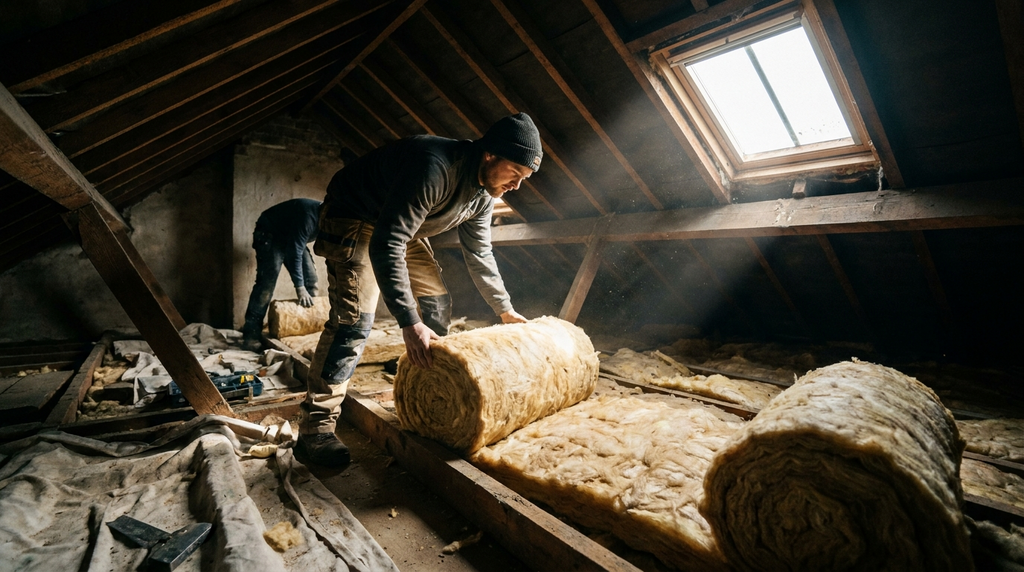
Internal wall insulation (IWI) involves fixing rigid PIR boards, typically 80–100 mm thick, or a wood-fibre batten system, directly onto the inner face of the external wall. After installation, the U-value drops to approximately 0.30–0.35 W/m²K (BRE guidance on solid-wall insulation, 2026), reducing heat loss through the wall by about 60%. The cost for IWI ranges from £60 to £100 per square metre installed (Energy Saving Trust insulation cost table, 2026).
For a typical 90 m² Edwardian semi with about 90 m² of external wall area, the total cost falls between £5,400 and £9,000. The heat saving is around £250 to £400 per year (DESNZ Energy consumption in the UK, 2026). The trade-off is that you lose 5–10 cm of floor space on every wall you insulate, which can affect room dimensions, door openings, and skirting boards.
External wall insulation preserves internal space but changes the street-facing appearance
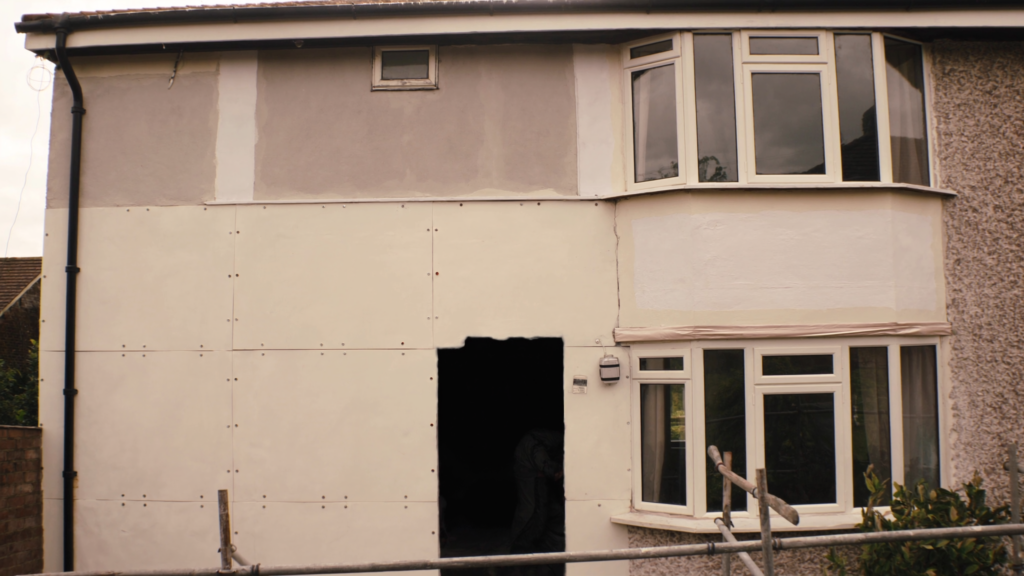
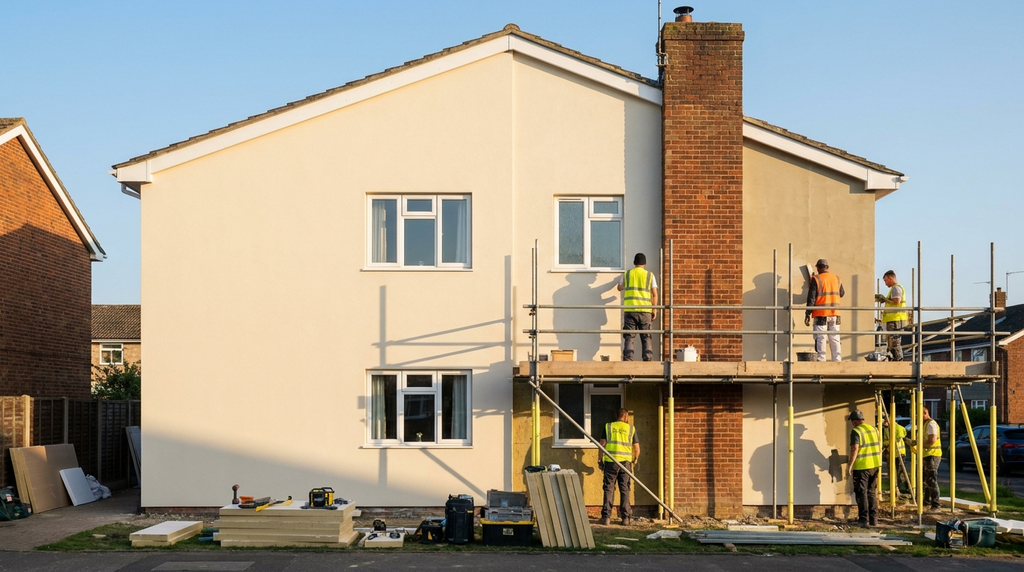
External wall insulation (EWI) wraps the outside of the wall with mineral-wool or EPS insulation, typically 100–120 mm thick, and finishes it with a weatherproof render. The U-value after EWI is the same as IWI, around 0.30–0.35 W/m²K (MCS installation standards for solid-wall systems, 2026). The installed cost is higher, ranging from £100 to £150 per square metre (Energy Saving Trust external wall insulation cost guide, 2026).
For the same 90 m² Edwardian semi, EWI costs £9,000 to £13,500. The annual heat saving is identical to IWI at £250–£400 per year, but the work is done entirely outside, so you keep every centimetre of internal floor area. The drawback is that the external appearance changes noticeably: the render colour, window reveals, and eaves detail will look different from the original brickwork, which can be a problem on period properties.
Quick numbers
| Insulation type | Typical U-value (W/m²K) | Cost per m² installed | Annual heat saving (90 m² semi) | Planning permission needed |
|---|---|---|---|---|
| No insulation (solid brick) | 2.1 | £0 | £0 | No |
| Internal wall insulation (IWI) | 0.30–0.35 | £60–£100 | £250–£400 | Usually no |
| External wall insulation (EWI) | 0.30–0.35 | £100–£150 | £250–£400 | Often yes |
| Full retrofit (IWI + loft + floor) | 0.20–0.30 | £150–£200 | £500–£700 | Varies |
U-values are from the BRE solid wall insulation U-value calculator (BRE, 2026). Costs are from the Energy Saving Trust insulation cost and savings table (EST, 2026). Planning permission guidance is from GOV.UK (GOV.UK planning permission for external wall insulation, 2026).
Internal insulation is the cheaper option but requires a vapour-control layer to avoid damp
IWI must include a vapour-control membrane on the warm side of the insulation, between the plasterboard and the insulation board. This stops warm, moist air from reaching the cold solid wall and condensing inside the insulation layer. Without it, interstitial condensation can form, leading to mould behind the plasterboard within 12 to 18 months (Historic England insulating traditional walls technical note, 2026).
IWI is not suitable for walls that have active rising damp or penetrating damp. You must commission a damp survey that complies with BS 8102 before going ahead (RICS damp in older buildings guidance, 2026). If the survey finds damp problems, those must be fixed first, which adds cost. Many Edwardian homes have solid floors or suspended timber floors that also need attention to avoid moisture bridging between the wall and floor.
External insulation is the only option that avoids losing internal space
EWI on an Edwardian house in a conservation area or on a listed building requires planning permission (GOV.UK planning permission for house alterations, 2026). Local planning authorities often refuse EWI for period properties because the render changes the character of the street scene. Even outside conservation areas, EWI can alter the appearance of window reveals, eaves, and the original brickwork pattern.
The cost premium over IWI is roughly 40–60% (Energy Saving Trust cost comparison of solid-wall insulation methods, 2026). For a 90 m² semi, that means paying £3,600 to £5,400 more to keep your internal floor space. If you are in a conservation area and planning permission is refused, IWI becomes the only practical option, even with the space loss.
The direct answer to “insulation edwardian house uk” is internal wall insulation with a vapour barrier, costing £5,400–£9,000 for a typical semi, saving £250–£400 a year
For the 1.6 million solid-wall Edwardian homes in England and Wales (DESNZ housing energy data release, 2026), internal wall insulation with a vapour-control layer is the most common and cost-effective retro-fit method. The payback period without a grant is 14 to 23 years, but with a Great British Insulation Scheme grant it drops to 7 to 12 years (Ofgem GBIS scheme rules and savings, 2026).
This answer applies to the majority of Edwardian houses that are not listed and sit outside conservation areas. If your home is listed or in a conservation area, EWI is unlikely to be permitted and IWI remains the only viable route. The payback figures assume gas heating at current price cap levels; if you use electric heating, the savings are higher because electricity costs roughly three times more per kWh than gas.
The Great British Insulation Scheme closed on 31 March 2026. It funded insulation measures only and never covered windows or glazing.
The Great British Insulation Scheme (GBIS) requires the installer to hold MCS certification for solid-wall insulation (Ofgem GBIS installer requirements guidance, 2026). TrustMark is a secondary requirement for all government-backed energy-efficiency work (GOV.UK TrustMark scheme for home improvements, 2026). To verify an installer, search the MCS register at mcscertified.com for “solid wall insulation” and cross-check with TrustMark at trustmark.org.uk for customer protection.
FENSA and Gas Safe Register are not relevant for solid-wall insulation. NICEIC or NAPIT registration matters only if the installer also rewires or adds electric heaters as part of the job. Always check both MCS and TrustMark before signing a contract. If you pay a non-certified installer, you cannot claim the GBIS grant and you lose the consumer protections that come with the scheme.
The Great British Insulation Scheme closed on 31 March 2026. It funded insulation measures only and never covered windows or glazing.
Frequently Asked Questions
Internal wall insulation for a typical 90 m² Edwardian semi costs £5,400–£9,000 installed, according to the Energy Saving Trust's 2026 cost table.
Yes. It cuts heat loss by 60% and saves £250–£400 a year on heating, based on DESNZ energy consumption data for 2026.
Rigid PIR boards 80–100 mm thick or wood-fibre batten systems achieve a U-value of 0.30–0.35 W/m²K, per BRE guidance on solid-wall insulation (2026).
Yes, it reduces floor space by 5–10 cm per wall, as the insulation boards and fixing system are fixed directly onto the inner face.
An uninsulated solid brick wall has a U-value of 2.1 W/m²K, losing heat over 7 times faster than a modern cavity wall (BRE solid wall U-value data, 2026).
Yes, the ECO4 scheme may cover solid-wall insulation for eligible low-income households. Check the Ofgem ECO4 eligibility criteria for 2026.