Insulation R Value U Value The Two Numbers That Matter Most for UK Homeowners in 2026
If you are looking at insulation for your home, you will quickly come across two technical terms: R-value and U-value. These numbers tell you how well a material stops heat from escaping, and they are the key to understanding whether your insulation is doing its job. The average UK home loses 35% of its heat through the walls and 25% through the roof, so getting these numbers right matters for your comfort and your energy bills (Energy Saving Trust, 2026).
Here is the direct answer: R-value measures a material’s resistance to heat flow (higher is better), while U-value measures the rate of heat loss through a whole building element like a wall or roof (lower is better). For UK homeowners in 2026, the target numbers to remember are a wall U-value of 0.30 W/m²K or lower and a roof U-value of 0.16 W/m²K or lower, which are the retrofit standards in current Building Regulations (Approved Document L, 2021 edition as amended 2025).
Quick Numbers Typical U-Values and R-Values for Common Insulation Types
The table below shows typical thermal performance for the most common insulation materials used in UK homes. R-values are taken from British Board of Agrément (BBA) certificates for each product type, and U-values are calculated using the standard method in BS EN ISO 6946. Note that R-values can vary by ±10% between manufacturers, so always check the product data sheet rather than relying on generic online tables.
| Insulation type | Typical thickness (mm) | R-value per 100mm (m²K/W) | U-value at 100mm (W/m²K) | U-value at 200mm (W/m²K) |
|---|---|---|---|---|
| Mineral wool (fibreglass/rockwool) | 100–300 | 2.7 | 0.37 | 0.19 |
| PIR board | 50–150 | 4.5 | 0.22 | 0.11 |
| EPS bead | 100–200 | 3.0 | 0.33 | 0.17 |
| Wood fibre | 100–240 | 2.5 | 0.40 | 0.20 |
| Sheep’s wool | 100–250 | 2.6 | 0.38 | 0.19 |
How to Convert Between R-Value and U-Value in 30 Seconds
The conversion is simple for a single layer of insulation. U-value equals 1 divided by R-value, and R-value equals 1 divided by U-value. For example, if an insulation board has an R-value of 4.5, its U-value is 1 ÷ 4.5 = 0.22 W/m²K. This method follows the standard calculation in BS EN ISO 6946:2017 (BSI, 2026).
For multiple layers, you add the R-values of each layer together, including the internal and external surface resistances (typically 0.13 and 0.04 m²K/W respectively for walls). Then calculate U = 1 ÷ total R. So if you have 100mm of PIR board (R=4.5) plus 100mm of mineral wool (R=2.7), the total R is 7.2, giving a U-value of approximately 0.14 W/m²K. This is how building professionals work out whether a wall or roof assembly meets the target U-value.
What U-Value Your Home’s Walls and Roof Must Achieve Under 2026 Building Regulations
Building Regulations set minimum U-values for new homes and for work carried out on existing homes. For new-build walls, the target U-value is 0.18 W/m²K or lower, and for new roofs it is 0.11 W/m²K or lower, as set out in Approved Document L 2021 with 2025 amendments enforced from 2026 (GOV.UK, 2026).
For existing homes having insulation work done, the targets are less strict but still significant. When upgrading walls, you should aim for a U-value of 0.30 W/m²K or lower. For roofs, the target is 0.16 W/m²K or lower. If your loft currently has less than 100mm of insulation, the regulations say you should top it up to achieve a total U-value of 0.16 W/m²K. These targets apply whether you are doing the work yourself or hiring a contractor, and they are the same across England and Wales.
R-Value Why Thicker Isn’t Always Better and How to Read a Product Label
R-value depends on two things: the material’s thermal conductivity (its lambda value, written as λ) and its thickness. Doubling the thickness of the same material roughly doubles the R-value. But different materials have very different conductivities. PIR board has a thermal conductivity of around 0.022 W/mK, giving an R-value of about 4.5 per 100mm. Mineral wool has a conductivity of around 0.037 W/mK, giving an R-value of about 2.7 per 100mm. This means PIR achieves the same R-value in roughly 40% less space (CIBSE Guide A, 2025 edition).
When reading a product label, look for the declared thermal conductivity (λ-value) in W/mK, not just the R-value. The R-value should be stated for the product’s full thickness, not per 100mm. For example, a 100mm PIR board might list R=4.5, while a 50mm board of the same material lists R=2.25. Always check the BBA certificate or manufacturer data sheet for the specific product you are buying, as generic online tables can be misleading.
Which Insulation Type Gives the Best U-Value for Your Home’s Specific Build
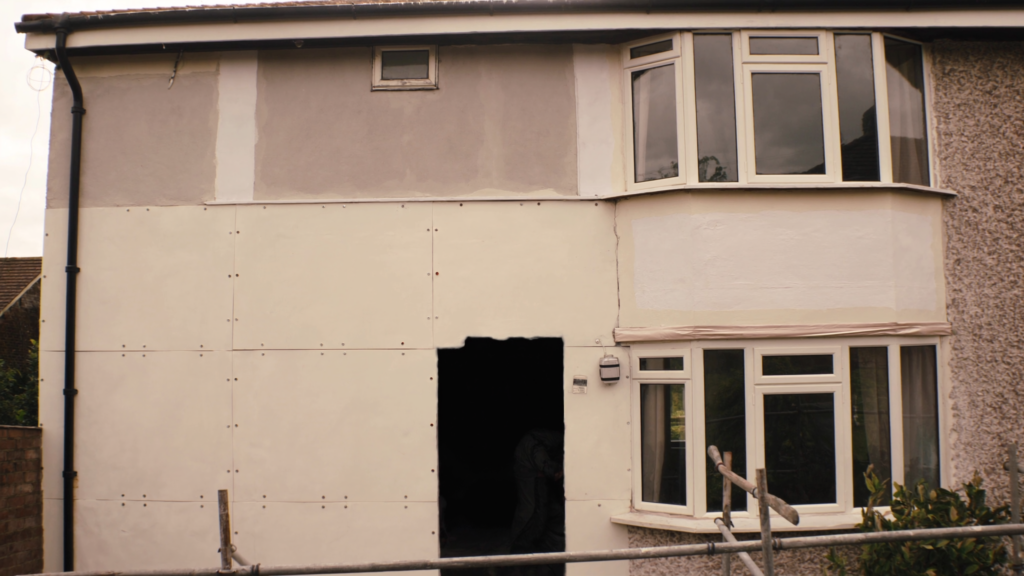
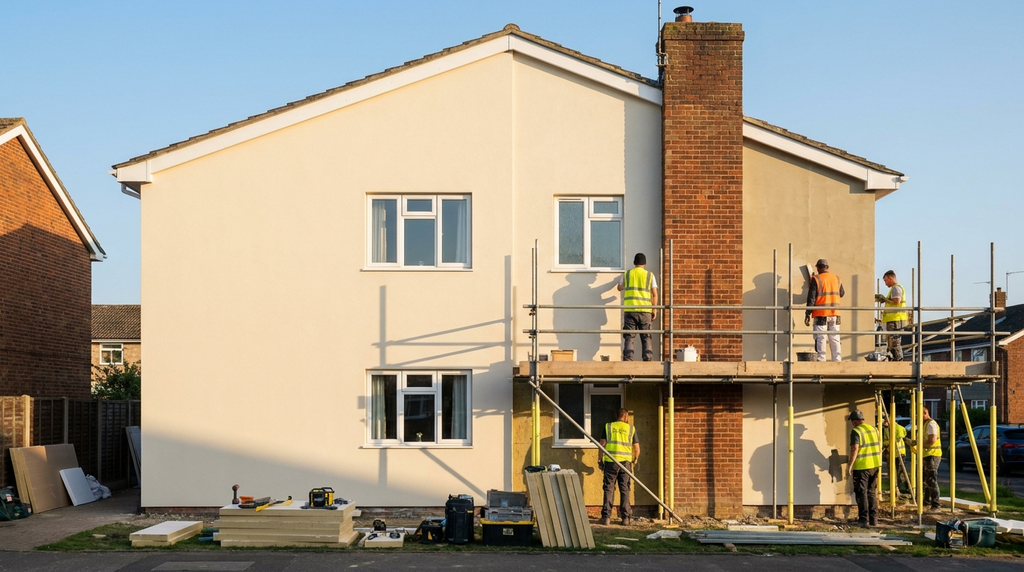
The best insulation type depends on your home’s construction. For solid brick walls with no cavity, internal or external PIR board is the most space-efficient option. A U-value of 0.30 W/m²K is achievable with 80–100mm of PIR. External wall insulation systems must be certified and installed by a registered contractor to be effective (MCS, 2026).
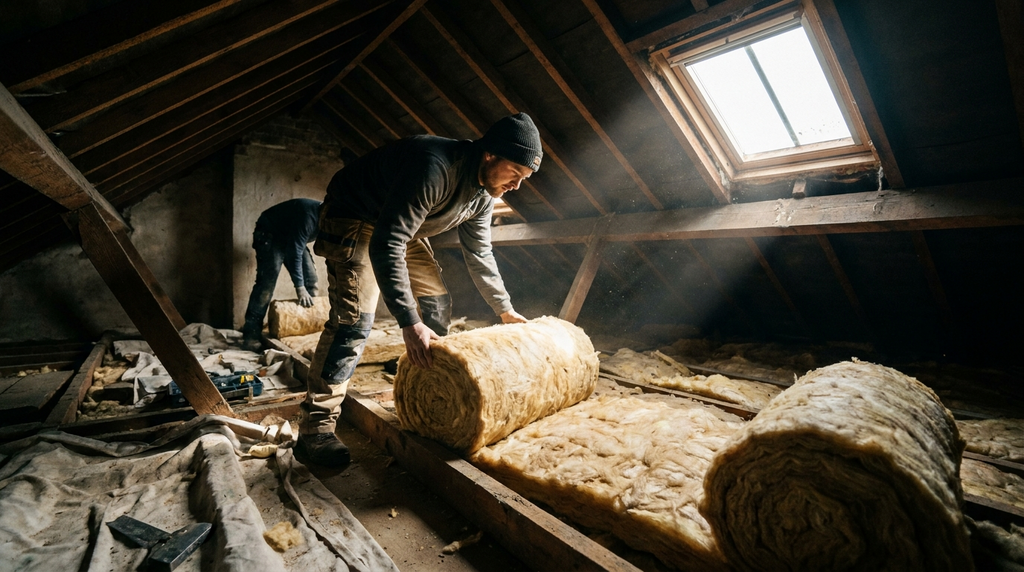
For cavity walls, EPS beads or mineral wool injected into the cavity are the most common solutions. A 100mm fill typically achieves a U-value of 0.30 W/m²K or lower. If your cavity is wider, PIR boards can be used but must be installed carefully to avoid gaps. For pitched roofs, mineral wool between the joists at 250mm thickness gives a U-value of around 0.16 W/m²K, while PIR boards above the rafters achieve the same at around 120mm thickness. The Energy Saving Trust provides a detailed comparison of insulation materials for different building types (Energy Saving Trust, 2026).
How to Verify Your Insulation Installer and Certify the Work for Grants
The Great British Insulation Scheme closed on 31 March 2026. It funded insulation measures only and never covered windows or glazing. For cavity wall insulation, the installer must be registered with the Cavity Insulation Guarantee Agency (CIGA). The Great British Insulation Scheme closed on 31 March 2026. It funded insulation measures only and never covered windows or glazing. For roof insulation, any competent builder can carry out the work, but to claim ECO4 or GBIS, the installer must be TrustMark-registered and hold MCS or PAS 2030 certification (GOV.UK, 2026).
You should always ask to see the installer’s certificates before work begins. Without the correct certification, your insulation may not be covered by a guarantee, and you will not be able to claim grant funding. The Ofgem ECO4 guidance for 2026 makes it clear that only TrustMark-registered installers with appropriate MCS or PAS 2030 certification are eligible for scheme funding (Ofgem, 2026).
The Direct Answer What R-Value and U-Value Mean for Your Energy Bills in 2026
Every 0.1 improvement in wall U-value saves approximately £25 to £35 per year on heating bills for a gas-heated semi-detached home, according to the Energy Saving Trust (Energy Saving Trust, 2026). For a typical 1970s semi-detached house with an uninsulated cavity wall (U-value around 1.5 W/m²K), upgrading to a U-value of 0.30 W/m²K saves between £200 and £250 per year. That is a 40–50% reduction in heating costs compared to having no insulation at all.
R-value and U-value are two sides of the same coin. R-value tells you the resistance to heat flow, so a higher R-value means slower heat loss. U-value tells you the rate of heat loss, so a lower U-value means less heat escapes each hour. The single number to remember for UK homes in 2026 is this: aim for a wall U-value of 0.30 W/m²K or lower and a roof U-value of 0.16 W/m²K or lower. Meeting these standards will cut your heating bills by roughly 40–50% compared to an uninsulated home and will keep you compliant with current Building Regulations.
How to choose the right insulation for your home
Frequently Asked Questions
R-value measures a material's resistance to heat flow (higher is better for insulation), while U-value measures the rate of heat loss through a whole building element (lower is better). The Energy Saving Trust notes that UK homes lose 35% of heat through walls.
A good wall U-value for UK homes is 0.30 W/m²K or lower, which is the retrofit standard in Approved Document L (2021 edition as amended 2025). New builds typically require 0.18 W/m²K or lower.
For loft insulation in UK homes, the recommended R-value is at least 7.0 m²K/W, achieved with around 270mm of mineral wool. The Energy Saving Trust advises this depth to meet current Building Regulations.
To calculate U-value from R-value, use the formula U = 1 / R (total). Add the R-values of all layers including surface resistances, then take the reciprocal. The method is standardised in BS EN ISO 6946.
A typical solid wall in a UK home has a U-value of around 2.1 W/m²K, meaning high heat loss. After adding internal or external insulation, this can be reduced to 0.30 W/m²K or lower, according to the MCS.