Why the gap happens (and why it matters)
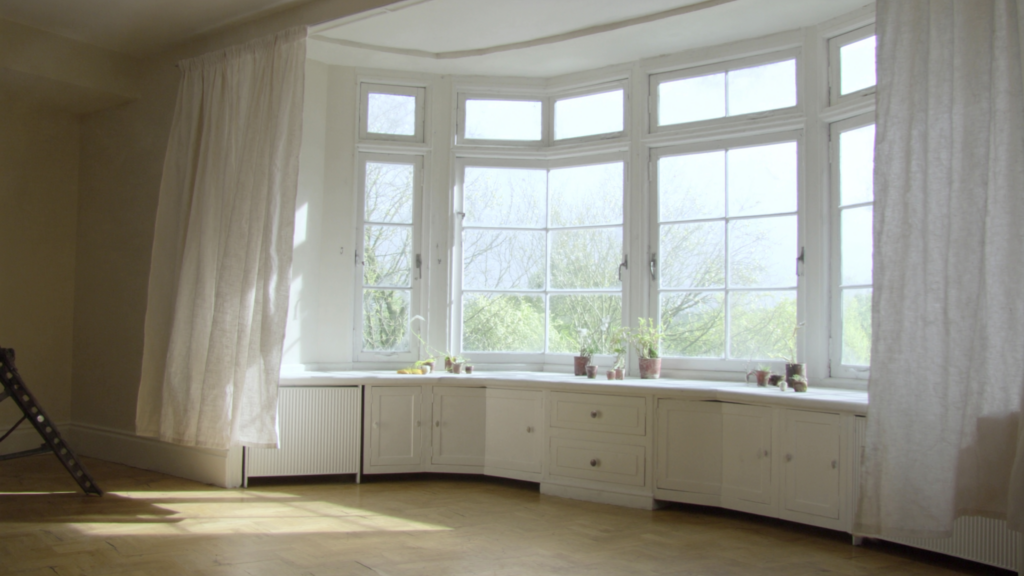
The geometry of a bay window is its charm, until you try to dress it. Standard curtain tracks run straight, but your bay curves or angles outward. That mismatch leaves a triangle of bare glass at each corner, a place where the room’s softness falls apart. On a still, cold morning, you feel it as a ribbon of air curling around the edge of the fabric, pooling at your feet. The radiator is on, the room is warm, but the gap says otherwise.
That gap isn’t just a draft. It’s a visual break, a spot where the curtain stops looking intentional and starts looking like a compromise. What you’re after is a bay that feels sealed, finished, and quietly luxurious. The kind of window treatment that doesn’t announce itself but simply works, holding the warmth in and the cold out without you having to think about it.
The track that bends (and the one that doesn’t)
The simplest fix is a track that follows your bay’s exact shape. Flexible curtain tracks can be curved to match the window’s contour, no gaps, no guesswork. For a deep or sharply angled bay, a custom-bent metal track is the quiet hero. It’s sturdy enough to hold heavier fabrics and holds its shape over years of use. For a shallow curve, a flexible plastic track works well with lighter curtains like linen or cotton.
The trick lies in the brackets. They must be mounted at the outermost corners of the bay, pulling the curtain flush to the wall rather than the window frame. That small shift makes the difference between a curtain that skims the glass and one that seals against it. If you’re replacing an existing track, measure from wall to wall, not window to window, it’s the only way to close that triangle of cold air.
Layer with a blind underneath
A Roman or roller blind fitted inside the bay’s recess creates a second seal beneath the curtain. The blind sits tight against the glass, while the curtain hangs outside the recess, covering the blind’s edges and the track. The gap is physically eliminated before the curtain even moves.
This also solves the problem of curtains that billow inward on windy days. The blind holds the line, keeping the fabric still and the room quiet. For a south-facing bay, a blackout blind beneath a sheer curtain gives you control over light without losing the softness of fabric. For a north-facing bay, a light-filtering blind keeps the room bright while the curtain adds warmth. It’s a simple layer, but it changes everything.
Let the fabric fall to the floor
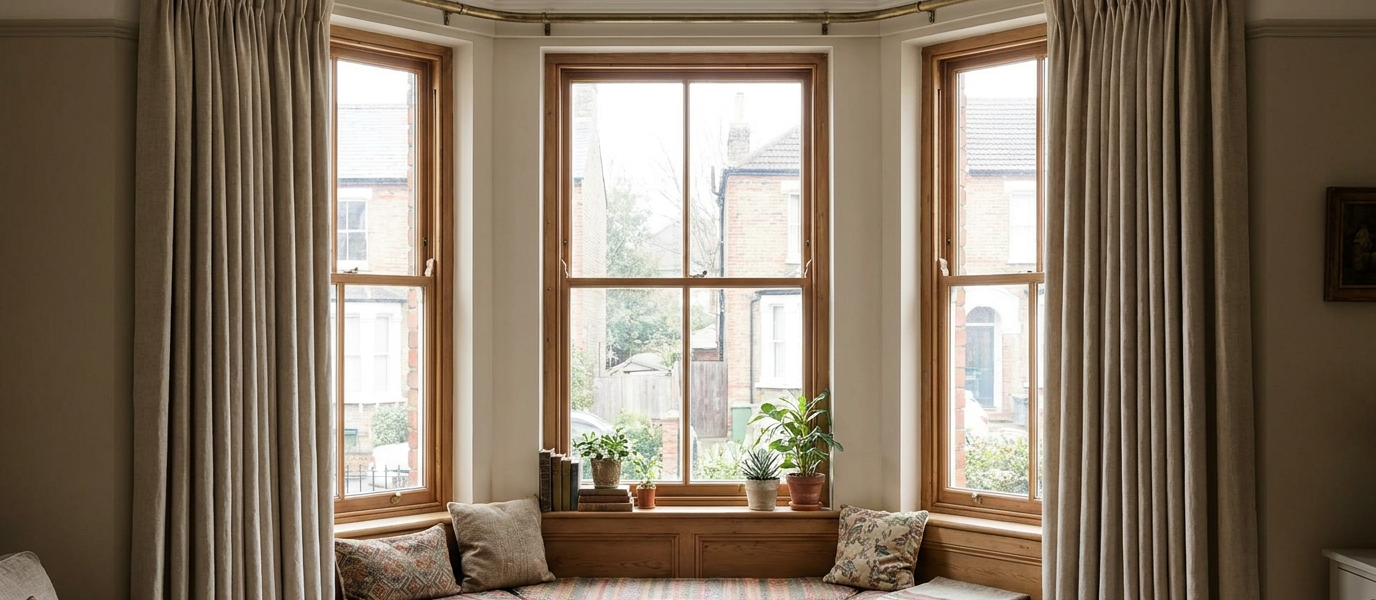
Curtains that stop at the sill leave a gap at the bottom where cold air rolls in from the window base. Floor-length curtains create a thermal pocket by trapping air against the glass, and the extra weight helps the fabric hang straighter against the track. For a bay, this means the hem must be measured from the highest point of the track, not the window, to avoid a puddle on one side and a float on the other.
A good rule: the curtain should just kiss the floor, or hover a centimetre above it. Any longer and you’ll trip over it; any shorter and the gap reappears. If your bay has a radiator beneath the sill, a floor-length curtain can still work, just ensure the fabric doesn’t block the heat. A lightweight lining or a curtain that stops just above the radiator but drops to the floor at the sides keeps the warmth flowing while sealing the base.
Use a pelmet to hide the mechanics
A fabric-wrapped pelmet or a simple wooden cornice sits above the curtain track, hiding the brackets and the bend. More importantly, it seals the top of the curtain against the ceiling, stopping warm air from escaping over the header. In a bay, a pelmet can also visually unify three separate curtain panels into one continuous shape, making the window feel like a single architectural feature rather than a collection of compromises.
Choose a pelmet that matches your curtain fabric or contrasts subtly, a deep charcoal pelmet with oatmeal curtains, for example, adds definition without shouting. For a Victorian bay with high ceilings, a deep cornice painted in the same colour as the wall draws the eye upward and makes the room feel taller. For a modern bay, a slim, upholstered pelmet in a neutral tone keeps the look clean and understated.
Pick a colour that softens with the seasons
A neutral or slightly muted tone, oatmeal, sage, stone, won’t fight the changing light in a bay as the sun moves across the glass. In the morning, the colour will glow; in the evening, it will recede. Darker colours absorb more heat but also show every fold; lighter colours reflect light but can look stark against a large window. The best choice is a fabric with a subtle texture or weave that catches the light differently at different times of day, making the bay feel alive rather than flat.
A soft Farrow & Ball Drop Cloth or a deep Setting Plaster pink works beautifully in a south-facing bay, where the light shifts constantly. For a north-facing bay, a warm stone or a pale terracotta adds depth without feeling cold. If you’re unsure, test a fabric sample in the bay at different times of day, morning, noon, and the dim, quiet hour just before dusk. The colour that works at noon may feel flat by evening.
Why texture matters more than colour
A smooth, shiny fabric will highlight every wrinkle and gap. A matte, nubby linen or velvet drapes with a softer fall that forgives minor track imperfections. Texture also adds depth to a bay that might otherwise feel like a single flat plane of glass and fabric. The reader gains a window treatment that feels layered and luxurious, not just functional.
Consider a heavyweight linen in a natural undyed shade, or a velvet in a muted sage. Both fabrics have enough body to hold their shape against the track, and their texture catches the light in a way that flat cotton never does. For a more relaxed look, a slubbed silk or a wool-blend curtain adds warmth and a sense of quiet luxury. The texture is what makes the bay feel like a room within a room, not just a hole in the wall.
Eight ways to soften a tall sash window
- Use a double-track system, one for a sheer layer that filters light, one for a heavier curtain that seals the gap at night.
- Add a decorative tie-back in a contrasting texture, velvet on linen, leather on cotton, to break the vertical line and add visual interest.
- Hang the curtain rod or track as high as the ceiling to draw the eye upward and make the bay feel taller and more dramatic.
- Choose a fabric with a subtle stripe or pattern that repeats across the three panels, creating a sense of continuity across the bay.
- Install a weighted hem strip inside the curtain lining to keep the fabric from floating away from the track on windy days.
- Use a curtain holdback that hooks into the wall at the corner of the bay, pulling the fabric taut across the angle and eliminating the gap.
- For a deep bay, consider a single continuous curtain that wraps around the curve rather than three separate panels, it’s more expensive but creates a smooth look.
- Finish with a simple tie or magnet at the bottom corner to anchor the fabric to the wall, invisible, but it stops the gap completely.
For more ideas on choosing the right shade for your bay, see door colour ideas, the same principles of light and texture apply. And if you’re considering a full window overhaul, our guide on window styles for period homes will help you match the treatment to the architecture. The goal isn’t perfection, it’s a bay that feels finished, warm, and entirely yours.