The first light that breaks a sleep cycle
It’s 4am. A grey-blue glow, thin as paper, slips under the bottom of the blind. You hear the rustle first, that particular, knowing rustle of a small body waking before it should. Then the murmur, then the cry. You’re already out of bed, because you know what comes next: a 45-minute negotiation with a child who thinks dawn is a reasonable hour. The exhaustion sits in your bones like cold tea.
You need darkness. Deep, reliable, unapologetic darkness. But you also need a room that feels like a bedroom, not a sleep-lab, not a blackout bunker, not the kind of space that makes you wince every time you walk past it during daylight hours. The tension is real, and it’s surprisingly hard to solve. Let’s unpick it.
Let your window dressing do double duty
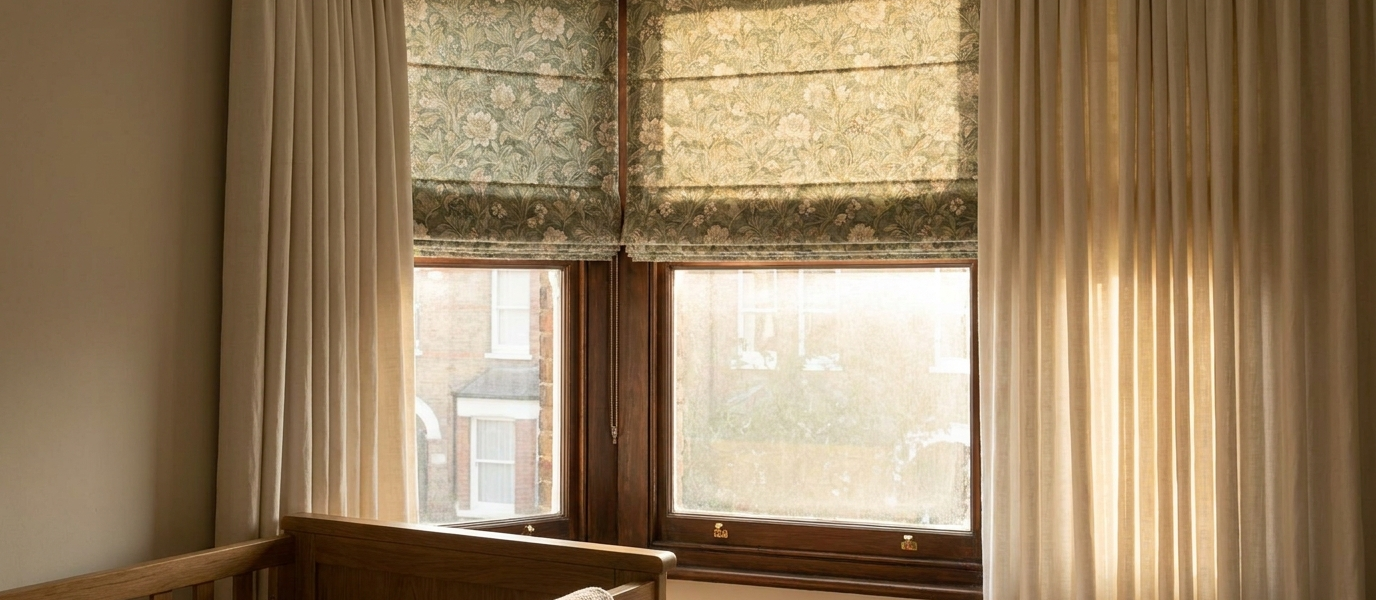
The most obvious solution, a roller blind, often looks like it belongs in a hotel conference room. It’s functional, yes, but it’s also clinical. What works better is a Roman blind with a proper blackout lining. The soft folds break up the flatness, and because Roman blinds sit in layers when drawn up, they catch shadows and light in a way that feels domestic, not institutional.
The trick is mounting the blind outside the window recess. This closes the light gaps at the sides, the sneaky little slivers that wake a light-sleeping child, while leaving the window frame visible. You keep the architecture of the room. But here’s the honest truth: a blind alone rarely does the full job. The real magic is layering it with curtains. Not fussy, not frilly, not overdone. A simple, floor-length curtain in a complementary tone, drawn at night, pushed back during the day. The blind handles the heavy lifting; the curtain softens the edge.
Pick a colour that softens with the seasons
White is the easy choice. It’s safe, it’s clean, it reflects heat. But white blackout curtains can look stark, like a hospital cubicle curtain that forgot its purpose. Consider instead a muted, changeable tone. A sage green that reads calm in summer and cosy in winter. A dusty lavender that feels gentle at midday and warmer under lamplight. A warm oatmeal that never fights the rest of the room.
There’s a practical note here too. White blackout linings reflect heat, which is useful in a south-facing nursery. Dark linings absorb heat, which can make a small room stuffy. If you’re choosing a coloured fabric, ask for a white or light-grey lining. It’s a small detail that pays back every hot July night.
And think about the room’s next life. A sage curtain that works for a baby will still suit a study or guest room when the child outgrows the nursery. You’re not decorating for a phase; you’re decorating for a decade.
Why texture matters more than colour
Colour gets all the attention, but texture is what makes a room feel lived-in. A flat, shiny blackout fabric, the kind that looks like it was cut from a tent, reflects light in an unflattering way. It catches the glare from a lamp and bounces it around the room. A textured fabric, on the other hand, absorbs and diffuses light. A linen-look blackout curtain has a slight slub, a velvet has a deep nap, a cotton with a subtle weave catches the light differently at dusk.
In a small nursery, texture can make the room feel larger and more finished. A velvet curtain in a deep tone, think Farrow & Ball’s Brinjal or a soft charcoal, adds weight and warmth without overwhelming the space. A linen-mix in a pale stone gives a relaxed, airy feel. The key is choosing a fabric that looks good at every hour, not just at midnight.
Eight ways to soften a tall sash window
Period homes with tall sash windows present a particular challenge. The windows are beautiful, they’re the room’s best feature, but they’re also draughty, leaky with light, and awkward to dress. A standard blackout roller blind looks dwarfed and wrong. Here are eight approaches that work:
- Layer a Roman blind at the top third of the window with floor-length curtains that pool slightly at the bottom.
- Use a pelmet or valance to hide the blackout hardware while keeping the window’s original architrave visible.
- Choose curtains that sit just below the sill when open, so they don’t block the window’s height.
- Mount the curtain pole high, almost at ceiling height, to draw the eye upward.
- Use a double-track system: one track for the blackout lining, one for the decorative curtain.
- Consider a blackout roller blind mounted inside the recess, paired with a sheer curtain for daytime softness.
- For Victorian sashes, a blackout roller blind with a scalloped edge mimics traditional fabric.
- Add a tie-back at child height, a simple leather strap or fabric loop, to keep curtains open during the day.
The goal is to honour the window’s character while solving the light problem. It’s possible, but it takes thinking in layers.
The lining is the secret ingredient
Most people think of blackout lining as a single thing: a thick, rubbery layer that stops light. But a good blackout lining does more than that. It insulates, keeping the room warmer in winter and cooler in summer. It reduces noise, absorbing the rumble of traffic or the neighbour’s dog. And it blocks light without adding bulk, so the curtain still hangs softly.
How do you check for lining quality without becoming a fabric expert? Feel the weight. A good lining has heft but not stiffness; it should drape like a well-made coat, not a shower curtain. Hold it up to a bright light, if you can see pinpricks of light through the weave, it’s not fully blackout. And ask about the interlining, the middle layer between the face fabric and the lining. A curtain with a proper interlining feels soft, almost heavy, and hangs in gentle folds rather than sharp creases.
When the room grows up, the curtains stay
Here’s the quiet wisdom: design for the long view. A nursery that works for a newborn can work for a toddler and a six-year-old if you choose wisely. Pick a neutral base fabric, a warm grey, a soft beige, a muted green, and add personality through trims, tie-backs, or a patterned pelmet that can be swapped out. A velvet curtain in a deep teal will look just as good in a child’s bedroom as it did in the nursery, especially if you swap the pastel cushions for something bolder.
The emotional payoff is real. You don’t have to redesign the room every three years. The curtains stay, the room evolves, and you save yourself the cost and hassle of starting from scratch.
The quiet confidence of a room that sleeps well
The morning after a good night’s sleep is a different world. The child wakes at 7am, not 4am. They stir calmly, stretch, maybe babble to themselves for a few minutes before calling out. You wake rested, not resentful. And when you walk into the room, it looks like a bedroom, not a cave, not a lab, not a compromise.
The real gain is not just blackout. It’s the sense that a functional choice can be beautiful without shouting about it. Sunlight filters through the curtain, catching the texture of the fabric. The room feels at peace. And so do you.





