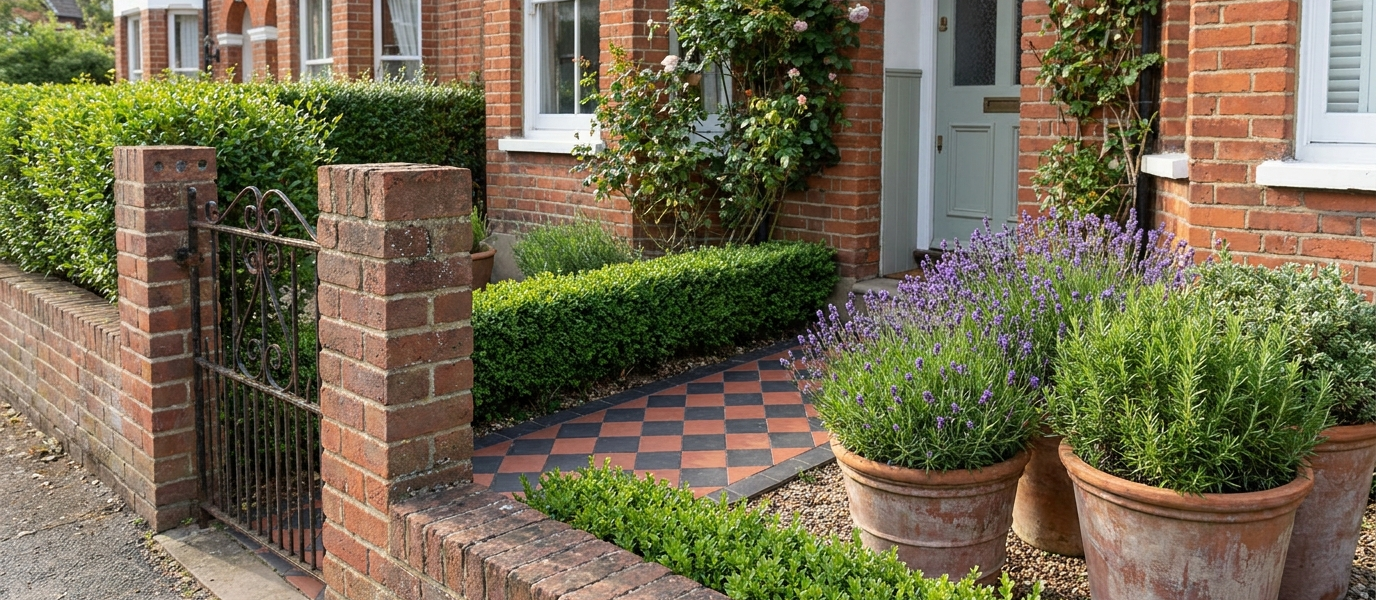
The frustration that started it all
You stand at your front door, keys in hand, and there it is: that wide, unyielding stretch of concrete or tarmac. Maybe it’s a shared access path with a neighbour, meaning you can’t touch it. Perhaps a conservation area rule forbids new paving. Or maybe the cost of digging it up and hauling it away is simply more than you can stomach right now. Whatever the reason, that hard grey ground feels like a sentence. You watch neighbours’ front gardens bloom with lavender, soften with gravel, invite with a gentle curve of brick. Meanwhile, yours stays stubbornly, immovably grey.
But here’s the thing you start to notice after a while: the paving is only the floor. Everything above it, the walls, the windows, the door, the plants, the light, that’s where the real transformation lives. The ground stays, but the garden above it can change entirely. And once you see it that way, the frustration becomes a kind of freedom.
Let the windows lead the transformation
In a front garden where the paving is fixed, the eye naturally travels upward. It lands on the windows, those tall, vertical rectangles that frame your home’s face. If your windows are old, draughty, or simply tired-looking, they become the weak link in the whole chain. But if they’re crisp, warm-toned, and thoughtfully proportioned, they anchor everything else.
Consider updating your glazing to slim sightlines and a warm timber or timber-effect finish. A soft grey-green or a muted sage frame, something like Farrow & Ball’s Green Smoke or a deep Railings, draws the eye without shouting. The effect is subtle but profound: the window becomes a deliberate piece of architecture, not just a hole in the wall. When the paving below is fixed, the windows become the architectural anchor. Get them right, and the whole front elevation starts to feel intentional, as if every other decision, the doormat, the pot, the climber, was made in conversation with them.
Plant in layers, not lines
The most common mistake in a narrow front garden is a single row of pots lined up along the path like soldiers. It’s tidy, yes, but it does nothing to soften the hard edges or draw the eye around the space. The remedy is layers: staggered heights, varied textures, and plants that spill slightly over the paving’s edge.
For a narrow plot, try a climber trained up a trellis beside the door, a jasmine or a clematis that will eventually blur the line between house and garden. At the corner of the path, place a low evergreen mound, like a compact box or a hebe, to anchor the scene. Behind it, a tall grass, Stipa gigantea or Miscanthus, that catches the evening light and moves in the breeze. The paving becomes a stage, not a limitation. The plants are the set design.
Eight ways to soften a tall sash window
Tall sash windows are a gift, but they can feel severe against a hard ground plane. Here are eight ways to soften them, none of which require touching the paving:
- A window box with trailing ivy or helichrysum, the green spills downward, breaking the vertical line of the frame.
- A bespoke painted trellis that mirrors the window’s proportions, fixed just below the sill, with a climbing rose or honeysuckle trained across it.
- A single sculptural plant in a large pot placed to one side, a standard bay tree or a clipped box sphere, to balance the window’s height.
- Shutters, even fixed ones, painted the same colour as the frame, to add depth and a sense of enclosure.
- A low, wide planter running the full width of the window, filled with lavender or rosemary for scent and soft texture.
- A hanging lantern from a bracket beside the window, drawing the eye outward and creating a focal point.
- A small metal obelisk with a climbing sweet pea, seasonal, cheap, and instantly charming.
- A mirror (carefully, so it doesn’t reflect harsh light) placed among foliage to bounce the garden back at itself.
The goal is to frame the window, not fight it. Let the planting echo its proportions, not compete with them.
Pick a colour that softens with the seasons
The standard grey or white front door is safe, but it’s also forgettable. When your paving is neutral or dark, as most concrete and tarmac is, the door and window frames can carry a warmer tone that draws the eye upward and gives the whole facade a lift.
Consider a muted green like Duck Green from Little Greene, or a deep ochre, think India Yellow from Farrow & Ball. A soft slate, like Down Pipe, works beautifully if you want something that shifts in different weather: grey in flat light, almost blue in the evening. Paint on the front door or window frames is one of the cheapest ways to change the whole feel of the front garden. It costs a few quid and a weekend, and it changes everything.
Why texture matters more than colour
When you can’t change the ground plane, surface interest becomes the main event. It’s what makes people stop and look. Think about tactile contrasts: smooth painted wood against rough brick, glossy leaves against matte stone, the softness of a woven doormat against hard paving.
A single piece of furniture can break the monotony. A slim bench in natural oak or a metal boot-scrape with a patina, something that feels worn and lived-in, creates a moment of warmth against the cold ground. Even a doormat made of coir or seagrass adds a layer of texture that the eye registers before the brain does. It’s the difference between a corridor and a room.
The evening shift, lighting that rewrites the space
After dark, the front garden changes entirely. A low-level uplight placed behind a large pot throws dramatic shadows across the wall, distracting from any dullness in the paving below. A lantern beside the door casts a pool of warm light that makes the concrete feel like a stage. A string light draped through a climber turns the whole entrance into something soft and inviting.
The trick is that lighting doesn’t touch the paving, but it changes how the paving reads. Shadows and highlights break up the grey expanse, creating depth where there was only flatness. The human gain is real: the front garden becomes a room you want to linger in, not just a corridor to the door. You find yourself standing there longer, keys in hand, looking back at the house you’ve transformed without moving a single slab.
door colour ideas





