The difference between a room that glows and a room that glares
Stand in a north-facing room on a grey Tuesday morning and you’ll know it instantly. The light is flat, cool, almost blue. Colours look muted, shadows barely exist, and the room can feel like it’s holding its breath. Now walk into a south-facing room at noon. The light pours in, hot and direct, bleaching out your carefully chosen sofa fabric and throwing harsh, unflattering shadows across the walls. One feels lifeless. The other feels aggressive. Neither feels quite right.
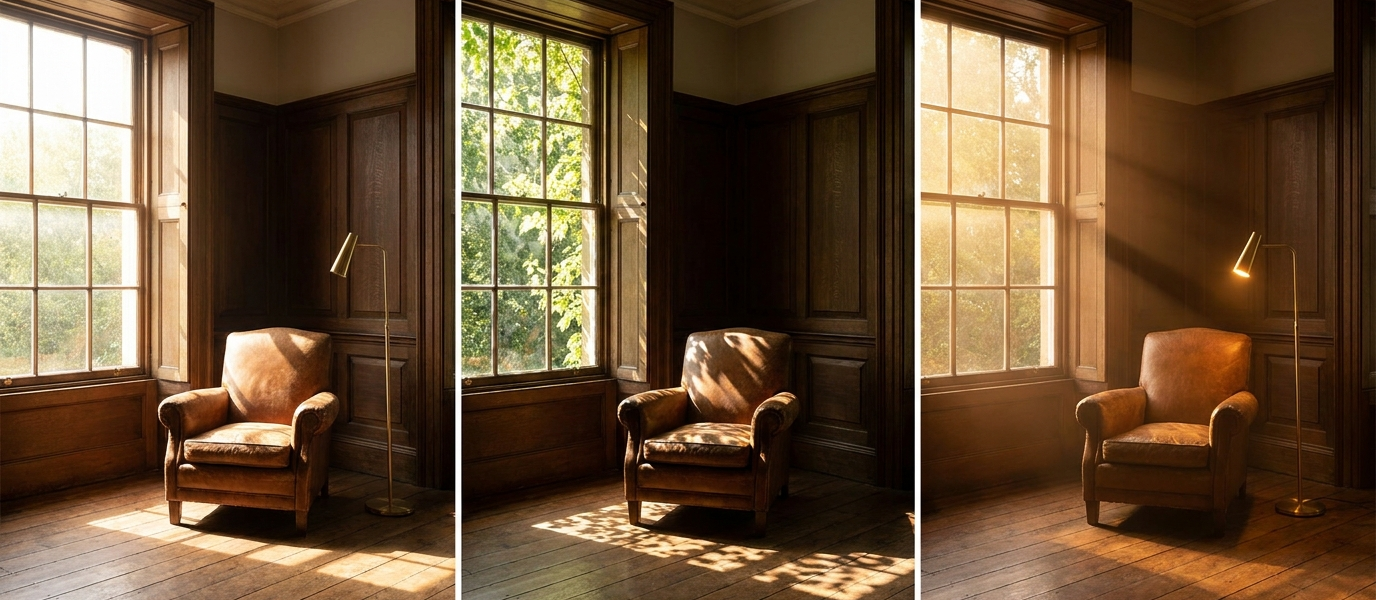
This is where natural light interior design reveals its true purpose. It is not about getting more light into a room. It is about shaping what arrives. Light, treated as a material rather than a utility, transforms a room from a functional space into one that shifts and breathes through the day. The best interiors don’t flood with light. They layer it, soften it, direct it. They make the light work for the room, not the other way around.
Frame the view, not just the window
Walk up to a window and notice where your eye goes. A low sill that sits just above the floor invites the garden in, making the room feel like a pavilion. A tall Victorian sash draws your gaze upward, adding height and a sense of ceremony. The proportion of the window frame is not just architectural detail, it is the first decision you make about how the light will behave.
There is a quiet psychology to a framed view. A window that deliberately crops a branch, a roofline, or a neighbour’s chimney feels intentional. It gives the eye somewhere to rest. A blank pane of glass, by contrast, offers nothing, just more sky, more pavement, more noise. A well-framed window makes the room feel larger because your mind has a destination. It settles. It stops searching.
Consider what your window frames. If it looks out onto a wall, a low sill and a deep internal reveal can create a stage for a single object, a ceramic vase, a trailing plant, that becomes the view itself. The window stops being a hole in the wall and starts being a picture.
Let the glass do the work, but choose it carefully
Most of us never think about the glass itself. We assume a window is a window. But the type of glass you choose changes everything about how daylight behaves in a room. Clear float glass is standard, but it has a faint green tint that can make warm colours feel muddy. Low-iron glass removes that tint, giving you a truer, cleaner light, worth considering for a room where you want colours to sing.
Then there is textured glass. A single pane change can transform the quality of light without altering the window itself. Frosted glass scatters daylight into a soft, milky glow, perfect for a bathroom where you want privacy without darkness. Ribbed glass bends the light into gentle stripes that move across the wall as the sun shifts. You gain a room that feels private without feeling dark, a small change with an outsized effect on mood.
Eight ways to soften a tall sash window
A tall sash window is a beautiful thing, but it can be a bully. It pours light in from top to bottom, often creating a single harsh beam that cuts across the room. Here are eight ways to tame it, each one a small act of light-shaping.
- Sheer linen panels that pool on the floor. Not for privacy, for diffusion. The fabric catches the light and throws it sideways, softening the beam into a gentle wash.
- A single portrait mirror opposite the window. Position it to catch the light and bounce it deeper into the room. The room brightens without the window working harder.
- Pale, matte walls. Glossy paint reflects light harshly, creating glare. Matte paint holds the light, letting it sit on the surface rather than bounce off it. A soft Farrow & Ball Drop Cloth or a warm white like Wimborne White works beautifully.
- A low, solid window seat. This creates a ledge for the light to land on. The light hits the seat, spreads across it, and then spills into the room. It gives the light somewhere to arrive.
- Blinds that sit inside the recess, not over it. A blind mounted on the frame breaks the clean line of the window. Inside the recess, it keeps the frame sharp and the window feeling architectural.
- A pendant light hung low at dusk. When the natural light fades, a pendant that echoes the window’s verticality keeps the room feeling tall. It mirrors the window’s proportions, creating a quiet visual rhyme.
- A single houseplant with broad leaves placed where the sun hits first. The leaves catch the light, cast dappled shadows, and give the room a living, shifting texture. A fiddle-leaf fig or a monstera works well.
- A painted window frame in a muted tone. Sage, slate, or ochre. A dark frame absorbs glare, stopping the window from becoming a white-hot rectangle that overwhelms the room. It also makes the view beyond feel more vivid.
Why a south-facing room needs a different strategy
South-facing rooms are often celebrated, but they come with a quiet problem. The light is so direct and so constant that it flattens everything. Colours wash out. Shadows are harsh and unflattering. The room can feel clinical, like a gallery without art. The common assumption is that you should embrace the light. In practice, you need to push back against it.
Start with the window itself. Internal shutters give you control, tilt the slats to let light in while diffusing it. Solar-control glass reduces heat gain without darkening the room. A deep window reveal, where the wall is thick enough to cast its own shadow, creates a natural buffer zone that softens the light as it enters.
Then there is the wall colour. The instinct is to go pale and reflective, but a dark wall absorbs excess light and makes the room feel cosy rather than clinical. A deep blue like Hague Blue or a charcoal like Down Pipe takes the edge off the brightness and gives the room a moody, intimate feel. The light that remains feels richer, more deliberate.
The quiet power of a borrowed light
Some rooms have no windows. A narrow hallway, a downstairs cloakroom, a windowless bathroom. These spaces can feel like dead ends, but they don’t have to. Borrowed light, light pulled from an adjacent room through an internal window, a glass door, or a high-level transom, transforms them into something that breathes.
A high transom above a bathroom door pulls light from the bedroom without compromising privacy. A glass-panelled internal door between a hallway and a living room lets the light travel, turning a dark corridor into a passage that feels connected to the rest of the house. The room gains flow without losing enclosure. It feels intentional, not accidental.
For a narrow hallway, consider a single pane of frosted glass set into the wall at ceiling height. It pulls light from the room next door without revealing what is on the other side. The hallway stops feeling like a tunnel and starts feeling like a threshold.
A window is not a light source, it is a light shaper
Natural light interior design is not about how much light you can get. It is about how you handle what arrives. A window is not a hole that lets light in. It is a tool that shapes the light, directing it, softening it, giving it somewhere to land. The difference between a room that feels alive and one that feels dead is not the size of the window. It is how the light behaves once it is inside.
The final reward is a home that feels different at 9am than it does at 4pm. The light shifts. The mood shifts. The room is not static. It breathes. And that is what makes it feel like a place you want to be.
door colour ideas