That first November evening
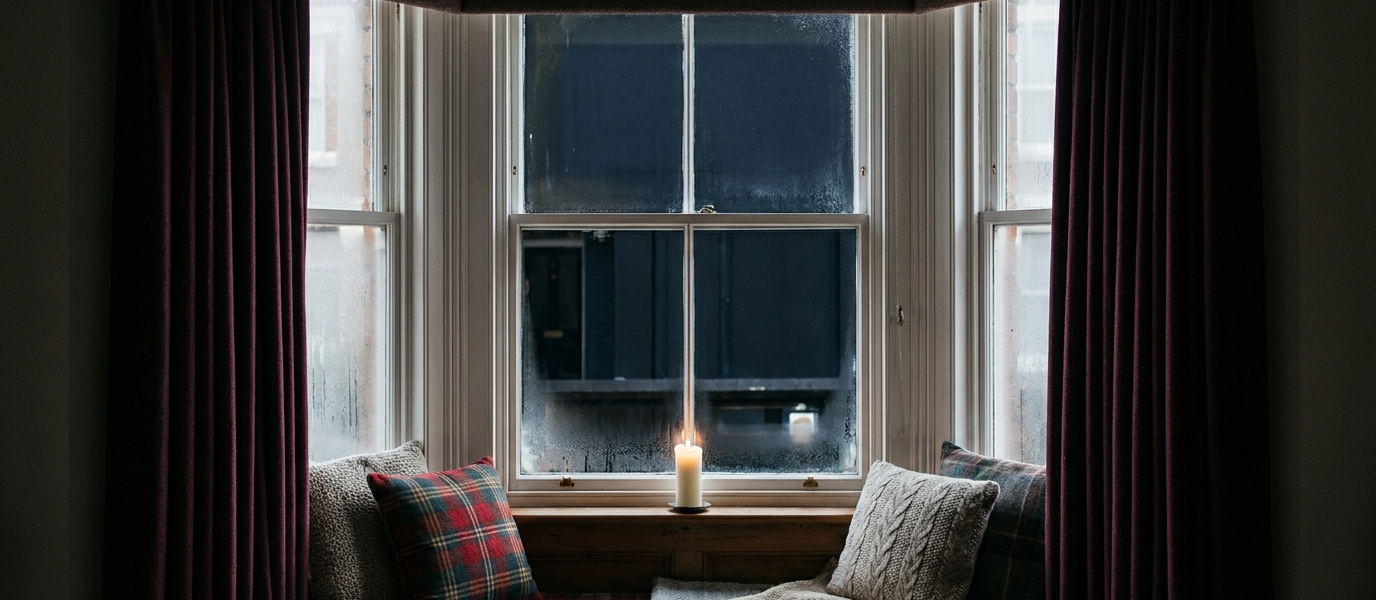
You pull the curtains, light a candle, pour something warm. The room looks beautiful, soft lamplight, deep colours, everything just so. But there it is: a thin, insistent draught creeping across the sill, curling around your ankles. The room looks right, but it doesn’t feel settled. This is the moment you realise your windows need dressing that works as hard as it looks, keeping the cold out and the atmosphere in, without sacrificing an inch of style.
Why this matters
The right window dressing doesn’t just insulate a room. It changes how that room lives. A chilly corner becomes the place everyone wants to sit. A north-facing sash that was once a problem becomes a quiet retreat. Winter window dressing is the difference between a house that looks warm and a house that is warm, and the two are not the same thing.
The case for a thermal Roman blind beneath your curtains
This is the secret that designers rarely mention but always use. A fitted Roman blind in a lined, interlined, or even wool fabric sits close to the glass, trapping a pocket of still air against the window. The curtain above stays purely decorative, velvet, wool, or a heavy linen, so you get the softness of a gathered drape without the draught.
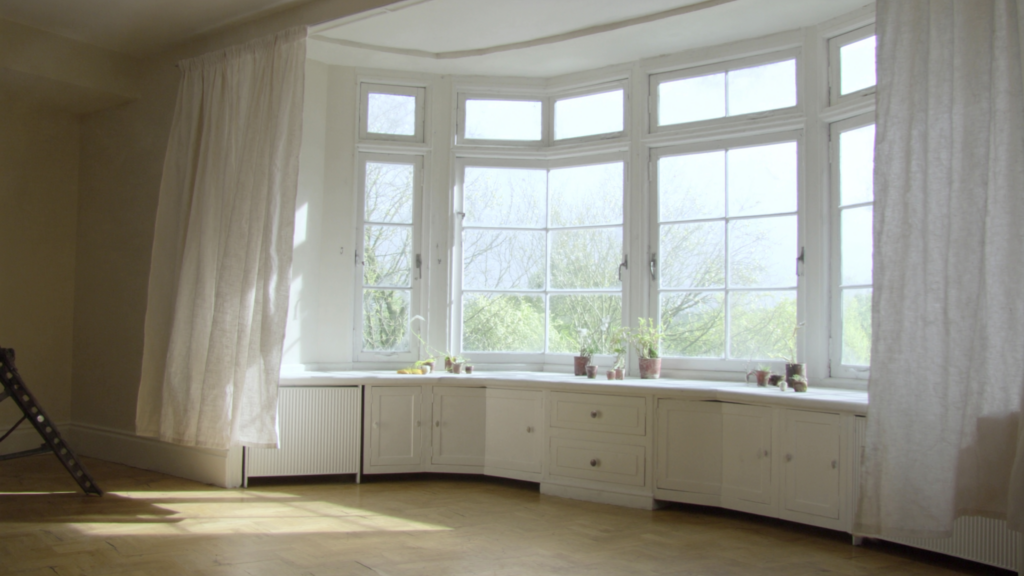
The blind does the thermal work; the curtain does the atmospheric work. Neither compromises the other. For a bay window, a single Roman blind across the full width is surprisingly effective. For a tall sash, a blind that stops just above the sill keeps the radiator clear while still sealing the glass.
Let your curtain pole extend beyond the frame
This is the single cheapest upgrade that changes everything. A pole that reaches six to eight inches past the window on each side allows curtains to stack clear of the glass when open, and seal the frame completely when closed. The psychological effect is immediate: the window feels larger, the room feels wider, and the fabric becomes a proper barrier rather than a thin veil.
For bay windows or tall sash windows, ceiling-mounted tracks achieve the same seal without a visible pole. The track disappears behind a pelmet or cornice, and the curtain drops in a clean, uninterrupted line from ceiling to floor. It’s a detail that costs little more than a standard pole but transforms how the room holds its heat, and its atmosphere.
Pick a colour that softens with the seasons
Deep, muted tones, charcoal, forest green, ochre, a plum like Farrow & Ball’s Brinjal, absorb light and warmth rather than reflecting it. The shift from summer linen to winter velvet or wool can be as simple as swapping a single layer, not the entire window. A summer linen curtain stays in place; a winter wool blind drops behind it. The palette deepens, the room contracts, and the window dressing shifts from airy to enveloping.
Why this matters: a winter window dressing should feel like the room is pulling inwards, cosying itself. Pale, airy colours work against that instinct. A deep charcoal velvet reads as warmth before you even touch it.
Eight ways to soften a tall sash window without blocking its proportions
- A floor-length curtain hung from just below the ceiling, not the top of the frame, this elongates the window and seals the top of the glass.
- A Roman blind in a heavy cotton velvet, stopping just above the sill, keeps the radiator clear, seals the glass.
- A thin, unlined sheer behind the main curtain for daylight privacy without cold, a whisper of warmth.
- A pelmet or cornice box that hides the track and adds a layer of insulation at the top, that top gap is where most draughts sneak in.
- A wool or cashmere-blend throw draped over the curtain rod as a decorative topper, unexpected, tactile, and genuinely warming.
- Layered shutters, full-height with a separate top panel that can tilt independently, lets you control light and privacy without losing heat.
- A thermal liner clipped to the back of an existing curtain, invisible from the front, the cheapest fix, and surprisingly effective.
- A single, oversized curtain panel pulled to one side, asymmetrical and sculptural, dramatic, sealing, and surprisingly practical for narrow windows.
Why texture matters more than colour for warmth
A room can be entirely neutral and still feel deeply warm if the textures are right: brushed cotton, boiled wool, velvet, bouclé, chenille. Colour is emotional; texture is physical. A chunky wool curtain reads as warm before you even touch it. A flat-fronted Roman blind in a linen-cotton blend with a brushed finish, paired with a heavy velvet curtain in the same tonal family, different textures, same quiet palette, creates a room that feels wrapped, not just decorated.
This is where winter window dressing becomes something more than insulation. It becomes the fabric of the room itself.
The forgotten layer a window seat with a deep cushion
A window seat turns the window into a destination, not a weak point. Adding a thick foam cushion, at least four inches, in a wool or velvet fabric creates a thermal buffer between the glass and the room. The cushion itself becomes a barrier, trapping air and softening the cold that radiates from the glass. Pile cushions and a throw on the seat in winter; strip it back to bare wood in summer. The window dressing changes with the season, not just the view.
For a Victorian bay or a 1930s suntrap, a window seat with a deep cushion is the difference between a room that feels draughty and a room that feels like a hug.
Let your front door do the heavy lifting
A front door is the largest single window in most homes, and often the coldest. A full-length curtain on a ceiling-mounted track inside the door, heavy wool or velvet, seals the entire entrance without blocking the door’s operation. The effect is immediate: you walk into a house that feels wrapped, not just decorated. The curtain becomes the first layer of winter atmosphere, not an afterthought.
Choose a colour that echoes the hallway, a deep navy, a warm ochre, a charcoal that reads almost black in low light. The curtain should fall to the floor, pooling slightly, so it seals the bottom gap where the worst draughts enter. It’s a detail that costs around £150 to £400 depending on fabric and track, and it changes how the whole house feels the moment you step inside.