The most important thing you need to know about loft insulation top-up costs in 2026
If your home has 100mm of loft insulation, topping it up to the current recommended 270mm is one of the most cost-effective energy efficiency improvements you can make. The cost to top up loft insulation from 100mm to 270mm typically ranges from £200 to £600, depending on property size and access (Energy Saving Trust, 2026).
Loft insulation top up cost 2026 ranges from £200 to £600 for 100mm to 270mm. A typical semi-detached with a 50m² loft costs £350-£500 professionally. Savings of £180-£260 per year mean a 2-3 year payback. The Great British Insulation Scheme closed on 31 March 2026. It funded insulation measures only and never covered windows or glazing.
- Topping up from 100mm to 270mm costs £200-£600 depending on loft size.
- A typical 50m² semi-detached loft costs £350-£500 for professional installation.
- Annual energy savings range from £90 to £390 for most UK homes.
- Payback period is just 2-3 years for all property types listed.
- Households on benefits may get free top-up via the Great British Insulation Scheme.
- The most important thing you need to know about loft insulation top-up costs in 2026
- Who qualifies for free or subsidised loft insulation top-up grants in 2026
- Quick numbers – loft insulation top-up cost and savings table
- The direct answer – how much does it cost to top up loft insulation from 100mm to 270mm in 2026
- How to verify your installer is certified and eligible for grant-funded work
- The payback period and long-term savings from topping up to 270mm
- Factors that increase or decrease your final top-up cost
The single biggest factor determining your final cost is the square metre area of your loft, not the depth of existing insulation. Most UK homes with 100mm insulation can achieve significant energy savings by topping up to the recommended 270mm. A typical semi-detached house with a 50m² loft will see costs around £350 to £500 for materials alone, or £450 to £600 if a professional installer does the work.
Who qualifies for free or subsidised loft insulation top-up grants in 2026
The Great British Insulation Scheme closed on 31 March 2026. It funded insulation measures only and never covered windows or glazing. Qualifying benefits include Pension Credit, Universal Credit, Income Support, and others listed on the official eligibility page (GOV.UK, 2026).
Homeowners in Energy Performance Certificate (EPC) bands D to G with a total household income under £31,000 may be eligible for partial or full grant funding. Private tenants require landlord permission, but the grant application can still be made by the tenant. Those not on benefits or low income are unlikely to qualify for free top-up and must pay privately. The Great British Insulation Scheme specifically targets households with the lowest energy efficiency ratings (DESNZ, 2026).
Quick numbers – loft insulation top-up cost and savings table
| Loft area (m²) | Typical cost to top up from 100mm to 270mm | Annual energy saving (£) | Payback period (years) |
|---|---|---|---|
| 25 m² (small mid-terrace) | £200–£300 | £90–£130 | 2–3 years |
| 50 m² (semi-detached) | £350–£500 | £180–£260 | 2–3 years |
| 75 m² (detached) | £500–£600 | £270–£390 | 2–3 years |
These figures are based on a gas-heated home with existing 100mm insulation in good condition. Homes with electric heating save significantly more (Energy Saving Trust, 2026). Payback periods assume current energy prices under the 2026 price cap (OFGEM, 2026).
How much does it cost to top up loft insulation from 100mm to 270mm in 2026
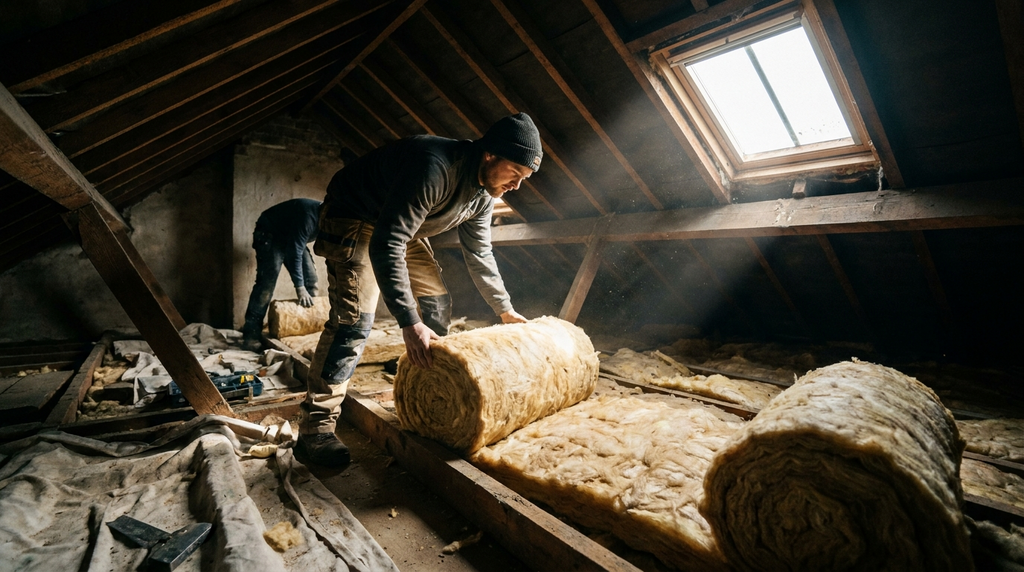
For a typical semi-detached house with a 50 m² loft, the cost ranges from £350 to £500 for DIY materials or £450 to £600 for professional installation. The cost per square metre for professional top-up is approximately £8–£12 for mineral wool or £12–£18 for sheep’s wool or recycled materials (Energy Saving Trust, 2026).
Labour typically adds £100–£200, with higher charges for lofts with limited access or obstructions like water tanks. These figures assume the existing 100mm insulation is in good condition and does not need removal. If your existing insulation is damp, mouldy, or damaged, removal and disposal can add £100–£200 to the total (MCS installer survey data, 2026).
how to check your current loft insulation depth
How to verify your installer is certified and eligible for grant-funded work
For grant-funded top-up, the installer must be registered with the MCS (Microgeneration Certification Scheme) or TrustMark for insulation work. For private paid work, MCS certification is not mandatory, but TrustMark registration is strongly recommended to ensure quality and consumer protection (TrustMark, 2026).
Always check the installer’s certification against the MCS installer database or TrustMark website before paying a deposit. If the installer is not certified, you cannot claim any grant funding and may void your home insurance or building warranty. The MCS database allows you to search by postcode and service type (MCS, 2026).
The payback period and long-term savings from topping up to 270mm
The typical payback period for a professional top-up is 2–3 years, based on current energy prices in 2026. Annual savings are estimated at £90–£130 for a small mid-terrace, £180–£260 for a semi-detached, and £270–£390 for a detached home (Energy Saving Trust, 2026).
Savings are calculated against a gas-heated home with standard loft insulation at 100mm. Homes with electric heating save significantly more because electric heating is typically more expensive per kWh. Over a 10-year period, the cumulative saving can range from £900 to £3,900, depending on property size and heating type. Typical domestic consumption values for 2026 show average gas use of 11,500 kWh per year for a semi-detached home (OFGEM, 2026).
comparing loft insulation with other home insulation upgrades
Factors that increase or decrease your final top-up cost
Loft size is the primary cost driver – larger lofts require more material and labour. Access difficulty, such as a narrow hatch, no boarding, or obstructions like water tanks or cables, can add £50–£150 to labour costs. Material choice affects price: mineral wool is cheapest at £8–£12 per square metre, while sheep’s wool or recycled plastic is more expensive at £12–£18 per square metre (Energy Saving Trust, 2026).
If the existing 100mm insulation is damp, mouldy, or damaged, it must be removed and disposed of, adding £100–£200 to the total. Insulation installation guidance from NICEIC recommends that any insulation showing signs of moisture or pest damage should be removed entirely before new insulation is laid (NICEIC, 2026).
how loft insulation affects your EPC rating
Frequently Asked Questions
For a typical UK home, the cost ranges from £200 to £600, depending on loft size. A 50m² semi-detached loft costs £350-£500 for professional installation, according to the Energy Saving Trust.
Yes, if you receive means-tested benefits or have a household income under £31,000 and an EPC rating of D-G. The Great British Insulation Scheme closed on 31 March 2026. It funded insulation measures only and never covered windows or glazing.
Annual savings range from £90 for a small mid-terrace to £390 for a detached house, based on Energy Saving Trust data. The exact saving depends on your loft area and current insulation depth.
The current recommended depth is 270mm (about 11 inches) of mineral wool insulation, as advised by the Energy Saving Trust. Most homes built before 2000 have only 100mm or less.
Homeowners do not need permission. Private tenants require landlord permission before applying for a grant, but the tenant can still submit the application. This is stated by the Great British Insulation Scheme rules.