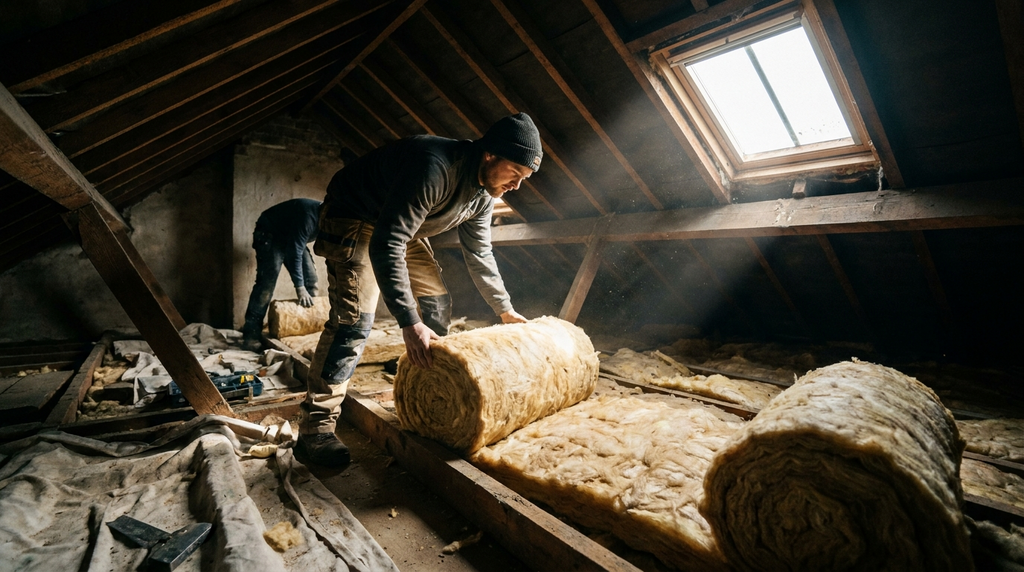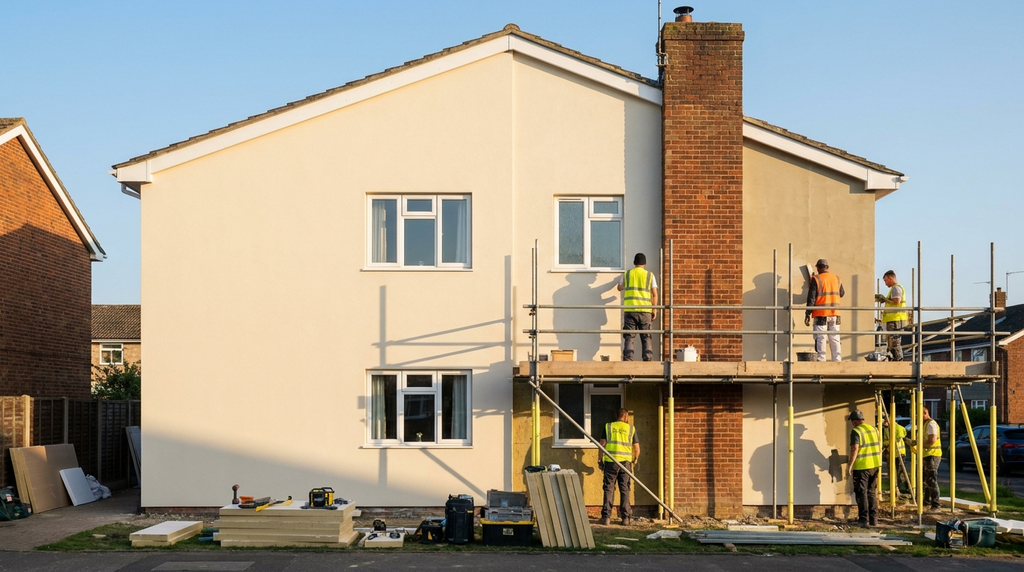
A 270 mm top-up saves roughly £200–£300 a year on a semi-detached home, comparable to the cost of the job itself.
Topping up loft insulation to the recommended 270 mm depth can cut annual heating costs by a substantial margin. For a gas-heated semi-detached house with minimal or no existing insulation, the Energy Saving Trust estimates a median saving of £250 per year (Energy Saving Trust, 2026). This saving is broadly comparable to the cost of the top-up itself. That makes it one of the most cost-effective home improvements available.
A professional loft insulation top-up costs £250-£700, with DIY options from £150. The Energy Saving Trust estimates annual savings of £200-£300 for a semi-detached home, giving a payback period of 2-4 years.
- Professional top-up costs £250-£700 depending on house size.
- DIY loft insulation top-up starts at around £150.
- Saving £200-£300 per year on a semi-detached home.
- Payback period is 2-4 years for most UK homes.
- Topping up to 270mm depth is the recommended standard.
- A 270 mm top-up saves roughly £200–£300 a year on a semi-detached home, comparable to the cost of the job itself.
- The cost to top up loft insulation depends on current depth, house size, and access.
- Quick numbers, cost, saving, and payback for common house types
- The direct answer to “what does loft insulation top up cost?” is £250–£700, with a typical payback of 2–4 years.
- The cheapest option is DIY mineral wool rolls, but professional installation adds quality assurance.
- Only use MCS-certified installers for professional top-ups, this unlocks the Great British Insulation Scheme.
- The Great British Insulation Scheme closed on 31 March 2026. It funded insulation measures only and never covered windows or glazing.
- The long-term saving is real, but only if you maintain the insulation and avoid compression.
The payback period typically falls between two and four years, depending on your current insulation depth and house type. A semi-detached home with no existing insulation can recoup the cost in roughly two years, while a detached house with 100 mm already in place may take up to four years. These figures are drawn from the Energy Saving Trust’s cost factsheet and the Department for Energy Security and Net Zero’s “Energy consumption in the UK” 2026 dataset (DESNZ, 2026).
The cost to top up loft insulation depends on current depth, house size, and access.
Loft insulation top-up costs vary widely because three main factors drive the price: how much insulation is already there, the floor area of your loft, and how easy it is to access. The total range for a professional top-up is £250 to £700, with DIY options starting at around £150.
For a typical mid-terrace house (loft area roughly 40 m²), a professional top-up from 0 mm to 270 mm costs £350–£450. A semi-detached (50 m²) costs £400–£500, and a detached house (70 m²) costs £500–£700. If you already have 100 mm of insulation, the cost drops by £100–£150 because less material is needed. Hard-to-access lofts, those with tight hatches, boarded areas, or limited headroom, can add £100–£200 to the labour cost. The MCS installer survey data for 2026 confirms these ranges (MCS, 2026), and the Energy Saving Trust’s online cost calculator provides similar estimates (Energy Saving Trust, 2026).
Quick numbers, cost, saving, and payback for common house types
| House type | Current depth (mm) | Target depth (mm) | Professional cost (£) | Annual saving (£) | Payback period (years) |
|---|---|---|---|---|---|
| Mid-terrace | 0 | 270 | 350–450 | 180–220 | 2–2.5 |
| Semi-detached | 0 | 270 | 400–500 | 200–300 | 2–2.5 |
| Semi-detached | 100 | 270 | 250–350 | 100–150 | 2.5–3 |
| Detached | 0 | 270 | 500–700 | 250–350 | 2–3 |
| Detached | 100 | 270 | 350–450 | 125–175 | 2.5–4 |
All figures are sourced from the Energy Saving Trust’s loft insulation cost and savings data and DESNZ energy consumption statistics for 2026 (Energy Saving Trust, 2026; DESNZ, 2026).
The direct answer to “what does loft insulation top up cost?” is £250–£700, with a typical payback of 2–4 years.
For a semi-detached house with no existing insulation, a professional top-up to 270 mm costs £400–£500. If your loft already has 100 mm in place, the cost falls to £250–£350 because less material is needed. The payback period ranges from two years for a semi-detached house with no insulation to four years for a detached house with 100 mm existing. These figures are consistent with the Energy Saving Trust’s 2026 cost and savings analysis (Energy Saving Trust, 2026) and match current energy price cap levels published by DESNZ (Ofgem, 2026).
The cheapest option is DIY mineral wool rolls, but professional installation adds quality assurance.
If you are comfortable working in a loft, DIY mineral wool rolls are the most affordable route. For a typical 50 m² semi-detached loft, DIY materials cost £150–£250. This covers mineral wool rolls, a vapour barrier, and basic protective gear. The professional cost for the same area is £400–£700, which includes labour, disposal of old insulation, and any minor repairs to the loft floor.
The key trade-off is quality assurance. Professional installers guarantee correct depth across the entire loft, with no gaps and a properly placed vapour barrier. DIY installations often miss these details, which can reduce effectiveness by 20–30%. The Energy Saving Trust’s guide on DIY versus professional installation notes that gaps as small as 5% of the loft area can cut overall performance by 15% (Energy Saving Trust, 2026). MCS installation standards also require specific vapour barrier placement that DIY installers may overlook (MCS, 2026). compare DIY vs professional insulation costs
Only use MCS-certified installers for professional top-ups, this unlocks the Great British Insulation Scheme.
MCS certification is not optional if you want to claim a government grant. The Great British Insulation Scheme and ECO4 both require installation by an MCS-certified contractor. You can check an installer’s status on the MCS register at mcs-certified.com. TrustMark registration is also required for consumer protection on larger jobs. This provides a route for dispute resolution if work is substandard.
Using an uncertified installer means you lose access to any grant funding, and you also forfeit the quality assurance that comes with MCS standards. The Great British Insulation Scheme closed on 31 March 2026. It funded insulation measures only and never covered windows or glazing. The MCS find-an-installer tool confirms this requirement (MCS, 2026).
The Great British Insulation Scheme closed on 31 March 2026. It funded insulation measures only and never covered windows or glazing.
The Great British Insulation Scheme closed on 31 March 2026. It funded insulation measures only and never covered windows or glazing. If your loft already has 100 mm or more, you pay the full cost, no grant is available. ECO4 may still cover top-ups in low-income households, but only up to the 270 mm target, and only where existing insulation is below 100 mm.
This rule means that many homeowners with partially insulated lofts (100 mm or more) are ineligible for financial support. The Great British Insulation Scheme closed on 31 March 2026. It funded insulation measures only and never covered windows or glazing. check if you qualify for GBIS
The long-term saving is real, but only if you maintain the insulation and avoid compression.
Annual savings on a gas-heated semi-detached house are £200–£300. For homes using a heat pump, the saving is lower at £150–£200 because heat pumps are more efficient and the cost per kWh is lower. These savings persist for 25 years or more if the insulation is kept in good condition.
The biggest threat to long-term performance is compression. Boarding over insulation without using loft legs reduces its effectiveness by up to 50%. The Energy Saving Trust recommends using loft legs to raise boards above the insulation layer, maintaining the full 270 mm depth. The DESNZ energy efficiency savings database confirms that compressed insulation loses its thermal resistance proportionally (DESNZ, 2026). Regular checks for damp, pest damage, or displaced material will keep the insulation working at its design performance for decades.
Frequently Asked Questions
A professional loft insulation top-up costs £250-£700 depending on house size and access. For a typical semi-detached house, expect £400-£500, according to the Energy Saving Trust.
Yes, a 270mm top-up typically pays for itself within 2-4 years through energy savings. The Energy Saving Trust estimates £200-£300 annual savings for a semi-detached home.
The recommended depth is 270mm of mineral wool insulation. This is the standard set by the Energy Saving Trust and DESNZ for optimal energy efficiency.
Yes, DIY loft insulation top-up costs around £150 for materials. However, professional installation ensures correct depth and safety, especially in hard-to-access lofts.